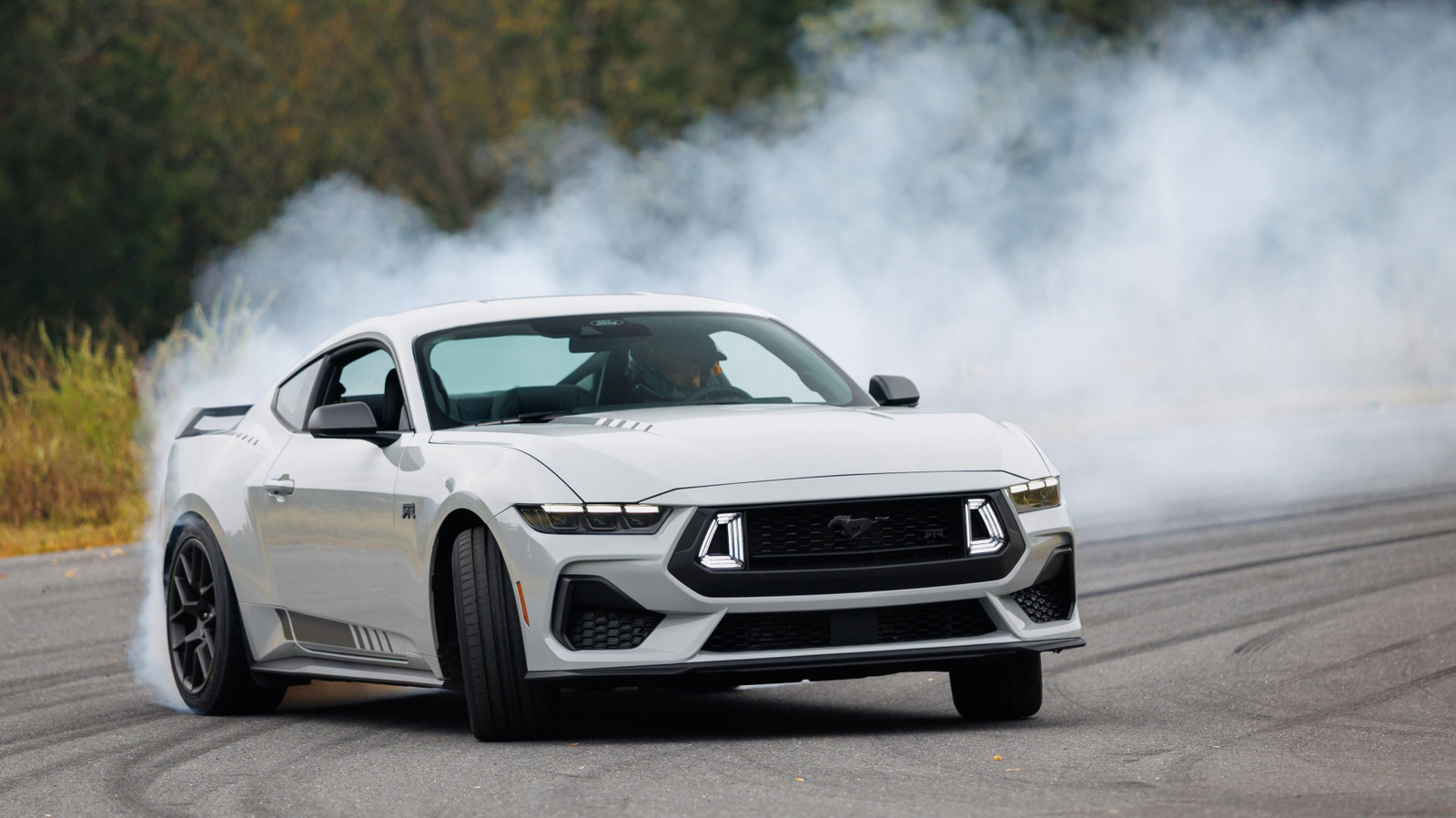
When Ford gave its iconic Mustang a dramatic redesign for the 2015 model year, the car arrived with many major changes. One came out back, where the Mustang moved to a standard independent rear suspension for the first time in its existence. Another big change came under the hood, where Ford added the 2.3-liter turbocharged EcoBoost engine as the Mustang’s volume engine option. A couple of years later, with the old V6 removed from the lineup, the four-cylinder EcoBoost became, and remains, the Mustang’s base engine. However, despite being the base engine and upsetting some Mustang purists for its lack of displacement, it’s hard to argue that the Mustang’s 2.3 EcoBoost lacks power. The base model 2026 Mustang EcoBoost is rated at 315 horsepower, which is actually the same power as the V8-powered 2010 Mustang GT, and the EcoBoost also outperforms previous V8 Mustang GTs from the ’90s and ’00s. The latest Ford Mustang EcoBoost is a car that shows how far four-cylinder performance has come, but in the modern enthusiast market, it’s not even the most four-cylinder option. powerful. To demonstrate this, we’ve rounded up five different four-cylinder vehicles that surpass the Mustang in rated horsepower, with the mix of cars including everything from hatchbacks to sports sedans and even a crossover SUV. Acura Integra Type S Back in the ’90s and ’00s, high-performance Honda and Acura vehicles were known for their unique high-revving naturally aspirated engines. Today, however, Honda has fully embraced turbocharging and the powerful Honda Civic Type R is known as one of the fastest front-wheel drive cars in the world. In terms of power, the 2.0-liter turbocharged four-cylinder that powers the latest Civic Type R ties the Mustang EcoBoost with the same 315 horsepower, but Honda builds another attractive hatchback that actually surpasses them both in the power department. That car is the very fun Acura Integra Type S, which is a close and slightly more sophisticated brother to the Civic Type R, using the same platform and the same 2.0-liter turbo engine. While the Acura and Honda engines are basically identical, the Integra uses a more aggressive exhaust system, which increases its output by five horsepower, for a total of 320. Direct comparisons between the two Honda products show that the Integra isn’t enough to give the heavier Acura a performance advantage, but both cars are still considered among the best hatchbacks you can buy. In particular, the Integra Type S compares very well to the Mustang EcoBoost in performance metrics, allowing buyers to choose between the precision and practicality of the Acura or the rear-drive personality of the Ford. Cadillac CT4-V Given that American automakers are world-famous for their V8 engines, one would expect most of the Mustang EcoBoost’s top four-cylinder rivals to come from German or Japanese brands, and that’s the case for most of the selections in this selection. However, Ford’s archrival General Motors also has a very powerful four-cylinder engine of its own, larger and more powerful than the Ford 2.3. That engine is GM’s 2.7-liter turbocharged four-cylinder, known as the L3B. The 2.7 turbo is found primarily in Chevrolet and GMC trucks, where its 310 horsepower is just shy of the Mustang EcoBoost’s output. However, in the high-performance Cadillac CT4-V sports sedan, the L3B receives some tweaks that raise its maximum output to 325 horsepower. The four-cylinder-powered CT4-V isn’t on the same level as the flagship CT4-V Blackwing with its twin-turbo V6, but the regular CT4-V is still very quick, capable of hitting 60 miles per hour in less than five seconds. With the Cadillac CT4 discontinued at the end of the 2026 model year, GM will have to hand the four-cylinder crown back to Ford, at least for the time being. Speculation suggests GM is hard at work on a new line of rear-drive models, which could include a reborn version of the Mustang’s old rival, the Chevrolet Camaro. When those new GM models arrive, we wouldn’t be surprised to see a turbo four-cylinder engine option that’s at least equal to the current L3B. Volkswagen Golf R and Audi S3 Viewed as a whole, today’s market doesn’t have the same number of high-performance cars at affordable prices that we saw in decades past, but at least the hatchback segment is alive and well, with several excellent options for enthusiasts. One of these options is the Volkswagen Golf R, which takes the performance of Volkswagen’s four-cylinder to a new level. Sharing its DNA with the iconic Golf GTI, the Golf R greatly elevates the GTI’s performance, adding an all-wheel drive system and giving Volkswagen’s turbocharged 2.0-liter four-cylinder engine a significant power boost. Already off to a fast start, Volkswagen updated the Golf R for the 2025 model year, increasing its output to 328 horsepower. With the aforementioned 4Motion AWD system, this well-equipped Volkswagen can hit 60 miles per hour in the low four-second range, making the Golf R one of the fastest and most mature hatchbacks you can buy. Plus, if we’re going to talk about the Golf R, we also have to mention its very close corporate cousin, the Audi S3. Basically, the S3 puts the Golf R’s powertrain into a sedan and has the same 328 horsepower as its Volkswagen counterpart. With these German offerings, buyers can choose their preferred make and body style, but either way they’ll get one of the most powerful four-cylinder engines on the market today. Porsche 718 Cayman S and Boxster S With the legendary reputation of the Porsche 911 and its flat-six engine, some car enthusiasts may not associate Porsche with high-power four-cylinder engines, but Porsche has made some of those as well. The company has a long history of making impressive four-piston engines, and the engine in the Porsche 718 Cayman S and its Boxster S sibling are among the most powerful road-going examples out there. With a displacement of 2.5 liters, the four-cylinder boxer engine that powers the 718 Cayman and the Boxster S has a power of 350 horsepower. When the car debuted in 2017, during Car & Driver testing, the Cayman S hit 60 miles per hour in just 3.6 seconds. What’s also unique about the 718’s four-cylinder engines is that, unlike the Mustang’s 2.3 EcoBoost and the other inline-fours on this list, the Porsche four-cylinder design is unique specifically to the Cayman and Boxster, and is not shared with other mainstream models. Sure, some Porsche fans might recommend skipping the four-cylinder models and going straight for the wonderful flat-six Cayman GTS or GT4, and there are plenty of reasons why one might want to do so. However, both on its own merits and in comparison to other four-cylinder engines on the market, the Porsche 2.5 easily ranks among the best out there. Toyota RAV4 Plug-in Hybrid Given its relatively small displacement, it’s no surprise that all of the engines on this list, including Ford’s own 2.3 EcoBoost, use turbocharging to achieve their impressive power levels. Toyota, however, has a powerful 2.5-liter four-cylinder that surpasses the Mustang’s power without using a turbocharger. Instead, the 2026 Toyota RAV4 Plug-In Hybrid’s powertrain uses a combination of a four-cylinder internal combustion engine and three electric motors to generate a combined total of 324 horsepower. The result is one of the fastest mainstream compact crossover SUVs you can buy, capable of hitting 60 miles per hour in the low five-second range. Sure, the RAV4 PHEV’s high curb weight and family crossover DNA might prevent it from ever being a high-performance machine like other cars on this list could be, but the unexpected nature of its power is part of the fun. Beyond that, the RAV4 PHEV’s powerful configuration shows that hybrid electrification can be as transformative as adding a turbocharger to a four-cylinder engine. In the case of the RAV4, it can also provide a big boost in fuel efficiency at the same time.