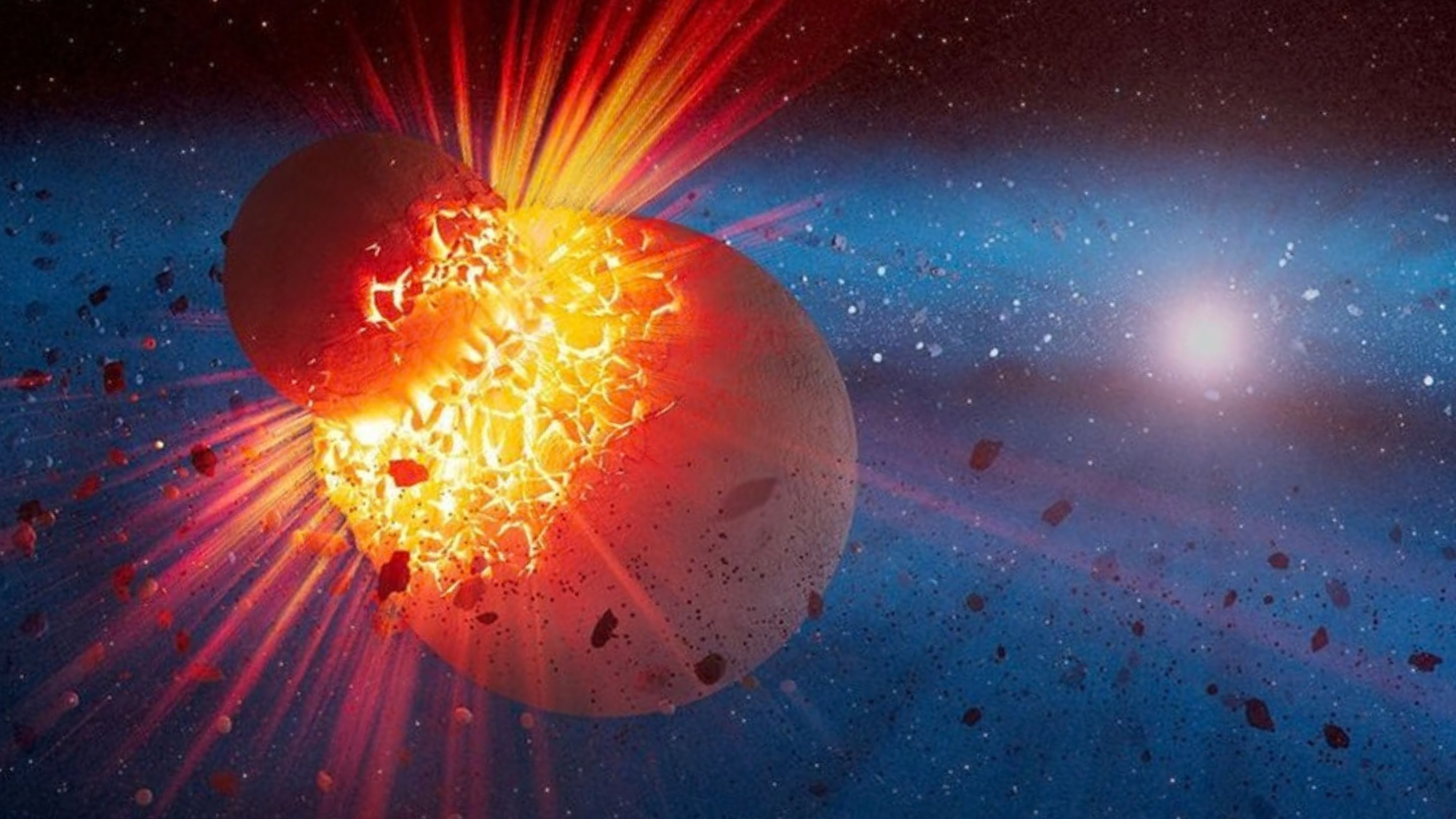
Using NASA’s James Webb Space Telescope (JWST), astronomers are investigating turbulent planetary systems in which worlds collide violently. This research could shed light on the hypothetical collision between Earth and a Mars-sized planetary body called Theia, which is believed to have spilled matter around our planet that merged to form the Moon billions of years ago. Young planetary systems are notoriously violent, featuring young stars surrounded by disks of gas and dust called protoplanetary disks. Within these disks, small bodies called planetesimals collide and stick together to begin the planet formation process. However, NASA’s now-retired Spitzer Space Telescope discovered that there is a class of protoplanetary disks that are even more violent than usual, so-called extreme debris disks. These systems contain unusually large amounts of hot dust near the young star, in a region similar to that occupied by the rocky planets of the solar system. Investigating extreme debris disks is challenging, in part because they are so rare. Scientists estimate that these systems exist in only 1% of stars. It is suspected that our Sun was one of these rare stars. A team of scientists set out to investigate 21 extreme debris disks with the incredible observation power of JWST. This included follow-ups from four of the five environments from Spitzer’s archival data and 16 from JWST, with 12 newly observed disks. “This is the first time we have put together enough systems to truly understand this subclass we call extreme debris disks,” team leader Kate Su of the Space Sciences Institute in Boulder, Colorado, said in a statement. “Before JWST, we had limited information. We knew that they are strange and very different from the typical cold debris disks we know, such as Vega and Fomalhaut. You might like “Now that we have more data, we can pinpoint what these disks represent for the formation and evolution of planets.” These collisions may also help explain the variability in brightness observed in these systems, which allowed us to identify their compositions, which was most exciting to me,” said Agnes Kospal, a team member at the Konkoly Observatory in Budapest, Hungary. “We have no other way to study these planetary embryos directly because they are too small.” What to read next JWST research on the compositions of extreme debris disks. (Image credit: NASA, ESA, CSA, Joseph Olmsted (STScI)) Silica-rich disks are produced by high-energy impacts of Mars-sized objects, in which most of the material vaporizes. Silica-poor disks are created by less energetic events of bodies about the size of a moon rubbing against each other. According to their sample, about a third of the extreme debris disks are silica-rich disks. These were found only around stars less than 300 million years old. The researchers propose that this variability in brightness is caused by the rapid evolution of fresh debris through new impacts and changes to the orbits of the system’s occupants. Simulations that recreate the earliest era of the solar system. show that terrestrial planets, like Earth, should form within the first few hundred million years. This aligns with the ages of the observed silica-rich extreme debris disks and also aligns with the estimated formation of the Earth and Moon about 100 million years after the sun formed. from near the sun to the positions they occupy now. “How rocky planets formed and giant planets evolved are part of the larger story of the formation of the solar system. It’s quite a story,” Su said. “Our work on extreme debris disks helps us piece together the big picture of what we currently understand.” The team’s research was published Thursday (Oct. 1) in The Astrophysical Journal.