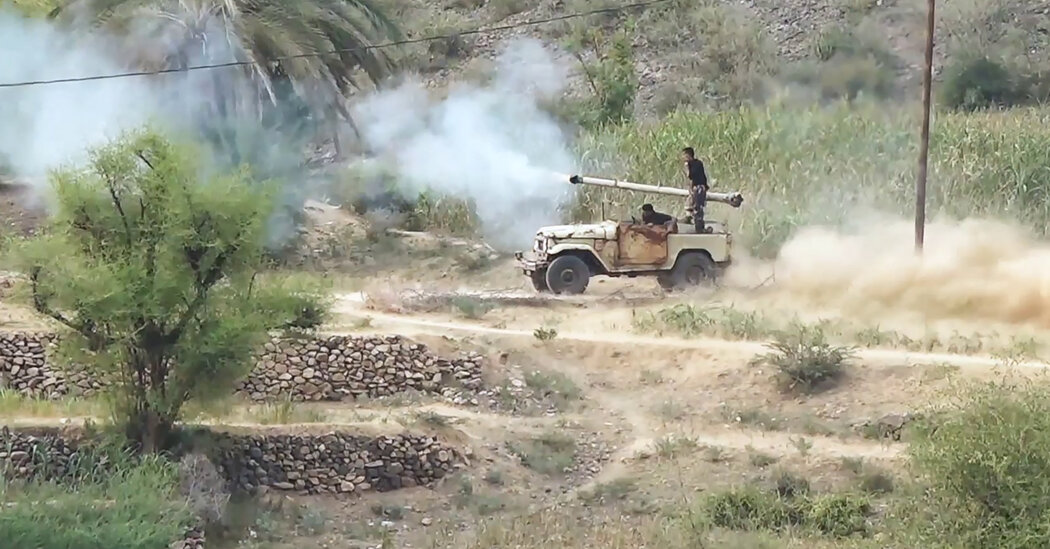
After four years of relative peace, Yemen has once again descended into all-out war. In a lightning offensive, the Iran-backed Houthi militia has taken control of the country’s Red Sea coast in recent weeks. The group is now engaged in fierce clashes with Saudi-backed Yemeni government forces on multiple fronts, and cross-border attacks in Yemen and Saudi Arabia have intensified. The war has opened a second front in a Middle East conflict that began when the United States and Israel attacked Iran in February, increasing regional volatility, skyrocketing energy prices and darkening the shadow over the global economy. A year ago, Crown Prince Mohammed bin Salman of Saudi Arabia, the country’s de facto ruler, and President Trump signed a strategic defense agreement. The Saudi leader has repeatedly called on Trump to intervene militarily against the Houthis, part of the so-called Iranian-led resistance axis, along with Hezbollah in Lebanon and Hamas in Gaza. But Trump has wavered. He initially rejected Saudi requests, then over the weekend told the Pentagon to prepare for airstrikes, only to change course and decide to postpone them, according to Trump administration officials. Here’s how the war resumed, why the Houthis were able to gain ground so quickly, and what the resumption of fighting means for anyone involved with the conflict. anti-imperialist force fighting foreign influence, stormed the capital, Sana’a, and ousted the internationally recognized government. Shortly after, a Saudi-led military coalition backing the government began a bombing campaign, plunging the impoverished nation into devastating conflict. The two sides agreed to a fragile truce in 2022, but that fell apart in the wake of the US-Israel war with Iran. In July, the Houthis accused Saudi Arabia of bombing Sana’a airport to prevent an Iranian plane from landing. The group also opposed long-standing restrictions placed on Yemeni airspace and declared a naval blockade on Saudi shipping in the Red Sea, blocking a route the Saudi government relied on to export oil after Iran hampered shipping through the Strait of Hormuz. A major turning point in the Houthi advance came this month, when Houthi forces captured Mokha, a strategic port on the Red Sea, and the island of Perim, located in the Bab al-Mandab Strait, a narrow waterway that is a crucial route. for global trade. Control of the territories put the group in a stronger position to attack passing ships. Last week, the group dramatically escalated its attacks on Saudi Arabia, launching missiles and drones at the capital, Riyadh. The Houthis described the strikes as retaliation against hundreds of Saudi airstrikes and other attacks in Yemen in recent weeks. Saudi officials have not addressed those allegations or acknowledged the Houthis’ claim to have shot down a Saudi fighter jet. What do the Houthis and Iran want? When the truce was reached four years ago, the Houthis said they had won the war and tightened their grip on northern Yemen. But since then, the economic situation in the areas under its control has worsened, sparking civil resentment and putting political pressure on the group. The Houthis blame Saudi Arabia’s interventions for the suffering on their territory, analysts say. In recent months, the group has demanded that restrictions on the entry of planes and ships into Houthi territory, including UN inspections, be lifted. The militia has also insisted that Saudi Arabia pay war reparations and withdraw completely from Yemen, meaning the end of Saudi support for the internationally recognized government. “The Houthis have no incentive to reduce tension,” said Ibrahim Jalal, a Yemeni researcher and political advisor. He added that Houthi leaders hope that maintaining pressure on Saudi Arabia will lead to more political concessions and increase their authority. Iran has also played a key role in boosting the militia, according to Baraa Shiban, a researcher on Yemen and the Gulf at the Royal United Services Institute, a London-based research organization. The Houthis are an Iranian ally, rather than a complete proxy. The group balances its relations with Iran alongside its own calculations. But if the Houthis are able to further disrupt the global economy and increase pressure on US gas prices, that would give Iran more leverage over Trump, Shiban added. Iran is counting on an escalation in Yemen to drag the United States deeper into the regional war and “put more pressure on the Trump administration,” he said. How did the Houthis advance so quickly? Yemen’s government, backed by Saudi Arabia, is the main bulwark against the Houthis and nominally controls a swath of southern and eastern Yemen. But throughout the civil war, the government has become weaker and more fragmented. Today, it is actually a heterogeneous coalition of armed groups, overseen by an eight-man “Presidential Leadership Council.” Many of them distrust each other and have opposing political goals, although they share a desire to defeat the Houthis. They are also beholden to Saudi Arabia, which supports the government financially and militarily, and the kingdom leaves little room for its Yemeni allies to make their own decisions. In contrast, the Houthis have more authority to act independently of Iran. They still rely on Iran for the most sophisticated drones and ballistic missiles, but they have been able to use artificial intelligence and other tools to make advanced weaponry themselves and developed their own supply chains to do so, analysts say. “The Saudis are used to treating their Yemeni partners as clients, as hired helpers. They pay them, but they don’t give them agency,” said Abdulghani al-Iryani, a senior researcher at the Sana’a Center for Strategic Studies, a research group. The Houthis have intensified attacks against Saudi interests, and some Yemeni government officials have described the opportunity for a counteroffensive against the militia. The Saudi government attempted to unite the factions in Yemen and stepped up military support. But the first test of those efforts – the battle for Mokha and the Bab al-Mandab Strait – was an abject failure, analysts say. Different forces on the government side struggled to effectively coordinate with each other while the Houthis were unified under highly centralized leadership. What will Saudi Arabia do next? Saudi officials have revealed little about their plans, even as they have repeatedly sought more military support from the United States. The kingdom has many reasons to be reluctant to return to war. Its previous bombing campaign in Yemen became a costly quagmire that contributed to the deaths of hundreds of thousands of Yemenis from violence, hunger and disease. Diplomacy has also failed to definitively end the conflict. But increasingly, some Saudi officials believe they have no choice but to confront the militia, analysts say. “The Saudis have a sort of growing belief that peace with the Houthis is impossible,” said Farea Al-Muslimi, a Yemen specialist at Chatham House, a London-based research group. “They try to buy them, they try to bomb them, they try to fight them, they try to visit them, they try to invite them. None of this has worked.” Even as some observers hope the conflict can be resolved quickly, Mr. Al-Muslimi fears the worst. “There are a lot of people who are excited about this or think it will be a quick war, but I have heard that phrase about almost every war in Yemen,” he said. “This is going to be a bloody and horrible war.”