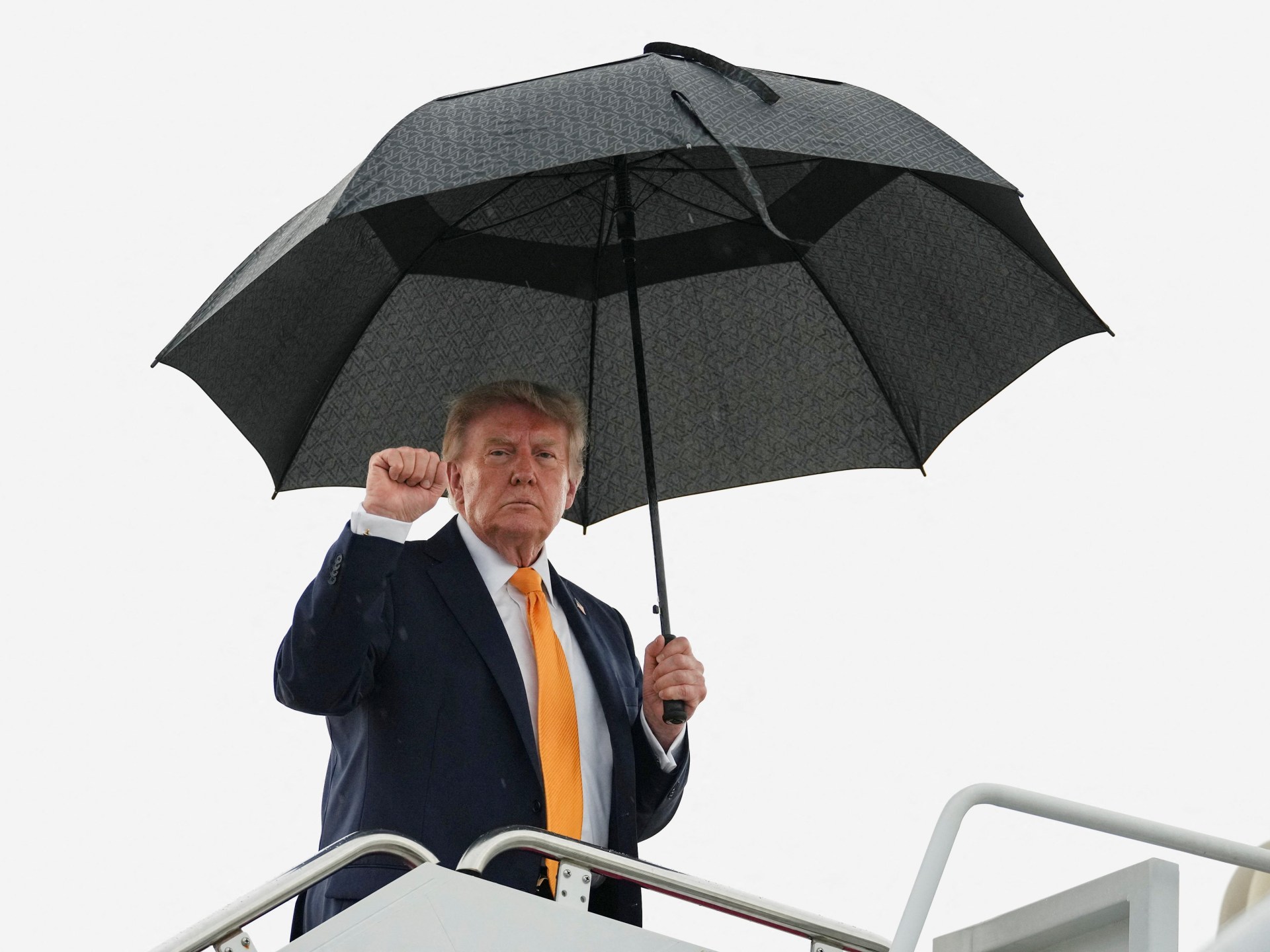
US President Donald Trump says Washington could attack Iran’s Pickaxe Mountain “very soon”, the latest in a series of threats he has made against the heavily fortified underground site located next to the bombed Natanz enrichment complex. Just hours after making that threat, an Iranian oil tanker off Kharg Island was hit by four American missiles, according to Iranian news outlet Khabar Fouri. Kharg Island is the main center of Iran’s oil exports, handling about 90 percent. Pickaxe Mountain. Tell the Iranians to be prepared… We will probably give Pickaxe a chance relatively soon.” The latest threat comes more than six months after the war the United States and Israel launched against Iran on February 28, amid mixed messages about the war from the Trump administration. On Friday, Trump attempted to downplay the war in Iran, calling it “small potatoes,” while a day earlier, at a White House press conference, Vice President JD Vance seemed suggest that the conflict had cooled and ignore an alleged US threat. attack on a wedding in southern Iran with “sometimes things happen”. of Iran have remained in limbo since a 60-day negotiating window expired in mid-August without a deal. Iran says it is not carrying out any work at the Natanz nuclear site. Its central military headquarters, Khatam al-Anbiya, has warned that bombing the nearby mountain would amount to a resumption of war across the region, at a time when the Trump administration would prefer to keep the war contained ahead of crucial midterm elections. Why has Pickaxe Mountain become, once again, the latest focus of Trump’s threats? A satellite view shows the entrances to the tunnels on Pickaxe Mountain, at the Natanz nuclear plant facility, near Natanz, Iran, on June 30, 2026. [Vantor/Handout via Reuters]What is Pickaxe Mountain? Known in Iran as Kuh-e Kolang Gaz La, the site is located approximately 220 kilometers (140 miles) south of the capital Tehran, in the province of Isfahan, and just 2 kilometers (1.2 miles) from the Natanz enrichment plant. US intelligence reports indicate that the facility has been dug deep into the mountain, beneath hundreds of meters of solid granite rock, to protect it from powerful bombs designed to penetrate bunkers. The main chambers are believed to be at least 100 meters (330 feet) underground. Some Western analysts have speculated that the mountain was intended to house an undeclared enrichment plant, a hedge against attacks on known Iranian facilities. The Institute for Science and International Security, which tracks the site by satellite, has assessed that it is still under construction and not yet operational. However, Iran has always maintained that it is developing only a nuclear energy program and has no plans to build a nuclear weapon. Why Pickaxe Mountain Matters? Because it is intact. Pickaxe Mountain was left alone during the June 2025 US attacks on Fordow, Natanz and Isfahan at the end of Israel’s 12-day war against Iran, and has escaped the current war almost entirely; The Institute for Science and International Security has only recorded the destruction of one vehicle in a nearby rubble pile. Since Iran’s centrifuge manufacturing base and enrichment rooms elsewhere were damaged in the war, analysts see the tunnels as the most obvious place for Tehran to rebuild: for component production, assembly or uranium enrichment. alarmist than Israel. Centrifuges only matter if there is uranium to run through them; The machines concentrate uranium gas, and without a supply of it they cannot produce anything. How much damage has been done to Iran’s nuclear sites? By most estimates, a considerable amount. The European Council on Foreign Relations estimates that the 2025 attacks likely destroyed many of the approximately 18,000 centrifuges then operating at Iran’s Natanz and Fordow facilities, along with several centrifuge production sites and Ardakan, Iran’s only yellowcake milling plant. Yellowcake is a powdered uranium concentrate obtained from ground uranium ore. Nearly 4,000 additional centrifuges were installed, but they were idle at the time; however, they may have survived the attacks. The International Atomic Energy Agency (IAEA) confirmed additional damage to the entrance buildings of the Natanz underground enrichment plant in March 2026, although it did not detect any additional impact on the plant itself. The Institute for Science and International Security reported in June that the tunnel entrances at the three main sites remain sealed, that there is no evidence that any enrichment is taking place and that the centrifuge program still appears to have been destroyed. Didn’t Trump say Iran’s nuclear sites? Had it already been destroyed? Yes. After the June 2025 attacks, Trump said all three sites had been “completely and totally destroyed.” However, just days later, a leaked preliminary assessment from the US Defense Intelligence Agency concluded that the sites had been significantly damaged but not destroyed, estimating that the attacks had set back Iran’s nuclear program by less than six months. The current situation remains unclear. “No one really knows what the status of Iran’s nuclear program is right now; there is a lot of uncertainty and ambiguity about how much damage Iran has suffered as a result of these last two wars,” Nader Hashemi, a professor of Middle East politics at Georgetown University, told Al Jazeera. Iran is currently believed to possess about 440 kg (970 pounds) of 60 percent enriched uranium. But having the material is only part of the equation, Hashemi said. produce a nuclear weapon, it would have to enrich that uranium up to 90 percent. That would require access to its centrifuges, “of which we don’t know to what extent they may have been damaged,” he said. No inspector has entered the bombed sites, and Trump’s framework has moved from “destruction” to a promise to attack any site where Iran is “even thinking about having nuclear enriched uranium in total, including the 440 kg stockpile enriched to 60 percent.” In theory, this amount of enriched uranium – if enriched to 90 percent – is enough to produce more than 10 nuclear warheads, IAEA chief Rafael Grossi told Al Jazeera in early March. However, it is not clear where this stockpile may be. Iran suspended cooperation with the agency after the attacks, and the IAEA now says it has no way to report on the size, location or composition of that arsenal. Of 60 percent of the material is bottled in tunnels in Isfahan. On Friday, Trump again claimed that the United States had prevented Iran from developing a nuclear weapon, arguing that Washington’s intervention had protected Israel and the entire Middle East. He insists that the program is peaceful and has dismissed Washington’s focus on Pickaxe Mountain as a fabricated pretext to attack it.