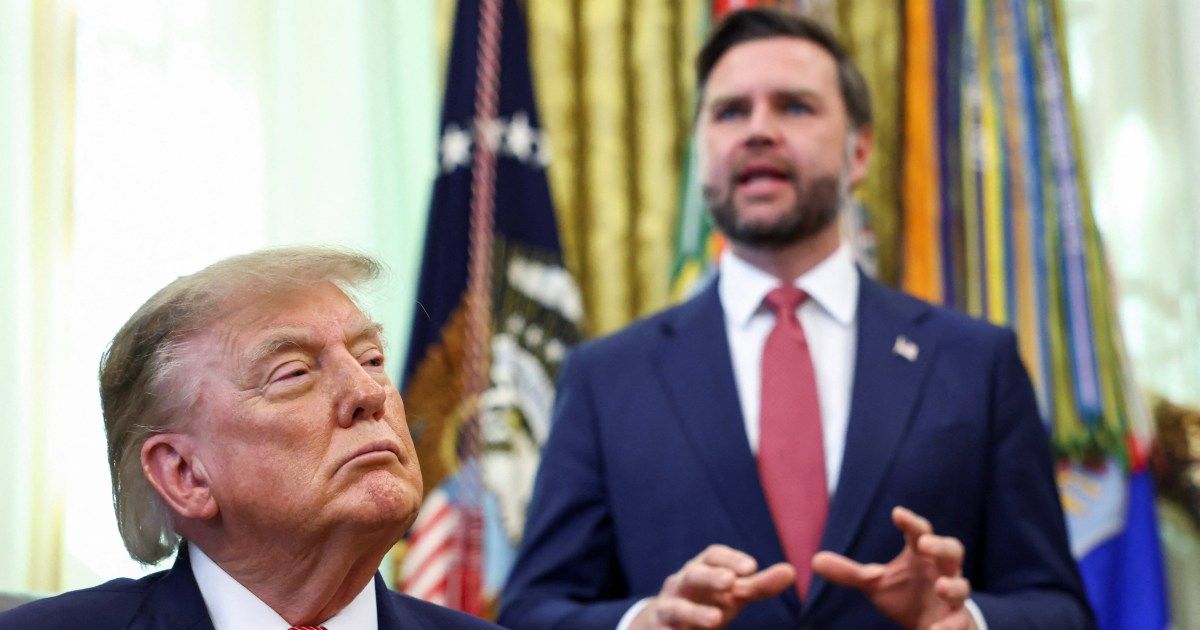
Just hours before Iran claimed it had hit the US military’s early warning radar system in Bahrain early Friday, US President Donald Trump said he had told his country’s chief negotiator, Vice President JD Vance, that “we don’t need a deal with Iran.” of the war between the United States and Israel against Iran. He has blamed Trump’s military attacks on Iran and the subsequent energy crisis and inflation in the United States for Republican losses in Congress. Meanwhile, several commercial ships attempting to transit the Strait of Hormuz have struck naval mines or been hit by the Iranian military over the past week, but Trump continues to claim that Washington still controls the critical waterway. So where is the war headed? And Trump is sidelining Vance? U.S. President Donald Trump and Vice President JD Vance look on during a Veterans Day ceremony at Arlington National Cemetery in Arlington, Virginia, on November 11, 2026. [Kylie Cooper/Reuters]What did Trump say to Vance? Trump wrote on his Truth Social platform that he had asked Vice President Vance “to focus his complete and utter attention on the massive corruption and crime taking place in Democrat-run cities and states across the United States.” “We don’t need an agreement with Iran,” he added. “Those days are long gone. We have your money, hundreds of billions of dollars, and we have your Strait!” The Trump administration appears increasingly divided over the previous arc of war against Iran since the midterm losses. Secretary of State Marco Rubio has said that Washington’s economic pressure campaign against Iran is proving effective, making a resumption of large-scale military operations unnecessary. “The economic pressure on Iran is going to get even worse,” he added. Trump has given mixed messages about his plans for war. Despite threatening to “destroy” Iran last week, Trump this week said that further attacks on Iran are “quite unlikely.” US President Donald Trump, Vice President JD Vance and Secretary of State Marco Rubio attend a meeting with oil industry executives at the White House in Washington, DC, on January 9, 2026. [File: Kevin Lamarque/Reuters]What role has Vance played in the talks with Iran? Vance favors a deal with Iran, which Trump believes is not currently possible. Vance led negotiations with the United States in April in Islamabad, where he helped secure the memorandum of understanding with Iran in June. However, that quickly collapsed due to glaring gaps in each side’s understanding of what had been agreed, particularly in reference to control of the Strait of Hormuz. The US vice president also led direct talks with Iran in Switzerland and is part of renewed diplomatic efforts, involving Qatari and Pakistani mediators and seeking to continue negotiations with Iranian officials. On November 4, following extensive Republican defeats in the midterm elections, Vance publicly questioned whether the war had been worth the political and economic costs. In a post on X, he wrote, “The reason we lost is the war. The president himself said it last night,” endorsing the diplomatic resolution as good advice. He added: “If you want to argue that it was worth it, that it was worth it, that it was worth losing the Senate for the next six years, then do it.” On June 17, speaking at the G7 summit in Evian-les-Bains, France, when both sides had just signed the Islamabad Memorandum of Understanding, Trump told reporters: “This way, if it works, I’ll take the credit. If it doesn’t work, I’ll blame JD. You better watch out, JD.” The next day, Vance told reporters that he believed the president was “joking.” It is not clear. On Friday morning, Tehran said it had attacked and destroyed an early warning radar system belonging to the US military in Bahrain, in what it said was retaliation for an airstrike on a telecommunications tower in the southern Iranian port city of Sirik. Meanwhile, on Thursday, Trump said Washington’s allies in the Middle East had asked him to postpone further large-scale attacks on Iran. He added that the United States could destroy Iran’s energy infrastructure, bridges and manufacturing facilities in three days if it wanted to. “Saudi Arabia has asked me to please let everything be as it is now for a while,” he said at the White House, adding that Qatar, Kuwait, the United Arab Emirates and Bahrain preferred the current approach. Asked if he would have launched more attacks without those requests, Trump responded: “Yes, I would.” Although Trump acknowledged that the increase in fuel prices caused by the war contributed to the Republicans’ decision. After his defeat in the midterm elections, he defended his decision to attack Iran. Meanwhile, Brigadier General Ali Reza Belaili, adviser to Iran’s Revolutionary Guard Corps (IRGC) aerospace force, said an order from Iran’s supreme leader to attack “enemies” without geographical boundaries will be implemented “at the appropriate time.” Iran’s Mehr news agency quoted him as saying that “the longer the Americans persist, the deeper they will sink into this quagmire of their own creation.” Foreign Minister Jean-Noel Barrot, left, welcomes Qatar’s Prime Minister Sheikh Mohammed bin Abdulrahman bin Jassim Al Thani before a meeting during the G7 foreign ministers’ summit at the Quai d’Orsay in Paris on November 10, 2026. [AFP]What’s the latest in diplomatic efforts? This week, Mohammad Bagher Ghalibaf, speaker of the Iranian parliament and chief negotiator, told Al Jazeera that the Strait of Hormuz “will never return” to its state before the US-Israel war against Iran. It was then that all commercial shipping could pass through the strait freely without having to pay tolls. In fact, Iran closed the strait, through which a fifth of the world’s peacetime oil supplies were shipped, in early March following the start of attacks by the United States and Israel. This caused turbulence in global energy markets. Ghalibaf said Tehran had sent a clear proposal for a ceasefire and reopening of the strait to Washington through Qatari mediators, laying out seven conditions, adding that Iran is now waiting for an official response from the United States. “The ball is now in the American court,” he said. fighting on all fronts and an explicit announcement of the end of the war. The United States has previously refused to accept these demands without first a deal on Iran’s nuclear program. Iran wants to negotiate that separately. Aniseh Bassiri Tabrizi, associate fellow at the Chatham House think tank’s Middle East and North Africa Programme, told Al Jazeera: “We are still in a ‘no war, no peace’ situation, and that is unlikely to change any time soon. “Major attacks are unlikely in the coming days, but things are likely to change one way or another in the next two weeks,” he said. “Gulf countries are not necessarily endorsing this as a new normal, even if they prefer this to the prospect of a new war.” What’s the latest on the US strikes and the ships attacked in Hormuz? Speaking to Al Jazeera, Ghalibaf said this week that “there is no ‘free water’ [international waters] there, and the 1982 [UN Convention on the Law of the Sea] “Does not apply” to the Strait of Hormuz. The strait, in fact, crosses only the territorial waters of Iran and Oman. “Regulations within the Strait of Hormuz are governed by the laws of the two littoral states that border it,” he added, reiterating Iran’s position that it is strictly controlling the waterway. Tehran has said multiple “offending” vessels – which it says have used an “illegal” route, referring to the strait’s southern corridor – have caught fire during attempts to transit the Strait of Hormuz. Iran has previously told approved ships to use a northern route that passes closer to its own coast. Alternative routes through the Strait of Hormuz – August 19 (Al Jazeera) At least 12 oil tankers have been hit in the last 12 days, according to Iran. The US military’s Central Command (CENTCOM) says it has been “working around the clock” to keep the strait open. On Wednesday, CENTCOM said at least 4,000 ships crossed the waterway with the help of the US military, carrying more than 1.7 billion barrels of crude oil. However, all shipping agencies continue to advise against traveling through the strait, and insurers have drastically increased prices for these trips or even denied any coverage.