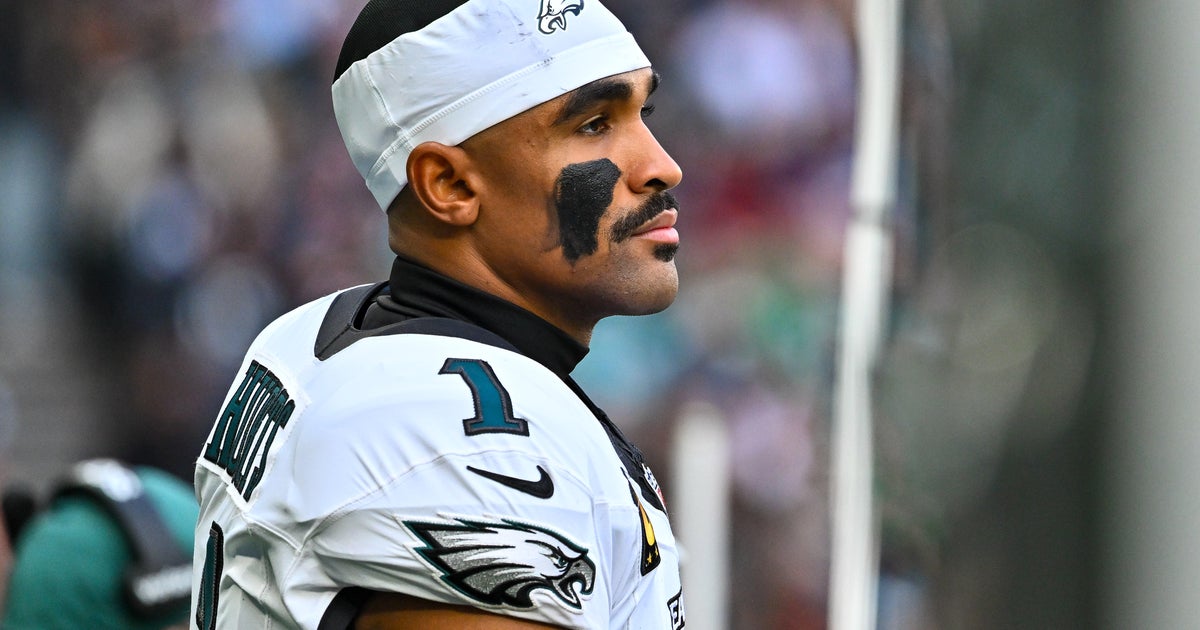
Philadelphia Eagles quarterback Jalen Hurts, a Super Bowl champion and one of the NFL’s top stars, now faces a long absence due to blood clots in his lungs, and his team faces serious questions about his medical treatment. Hurts’ agent, Nicole Lynn, and the Eagles said in a statement Monday that his “prognosis is very good and we anticipate a full recovery.” The condition could be life-threatening, and the Eagles say Hurts could miss the rest of the season. However, Hurts was cleared to play a week ago in London after a blood clot was found in his leg. He threw for 222 yards and a touchdown, but the Eagles lost to the Jacksonville Jaguars, 19-17. Just a day earlier, he was diagnosed with a superficial blood clot in his left calf and doctors ordered him to stay awake through the night, according to NFL sources, who report that the quarterback didn’t sleep for about 36 hours. After being released from the hospital, he was reportedly given some time to rest before taking the field against the Jaguars. The NFL in a statement Tuesday disputed that report, calling it “misinformation” that Hurts did not sleep for 36 hours before the Oct. 11 game. “That was not true and no one told him not to sleep because of his situation,” NFL spokesman Brian McCarthy said. “The club told all players, coaches and staff to try to stay awake as much as possible on Saturday as the team was returning home after the game in London. The team did not have a bye week and, like other NFL teams traveling to London and back, they were trying to maintain as normal a routine as possible.” Since then, the diagnosis has worsened. The star quarterback now faces deep vein thrombosis and a bilateral pulmonary embolism with blood clots in his left leg and both lungs, the team and his agent said. Deep vein thrombosis, also known as DVT, refers to a condition in which a blood clot develops in the deep veins, usually in the lower extremities, according to the U.S. Centers for Disease Control and Prevention. A pulmonary embolism, or PE, is the term for when the clot breaks loose and travels to the lungs, which can be life-threatening, the CDC says. “You have a clot in your leg. The problem is that it can travel through the veins and get to the heart, and from there, go to the lungs and block the blood vessels in the lungs. And you get things called pulmonary embolisms. That’s very serious,” CBS News chief medical correspondent Dr. Jon LaPook, who is not treating Hurts, told “CBS Mornings.” Whether this could be the end of his career, LaPook said, it’s “too early to tell.” “Normally what you do is treat this with blood thinners for three months and then see what happens,” he continued. “Now they will monitor it closely. It may be more than that, and after that, they will take them off blood thinners.” Jalen Hurts of the Philadelphia Eagles watches during the NFL game against the Jacksonville Jaguars in London on Oct. 11, 2026. Vince Mignott/DeFodi Images/Getty Images LaPook said Hurts’ doctors would likely test his blood to see if there are any problems that increase the risk of clotting. The revelation of the diagnosis is sparking a backlash against the Eagles and their medical staff. Eagles head coach Nick Sirianni did not answer Monday why the quarterback was allowed. “I’m not a medical expert. I lean on our guys in all those situations, right? I’m a football coach,” he said. “I rely on our medical experts in every situation. I have complete trust and faith in them.” McCarthy in his statement Tuesday said the NFL has “been in contact throughout the process with the Eagles’ medical staff and with the Cleveland Clinic in London where the tests were performed.” The National Football League Players Association, the union that represents players, is demanding that the league conduct a “full investigation into what happened.” An NFLPA spokesperson told CBS News in a statement Tuesday night that it was “not aware of any NFL investigation into the medical care provided to Jalen Hurts,” adding that the league had “previously informed the union that it did not plan to review the care he received.” Flying could be a concern, doctor says. A main question from fans is whether flying to London, or flying back, could have exacerbated the injury. LaPook said it’s possible it could be a problem. “Flying, you can get dehydrated, you’re not moving much,” so blood doesn’t return to the heart either, LaPook said. “When he got there (to London), they tested him and found superficial thrombophlebitis, meaning a small clot, and… they gave him clearance to play. He ended up playing and then right after the game, he flew back. “The fact that Hurts didn’t get much sleep wasn’t as big a concern as the flight, LaPook said. “Well, the biggest point for me isn’t not sleeping, it’s the fact that I had a flight there, a flight back in a few days,” he said. “That increases the risk of blood clots in the first place. When on flights, we tell people to walk and maybe wear compression stockings.” The CDC has similar warnings about flights. “Prolonged periods of limited mobility are inherent to long-distance travel and may increase a traveler’s risk of VTE,” according to the agency. “The association between VTE and air travel was first reported in the early 1950s; since then, long-haul air travel has become more common, leading to increased concern about travel-associated VTE.” Different organizations offer different guidance on how soon someone with DVT should fly, but it is significantly longer than the time it took Hurts to fly back to the US. The International Air Transport Association says that if a person is stable, they should wait at least five days before a flight, while the British Thoracic Society advises that someone with DVT or PE should wait two weeks before flying. “Over the past few days, Jalen Hurts has received comprehensive medical evaluations from medical experts,” Eagles and Hurts’ agent said in the statement announcing his long-term absence. For now, the Eagles will wait three months to see how his condition improves with blood thinners. “We anticipate that he will have the opportunity to resume contact football activities when he is off blood thinners,” the statement said. “In the meantime, he will remain active on the team and continue to condition. More importantly, we anticipate there will be no long-term effects. We are thinking about Jalen and expect a strong recovery.” More from CBS News Go deeper with The Free Press in: