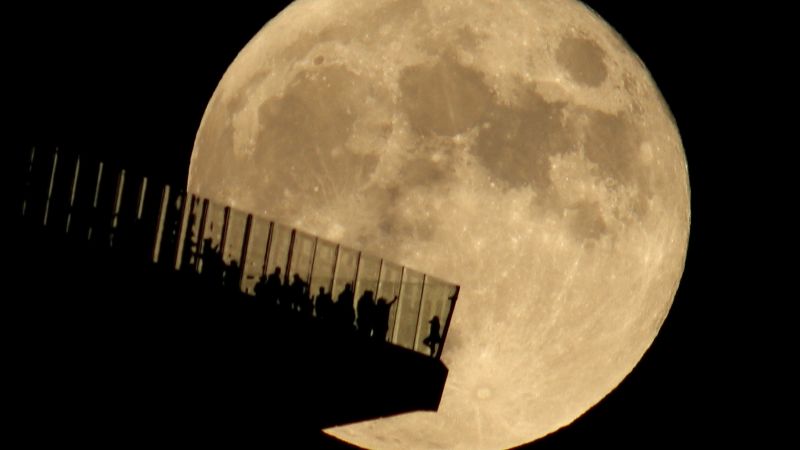
October’s full moon will grace the sky this weekend, and those with a keen eye will also be able to catch a glimpse of Saturn. Just one month after the fall equinox, the full moon will rise particularly early, becoming visible at dusk and reaching maximum illumination at 12:12 a.m. ET on Monday, October 26, according to EarthSky. As night falls on Sunday, Saturn will also appear golden and will be located just a few degrees south of the moon. The orb may appear more orange as it hangs lower on the horizon. This position causes the moonlight to pass through a denser layer of air, shortening the blue and violet wavelengths and highlighting the oranges and reds, similar to a sunset. Called the hunter’s moon, Native Americans traditionally took advantage of the moon’s bright light to hunt active wildlife and prepare food for the winter. The October full moon follows the September harvest moon, which marked when farmers typically harvested their crops. “These names were assigned to the moon because the moon has meaning,” said Noah Petro, head of NASA’s Planetary Geology, Geophysics and Geochemistry Laboratory at the Goddard Space Flight Center in Maryland. “I encourage people to ask themselves, as they look at the moon, ‘What does this time of year mean to me?’ “Everyone should have a personal connection.” Other nicknames for the hunter’s moon have their similar roots in seasonal traditions. Indigenous tribes adopted names that included drying rice moon, falling leaf moon, and migrating moon. Some groups also referred to it as the blood moon, a nod to its orange-red hue. The full moon will appear in its usual silver color for the next few months, but viewers who look closely will notice that the moon’s face changes as it rotates, said Petro, who is also a project scientist for the Artemis III mission. The moon owes its varying gradation to differences in surface composition and age, something Petro’s team plans to explore on the Artemis mission scheduled for June 2027. “When you see color differences on the moon, that tells you that something has already happened there: either the rocks are made of something different, or it’s a younger or older surface,” Petro said. “It tells you about geological history.” For optimal sky viewing, Petro suggested finding a location free of obstacles from trees or buildings, such as a large field. He added that cold winter nights can make it easier to see the moon, because the heat creates turbulence in the atmosphere and turns the sky hazy. “The beauty of the Moon is that you don’t have to have the most impressive telescope,” Petro said. “You need two things: clear eyes and clear skies. And with that, you can fall in love with the moon.” If the sky is not clear on Sunday night, the moon will also appear full on Saturday and Monday. The Hunter’s Moon comes at the end of a multi-day period in which the orb approaches and passes Saturn. The ringed planet may be difficult to spot due to the moon’s luminescence. The skygazing opportunities haven’t ended after this weekend’s double visual treat. From Monday to Wednesday, the Moon will approach, eclipse, and pass through the Pleiades star cluster, also known as the Seven Sisters. The Pleiades, which appear to the naked eye as a blurry collection of six or seven stars, are among the best-known sky clusters in the world. The Hunter’s Moon will mark 11 of the 13 full moons in 2026. The last two are supermoons, meaning the satellite will appear brighter and larger because it is closer to Earth in its orbit. November 24: Beaver Moon December 23: Cold Moon Subscribe to CNN’s Wonder Theory science newsletter. Explore the universe with news about fascinating discoveries, scientific breakthroughs and more.