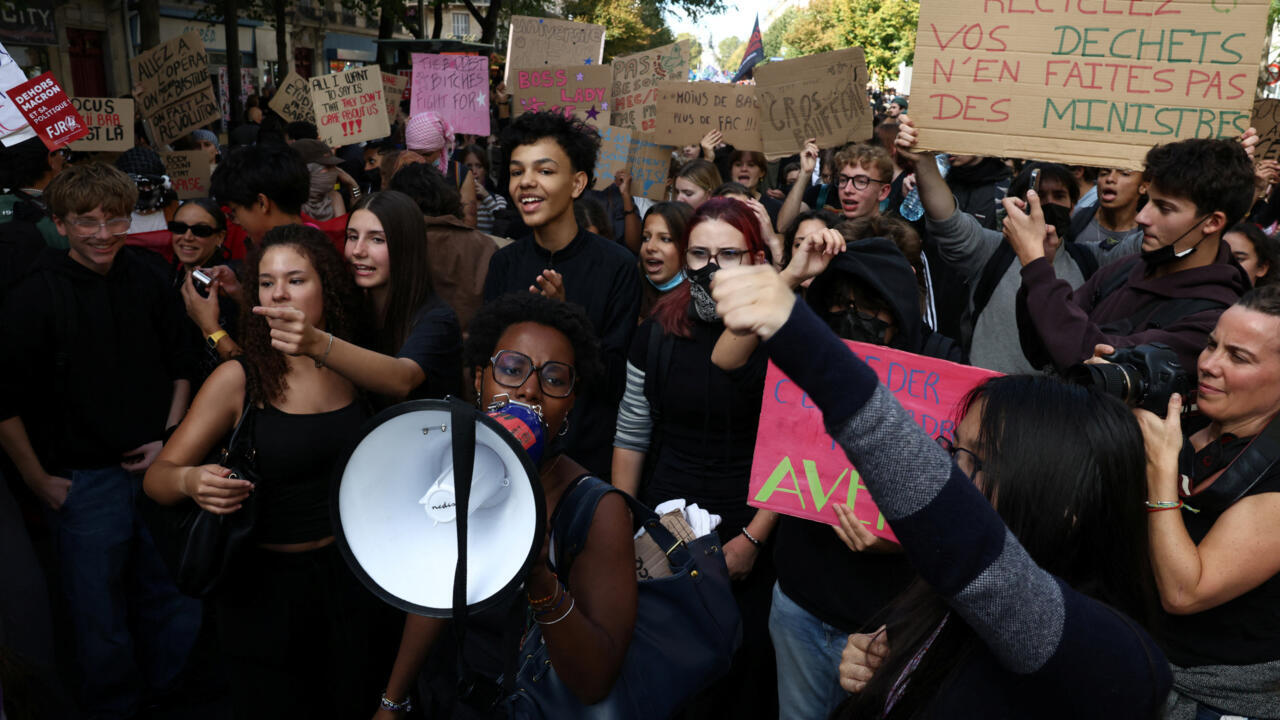

Mass protests in France’s secondary schools shook the country again on Tuesday, with hundreds of thousands joining the movement’s biggest day yet. The demonstrations began in late September and the first protest dates back to the Saint-Exupéry secondary school in Créteil, a southern suburb of Paris. A handful of Saint-Exupéry teachers went on strike on September 17 to complain about staff shortages. “We were missing a mathematics teacher, a French teacher, a literature teacher, a history teacher and an assistant teacher. The school nurse was on sick leave,” Laurent Bessiere, a mathematics teacher, told French radio station France Inter. That same night, students gathered to join the fight and planned a protest for the next morning. Piling some containers in front of the school entrance and holding banners, they stood up to make demands alongside their teachers. “We ask for the minimum,” one student told France Inter. Their demands struck a chord with other high schools across the country, which suffer from underfunding and understaffing. In response to the protests, Prime Minister Sébastien Lecornu has ordered his ministers to address their demands and submit proposals by the end of the month. But finding additional funds to implement education reforms will be difficult, given heated debates over France’s already strained 2027 budget. Read more ‘We’re fed up’: Paris students rise up in a movement that shows no signs of slowing Staff shortages A union of high school and university students on Monday published a list of 10 “emergency measures” that they say could serve as a basis for working with the government, whose response so far has been “repression,” they write. At the top of the list is the issue of staff shortages. Students are demanding a large-scale recruitment drive to create additional teaching positions so that each classroom has a person to lead it. They also want to guarantee that each center has at least one nurse, a psychologist and a professional counselor for every 500 students. More than half of France’s middle and high schools lack at least one teacher, a major union representing public school staff has found. And 69 percent of schools are missing at least one member of their teaching and support staff. Understaffing means classrooms are overcrowded and regularly hold 35 students at a time. Read moreWhy so many French teachers are quitting The figures do not reflect the optimism that French Education Minister Édouard Geffray expressed before the start of the new academic year in September. Speaking on France Inter at the end of August, he insisted that the teacher shortage would be “minimal” and that “all indicators” indicated that things were on track to be “much better” than in previous years. To meet the demand for teacher replacements, Lecornu referred to a plan from 2023 that encourages teachers to cover the short absences of their colleagues in a statement published on Sunday. Regarding long-term absences or vacant positions, Lecornu said he ordered his ministers to prioritize filling them in all regional education authorities. Dilapidated buildings Students have also repeatedly raised alarm about the sorry state of school buildings. A wave of viral Instagram videos posted by students resurfaced as the protests began. “I am a student at the Blaise Cendrars high school in Seine-Saint-Denis (a suburb north of Paris). Of course, I don’t have a roof over my head when I’m in class,” says a student ironically in a video that shows the deplorable state of her establishment. Others have reported seeing rats and cockroaches running through school hallways and flooded bathrooms. To display this content from Instagram, you must enable ad tracking and audience measurement. Accept Manage my options Speaking to French radio ICI on Wednesday, the vice president of the Ile-de-France region, James Chéron, rejected the criticism. He said the region’s €6.6 billion ten-year plan covers almost all public secondary schools and that almost 400 of its 468 schools are already new or renovated, with the rest under construction or “under study.” Chéron added that Seine-Saint-Denis has received “the largest investment.” But the students are not convinced. During successive heat waves that hit parts of France this summer, some classrooms reached 38° Celsius. Two-thirds of the nation’s elementary, middle and high schools were built before 1970 and cannot withstand rising temperatures caused by climate change. Read moreNew schedules, longer holidays: how can French schools adapt to heat waves? The maintenance of school and university buildings is at the top of the list of demands published by the students’ union. They ask that an “emergency plan” be implemented to renovate dilapidated buildings and adapt them to heat waves by installing air conditioners or refrigeration systems. They also want buildings to be well insulated to deal with cold waves. Providing “clean and functional bathrooms” is a key principle of the application. In this regard, Lecornu stated in his statement that the maintenance of the buildings, equipment and canteens of public secondary schools is the responsibility of the regional councils, but that the State will “support” them. Ministers are tasked with setting a timetable for urgent needs and clarifying who is responsible for what. “Studying in deteriorated premises is an obstacle to education,” Lecornu acknowledged. Long Hours Hours have also come under scrutiny. Students say school days are too long, sometimes running from 8 am to 6 pm because of gaps in their schedule where they don’t have classes. They point to a reform adopted in 2019 that allows high school students to choose specialization courses in their final years as one of the reasons why schedules may be altered. “When I was in high school, I started at 8 a.m. and finished at 6 p.m.,” recalls Julie, who is now in college. “My schedule was full and I still had extra extracurricular activities.” “I wake up at 6 in the morning because I live far from my high school. It takes me an hour to get home and then I have a lot of homework to do. I hardly spend time with my family,” one student told France 2 in an interview on Sunday. Although French students tend to spend fewer days in school than the OECD average, they compensate with longer school days. Protesters march during a demonstration by French high school and university students in Marseille on October 6, 2026. © Manon Cruz, Reuters Lecornu has called for improvements to independent study schedules and conditions to be reviewed with public school staff, student representatives and even local transport authorities. He encouraged them to use artificial intelligence to perfect the software used to create schedules ahead of the next school year. A citizens’ convention presented a proposal to the government in November last year on how to reform public school schedules, but so far the proposal has not been heard. Problems with the Parcoursup platform France’s national online platform for applying to higher education institutions, Parcoursup, is also in the line of fire. A bit like UCAS in the UK, high school seniors use it to apply to university courses and other programmes, receiving offers based on their school records and applications. Students argue that the system is opaque and appears arbitrary. Each university course ranks applicants with its own algorithm and local criteria, and students say they cannot see how decisions are made or why they were rejected. Many suspect that their applications, including the cover letters they spend hours writing, are never actually read. “I wrote a dozen cover letters without using ChatGPT, but I feel like my applications weren’t even vetted. When I see people accepted into the course I wanted with lower grades than mine, it seems completely illogical to me,” Ghjulia told FRANCE 24. The 18-year-old hoped to start medical school, but none of her applications were accepted, despite having good grades. But students also say Parcoursup entrenches inequality. A February 2026 report concluded that it helps maintain sociocultural inequalities. One reason is that the courses can see which high school an applicant attended, which can disadvantage students from less prestigious schools or from poorer areas. The report pulled out 51 proposals to address these issues, including removing cover letters, hiding the applicant’s school, and sharing local algorithms. To display this YouTube content, you must enable ad tracking and audience measurement. OK Manage my options One of your browser extensions appears to be blocking the video player from loading. To view this content, you may need to disable it on this site. Try again Cover image: © France 24 Lecornu promises to make Parcoursup more transparent. Under their plan, students would be told exactly how courses weight their grades and specialized subjects, how applicants are ranked and why they were accepted or rejected. Ministers Édouard Geffray and Philippe Baptiste have until the end of October to propose changes for the 2027 admissions round, which opens in January. The other demands listed by the students include financial aid, including ensuring student meals are capped at €1 and an end to police violence that has run rampant during the protests.