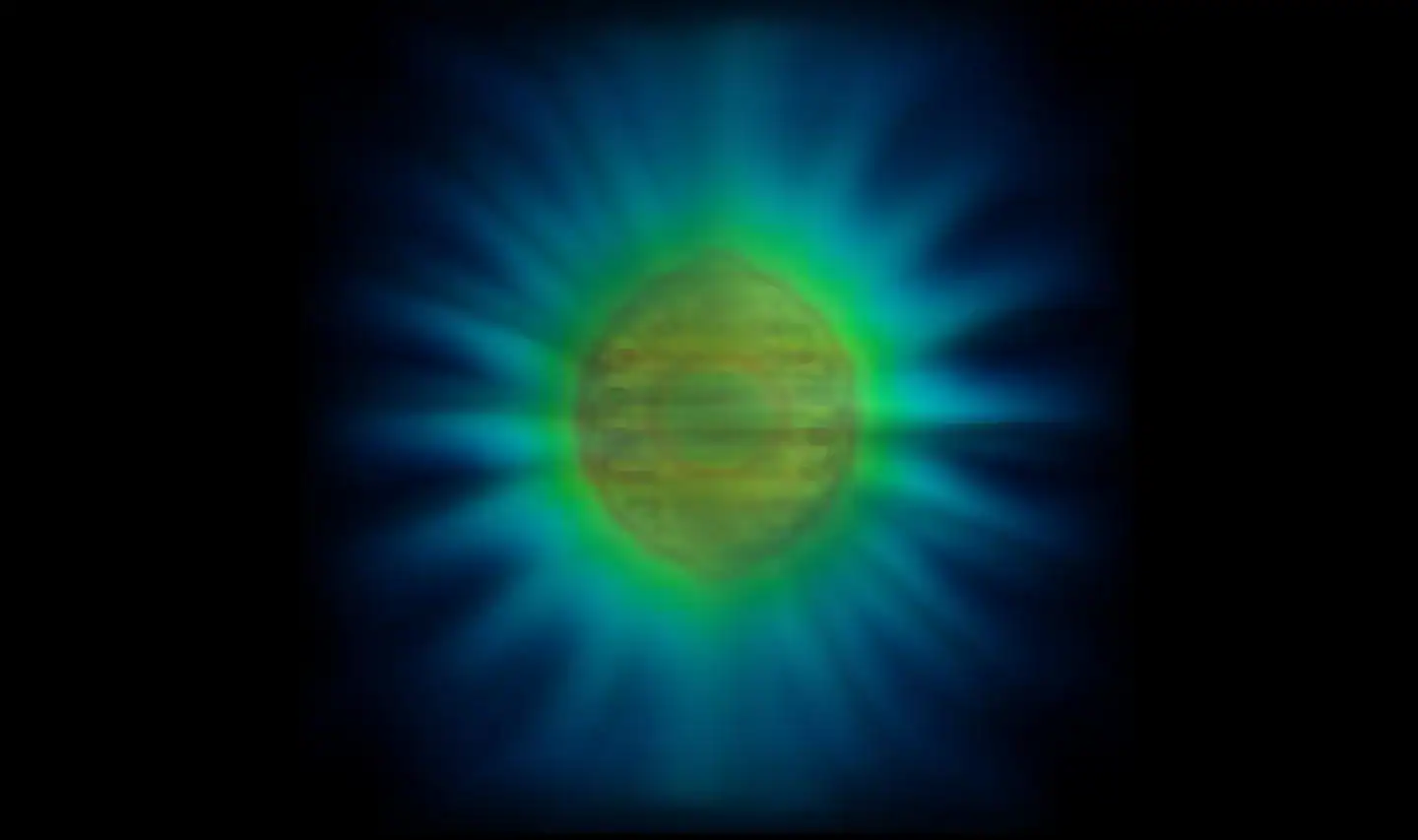
A one-photon visualization made by the authors of the new study. Credit: Benjamin Yuen When we look at the world around us, everything we see is thanks to light. It reflects, refracts and interacts, transmitting shape and depth to the objects it touches. But what about the light itself? Physicists at the University of Birmingham used a theoretical model published in November 2024 to visualize the shape of a photon (a single quantum of light) emitted by an atom interacting with a microscopic sphere of silicon. “We were able to produce this image of a photon, something that had not been seen before in physics,” said theoretical physicist Ben Yuen, lead author of the study. What does a photon look like? The visualization, carried out by researchers at the University of Birmingham, is not a photograph; You can’t just photograph a photon like you would a physical object. Rather, it is a detailed simulation derived from quantum calculations. The “shape” of a photon is, as physicists say, an intensity distribution. Basically, it is a map of the expected electromagnetic intensity associated with the photon in space. Under proper detection conditions, brighter regions correspond to a higher probability of detecting the photon. Dr. Yuen explained in more detail for New Atlas: “Because it is a quantum particle, it cannot be measured in one go as the measurement destroys it. However, if you were to repeat the measurement many times, you would see exactly this distribution.” In fact, scientists have already reconstructed aspects of the spatial structure of a single photon. In 2016, physicists at the University of Warsaw used quantum interference to create a single-photon hologram, recovering both the amplitude and phase of its transverse wavefunction. ×Thank you! One more thing… Please check your inbox and confirm your subscription. What differentiates the Birmingham study is that it calculates how this spatial structure arises from the interaction between light and its environment, from the vicinity of the emitting atom to much further away. By simulating a photon emitted by an atom placed on a silicon nanoparticle, the researchers highlighted an important observation: the photon is profoundly shaped by the environment. The nanoparticle, for example, made the photon thousands of times more likely to be emitted and even allowed the atom to reabsorb it several times. Why is it important? By better understanding the fundamental interactions between light and matter, scientists can design advanced technologies. The findings could be useful in fields ranging from quantum computing to renewable energy. “By understanding this, we lay the foundation for designing light-matter interactions for future applications,” Yuen said. “Think better sensors, improved photovoltaic power cells or quantum computing.” In quantum information systems, for example, the shape of a photon could determine how efficiently it carries data. In biological systems, similar theoretical approaches could help scientists understand how light drives chemical reactions such as photosynthesis. Traditionally, scientists model this interaction using simplified equations that consider light moving through empty space or bouncing between mirrors in a cavity. These methods may be inadequate when light interacts with complex materials (such as nanoparticles, quantum dots, or biological molecules) where the geometry of the environment dramatically reshapes the photon itself. “The geometry and optical properties of the environment have profound consequences for the way photons are emitted, including defining the shape, color and even the probability that it exists,” said co-author Angela Demetriadou, a theoretical professor of nanophotonics at Birmingham. This means that a photon does not have a universal shape. Unlike a small marble or grain of sand, it has no hard surface or permanent outline. Rather, its spatial structure depends on how it is produced and how it interacts with its environment. In this case, Yuen and Demetriadou simulated a photon emitted by an atom coupled to a microscopic sphere of silicon. The result was a twisted lemon-shaped structure; Its asymmetry is a direct trace of how the particle’s surface influenced the quantum fields from which the photon was born. Even that lemon shape is not permanent. As the photon propagates away from its source, its spatial intensity distribution evolves. “This is really the goal of nanophotonics,” Yuen said. “By shaping the environment, we can actually shape the photon itself.” From shaping light to quantum computers Since then, researchers have continued to explore ways to control the relationship between light and matter. In December 2025, Yuen and Demetriadou co-authored another study describing microscopic optical cavities designed to generate quantum entanglements between ultracold rubidium atoms, a potential component for future quantum networks. In September 2026, Demetriadou also began a Royal Society-funded research project aimed at developing a unified theoretical framework to describe quantum light in nanophotonic environments. The shape of light is more than an exercise in quantum curiosity. By manipulating their environment, physicists hope to control how light and matter exchange energy and quantum information. For a particle as elusive as the photon, this discovery is nothing short of illuminating. The findings appeared in the journal Physical Review Letters. Editor’s note: As part of ZME Science’s effort to review scientific stories and follow how evidence develops, we have revised this article, originally published in November 2024 and previously updated in October 2025. This update adds further research on quantum interactions between light and matter, provides historical context on previous photon imaging experiments, and clarifies what physicists mean by the shape of a photon.