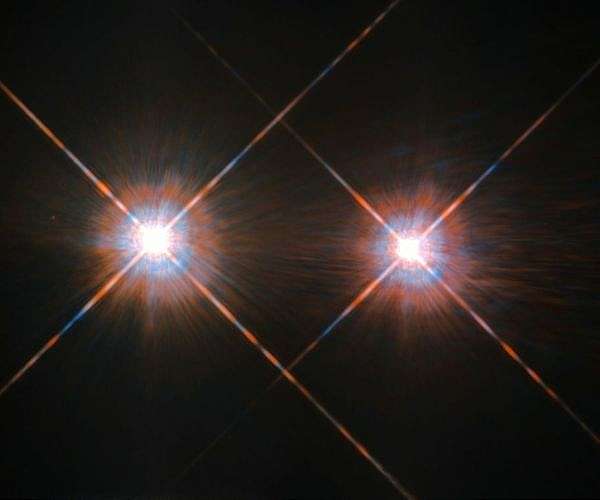
On a night in August 2024, the James Webb Space Telescope recorded a faint spot of mid-infrared light next to Alpha Centauri A. The source was more than 10,000 times fainter than the star and appeared about 1.5 arc seconds away, equivalent to a projected separation about twice the Earth-Sun distance. There were good reasons to take it seriously. The tests made the passage of an asteroid, a distant object in the background and familiar image processing artifacts unlikely. However, Webb looked again in February and April 2025 and found no comparable point sources. The possible planet, named in the analysis S1, had apparently disappeared. Two linked papers in The Astrophysical Journal Letters argue that a planet remains a plausible explanation. Their case combines one detection, two non-detections, and millions of simulated orbits. This is a couple of studies, not an established confirmation of a planet. One of the closest targets is also one of the most difficult. Alpha Centauri is the closest star system to the Sun, just over four light years away. Its central pair contains Alpha Centauri A, a G-type star very similar to the Sun, and Alpha Centauri B, somewhat smaller. A third member, Proxima Centauri, lies much further away from the pair. An ESA/Hubble portrait of A and B makes them appear clearly separated, but an accurate search for planets has to deal with the detailed light pattern of both stars. Webb’s mid-infrared instrument, MIRI, used a coronagraphic mask to suppress Alpha Centauri A. That’s just the beginning. Alpha Centauri B contributed its own off-axis glow, the stars moved rapidly against the background, and small differences in orientation changed the residual patterns that survived subtraction. The first of two 2025 papers, led by Aniket Sanghi, describes the observations and image analysis. Depending on the processing method, S1 was detected with a signal-to-noise ratio between four and six, corresponding to a quoted significance of approximately 3.3 to 4.3 sigma. This is interesting, but it’s not the kind of overwhelming single-epoch signal that makes tracking optional. Therefore, the team injected artificial point sources into the raw and processed images and asked if the pipeline could recover them. It also tested whether S1 behaved as an imperfection of the fixed detector, a residual copy of the stellar point spread function, or an unrelated moving object. Those checks support an astrophysical source, but no processing test can provide the second sighting needed to prove an orbit. The planet did not need to cease to exist to disappear. A coronagraph does not leave a perfectly transparent field around a darkened star. Sensitivity drops near the central mask, while diffraction characteristics, detector behavior, and imperfect subtraction make some directions easier to search than others. A planet in orbit can go from a visible zone to a region where the same instrument and the same exposure can no longer recover it. That possibility became central after Webb’s visits in February and April 2025. Both observations were non-detections. The careful claim is not that the planet was seen and then ceased to exist. It’s just that S1 was seen once and would have been below the recovery threshold at later positions for many otherwise acceptable orbits. NASA’s August 2025 work report calls it a “disappearing planet,” but also states the decisive limitation: additional observations are required. The phrase describes an observational problem, not the behavior of a confirmed world. Millions of orbits turned absence into a limitation. The second paper, led by Charles Beichman, combines the limits of imaging with orbital and physical modeling. The team generated millions of possible paths, retained those consistent with the position and brightness of S1 in August, and eliminated orbits that would be dynamically unstable due to Alpha Centauri B. The models also considered a point feature called C1 found in 2019 by the NEAR experiment on the European Southern Observatory’s Very Large Telescope. That earlier Nature Communications study treated C1 as a possible planet or concentration of warm exozodiacal dust and explicitly required independent confirmation. S1 and C1 are not known to be the same object. The 2025 exercise asks what comes next if they are. Under that shared object assumption, the accepted simulations gave a 52 percent probability that orbital motion would place the candidate in regions of low sensitivity during both Webb follow-ups. In other words, failing twice is not a particularly unlikely outcome. That calculation explains how observations can fit a planet; it does not prove that a planet caused the original signal. Surviving families usually have periods of between two and three years. They prefer an eccentricity of about 0.4 and an orbit inclined about 50 degrees, or the corresponding retrograde geometry, relative to the Alpha Centauri AB orbital plane. The star-planet distance would vary approximately between one and two astronomical units. Saturn’s mass is an estimate, not a measurement on a scale. S1 was measured on a MIRI filter centered near 15.5 micrometers. Turning that glow into a planet requires assumptions about age, thermal evolution, radius, reflectivity, and internal heat. Models point to a temperature of around 225 kelvin, a radius approximately one to 1.1 times that of Jupiter, and a mass of between 90 and 150 Earth masses. Saturn contains about 95 Earth masses, which explains the useful abbreviation “Saturn mass.” However, the range extends well above Saturn and no dynamic mass has been measured. A single infrared flux point also cannot yet provide an atmospheric composition. The candidate would be unusual for direct images. Most of the planets imaged directly are young, hot giants far from their stars, where separation and heat left over from formation make them easier to distinguish. S1, if real, would be a mature, cooler giant much closer to its host star than the known directly imaged population. SpaceDaily reported on Webb’s initial evidence in 2025. The abiding point is the same: This is the strongest imaging evidence yet for a planet around Alpha Centauri A, not a confirmed entry in the planet catalog. A habitable zone giant is not an Earth twin. The phrase “habitable zone” refers to the range of orbital distances where a properly constructed rocky planet could maintain liquid water on its surface. NASA’s habitable zone overview emphasizes that distance alone does not establish habitability. Atmosphere, pressure, composition, geology and stellar activity also matter. For S1, the distinction is even greater. The candidate appears to be a gas giant with no solid surface like Earth’s. Its location would make it mild by giant planet standards, but it would not support surface life as we know it. Undetected moons could be discussed as possibilities, just as moons of giant planets in our own solar system are discussed, but Webb did not detect a moon, liquid water, or any biological signature. “Our closest solar twin” also refers to the star, not the candidate planet. Alpha Centauri A is more similar to the Sun in spectral type and age than the red dwarf Proxima Centauri. The possible world next to it looks nothing like Earth based on available evidence. Confirmation now has a moving target to find. Orbital simulations are useful because they convert three observation dates into predictions. Instead of searching blindly, future visits to Webb can focus on times when a large fraction of viable routes place the source outside the least sensitive region of the coronagraph. A recovery in the correct changing position would show common proper motion and begin to narrow the orbit. Measurements on additional filters could test whether the source has the spectral energy distribution of a cooling giant planet or hot dust. Repeated astrometry could link S1 to C1 or show that the apparent connection was a coincidence. Astrometric and radial velocity programs can add independent limits, although binary stars also make those measurements demanding. A clear non-detection at a time and place where almost all viable planetary orbits predict visibility would also be informative. It would push the interpretation back toward a transient artifact or some form of dust structure not captured by current tests. For now, the disappearance is neither a fatal case for the planet nor proof of this in itself. Millions of simulations show how a Saturn-scale world could have slipped behind Webb’s observational blind spots. The next decisive step is easier to state and more difficult to achieve: the point of light has to return.