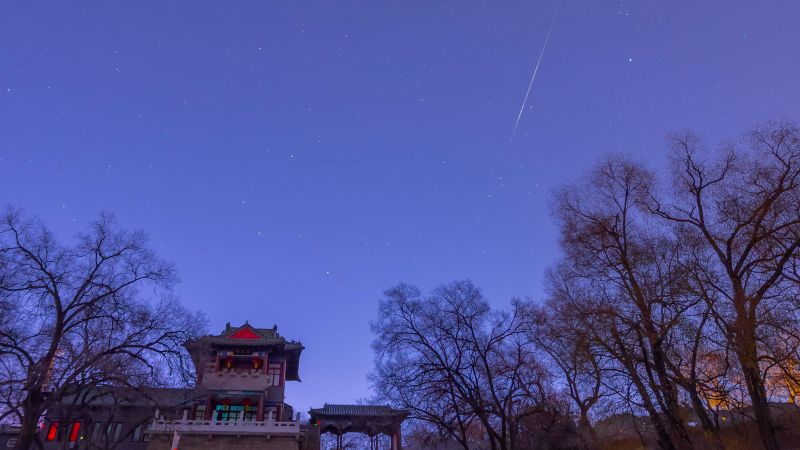
Every November, Earth passes through a trail of debris left by comet 55P/Tempel-Tuttle, creating the annual celestial display known as the Leonid meteor shower. As small pieces of the comet disappear into the atmosphere, they create meteors that can be seen burning in the night sky. This year, the shower is expected to peak overnight, Monday through Tuesday, when Earth passes through the densest part of the debris trail, according to the American Meteor Society. Under clear conditions, skywatchers could see up to 15 meteors per hour, said Bill Cooke, director of NASA’s Meteoroid Environment Office. “You’ll need a really dark sky,” Cooke said. “The Leonids are weak, so you won’t see any Leonids in the suburb.” He recommends finding a spot away from artificial lights and avoiding looking at your phone, which can interfere with your eyes’ ability to adapt to the dark. The best time to spot these fleeting meteors will be early in the morning, around 2 or 3 a.m., in any time zone, Cooke said. This is when the constellation Leo, where the meteors appear to originate, is highest in the sky. The moon, which will be in its waxing phase and 39% illuminated, will also have set by this time, leaving darker skies to see. The Leonids will be visible from both the Northern and Southern Hemispheres, although the Leo constellation appears lower in the sky south of the equator, potentially limiting the number of meteors visible in that region, according to the American Meteor Society. No special equipment is needed to enjoy the celestial spectacle. “Lie on your back and look at as much of the sky as you can. No telescopes, no binoculars, just your eyes,” Cooke said. “It’s cold out there, but you know, to see the Leonids you have to suffer a little discomfort.” The Leonids are known for producing spectacular meteor storms, which occur when at least 1,000 meteors cross the sky per hour, according to NASA. One of the most famous meteor storms occurred in 1833 when observers reportedly witnessed tens of thousands of meteors per hour. “People thought the world was ending. There are all kinds of stories in old newspapers from that time,” Cooke said. “That really shook people back then.” That unusually large burst of meteors also helped boost the scientific study of celestial objects as astronomers began investigating what caused the rays of light. “It was the Leonids that gave rise to meteorite science in the early 19th century, so without the Leonids we wouldn’t know as much about meteors as we do now,” Cooke said. “They are the shower that started it all.” The Leonids can produce meteor storms about every 33 years when the shower’s parent comet approaches the sun. As the comet approaches the Sun, it heats up and releases more debris, which Earth can later pass through, said Meredith MacGregor, an associate professor in the department of physics and astronomy at Johns Hopkins University in Baltimore. However, meteor storms are not guaranteed every three decades, as the gravitational pull of Jupiter and other planets can alter the trajectory of comet debris. Scientists expect the next Leonid meteor storm to occur in 2033, Cooke said. A meteor storm is not expected this year, but MacGregor said watching the annual Monday-Tuesday shower still offers a unique opportunity to connect with the cosmos. “When you go out, you see material entering our atmosphere that originated from the tail of a comet that came from the outer parts of our solar system,” MacGregor said, “and you can actually see it with your own eyes.” According to the American Meteor Society, the Leonid meteors are expected to shine in the sky until the shower ends on November 30. If you’re eager to see more, here are the remaining meteor showers that will peak in 2026: Geminids: December 13-14 Ursids: December 21-22 There are two full moons left in 2026, according to the Farmers’ Almanac. Both are supermoons, when the full moon appears larger and brighter than usual as it will be closer to Earth in its orbit. November 24: Beaver Moon December 23: Cold Moon Taylor Nicioli is a freelance journalist living in New York. Subscribe to CNN’s Wonder Theory science newsletter. Explore the universe with news about fascinating discoveries, scientific breakthroughs and more.