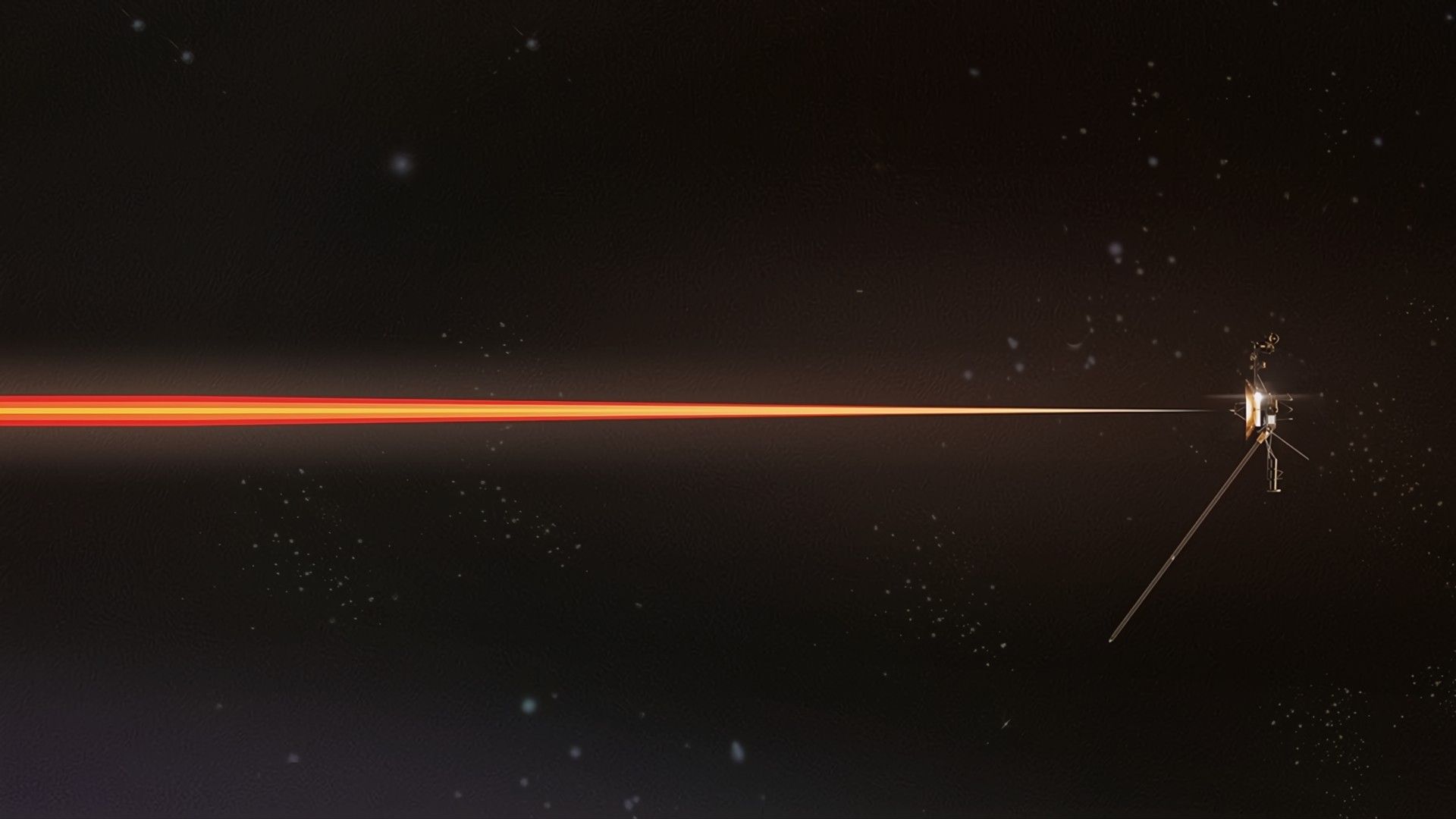
Follow Us Add us as a preferred source on Google Newsletter Subscribe to our newsletter PASADENA, California – NASA’s Voyager mission team cheered and wiped away tears here Thursday (Nov. 19), celebrating a major milestone: Voyager 1 just reached one light day from Earth, something no other spacecraft has ever done. The excitement persisted despite a communications anomaly that arose on the probe, which the team remains confident is temporary. Members of the Voyager team gathered for a news conference about the mission in the Von Karman Auditorium here at NASA’s Jet Propulsion Laboratory (JPL), the first such event for Voyager since 1989, when Voyager 1’s twin, Voyager 2, flew by Neptune. The meeting served to celebrate Voyager 1’s distance milestone: At 5:16 a.m. EST (1016 GMT) on Wednesday (Nov. 18), the probe reached one light day from Earth—the distance a photon travels in one day, which is about 16 billion miles (26 billion kilometers). That means it now takes a full day for a signal to travel from Earth to Voyager 1, the farthest man-made object in space. “I remember in 1977 standing at the Cape watching the launch of Voyager, and I never thought I would be here today, 49 years later, celebrating Voyager’s daylight. What an incredible milestone,” Voyager project scientist Linda Spilker said during Thursday’s event. An unexpected anomaly, but manageable. This day and week have been filled with excitement over the distance milestone, the Voyager mission team has been working hard, as usual, to keep the two nearly 50-year-old spacecraft alive and running. Unfortunately, as JPL spokesperson Raquel Villanueva shared at this celebration, on Saturday (Nov. 14), Voyager 1 stopped transmitting science and engineering data. The team remained in contact with Voyager 1 while investigating the problem and are confident they can resolve it soon. You may like NASA and Voyager team members celebrate Voyager 1’s light-day milestone at NASA JPL on November 19, 2026. From left: Nicky Fox, associate administrator, Science Mission Directorate; Jonathan Lunine, chief scientist at NASA’s Jet Propulsion Laboratory; Suzanne Dodd, Voyager project manager; Kareem Badaruddin, director of the Voyager mission; Jamie Rankin, Voyager deputy project scientist. (Image credit: Chelsea Gohd) “We listen to every spacecraft every day,” Voyager project manager Suzanne Dodd told Space.com at the event. Regarding Voyager 1, “we have an anomaly that is not something that has not been seen before,” Dodd said. “We have a very strong carrier signal. We currently have no frame synchronization, so we are not currently getting scientific or engineering data.” “But if you remember,” Dodd added, “a light day is a long way from us. [It takes] It takes 24 hours to send the signal to the spacecraft, 24 hours for the signal to go down, so it takes two days to diagnose anything on the spacecraft… So we can’t do anything quickly and the data rates are very low.” According to Dodd, this anomaly is not a major cause for concern in the long term. Rather, it is likely part of the natural aging process of spacecraft. “These spacecraft are old,” he said. “All of us old people have our pains and pains, and you know, sometimes it takes longer to stretch your muscles and remember things, so we’re in a realm where we’re going to see more anomalies with Voyager simply because of distance and age.” “But we feel that Voyager 1, although it’s not sending us telemetry data, is pointing at Earth. It’s sending us a strong carrier signal, and I’m sure it won’t be long before it’s sending data back to us.” What to read next And, for anyone curious about how Voyager 2, Voyager 1’s slower twin, is doing, Dodd shared that it’s doing very well on its own journey through interstellar space. “Voyager 2 is very healthy. He continues his mission. It has three scientific instruments,” he told Space.com. “Each spacecraft basically sets a record every day for longevity or distance,” Dodd added of the twin probes. A photograph of Saturn taken by Voyager 1, where the probe passed in November 1980. (Image credit: NASA/JPL-Caltech) A heartfelt celebration Despite the communications anomaly, and despite the fact that most of the team had been up all night to confirm the signal from a Voyager Day of Light 1 — The room was filled with excitement. Voyagers have been flying for nearly 50 years on a mission that was expected to last only five years, so the team was more than ready to celebrate amid the more technical updates about the mission and its current status in interstellar space, the event included images of Voyager Day of Light celebrations around the world, from children cheering on Voyager to iconic monuments illuminated in gold honoring the Disk. of the mission, the love for Voyager resonated around the world in photographs and photographs. The images of this international celebration were enough to move Nicky Fox, associate administrator of NASA’s Science Mission Directorate, almost to tears. “I actually thought I was going to start sobbing,” Fox joked to Space.com after the press conference. Voyager,’ it was just amazing.” Jessica Watkins beamed her own video message to the Voyager 1 spacecraft from the International Space Station, sharing the celebration. “Dear Voyager 1,” Watkins said, “like an outpost in orbit just 250 miles away. [400 kilometers] On Earth, we often feel distant but deeply connected to our home planet. The International Space Station has had crew living continuously off Earth for 26 years, welcomed hundreds of visitors from around the world, and enabled thousands of experiments to advance space exploration. “While you have journeyed into the unknown for nearly half a century, helping to pave our path, together our two journeys tell a single story of exploration,” he continued. “One stays close to home, and the other extends ever outward. Voyager 1, you have been a beacon of light, a symbol of exploration, a seeker of truth, a bringer of hope, a brave explorer, who has traveled farther than any human hand has ever reached. You represent the best that humanity has to offer.” As you reach within one light-day of Earth, the entire Expedition 75 crew and people across the planet send you our admiration and our wishes for a safe and continued journey as you begin your post-light-day era. There are so many milestones and amazing discoveries to come. You have a universe ahead of you and you carry with you our collective hopes and dreams. When we look up from Earth, we will always think of you as you continue into the unknown. May you continue to shine for all of us. Go Voyager 1!” Watkins said, ending his message with a slight jump back from aboard the station. At the conclusion of the press conference, the mission team invited those in the room who, over the past 50 years (or more, with one person sharing his enthusiasm for having worked on Voyager before it was called Voyager) have worked on the mission in one way or another, to face a round of applause. In the 90s, the people behind this enduring mission span many generations. A golden moment Interestingly, Fox actually began its Day of Light celebrations earlier in the week. She, along with writer and producer Ann Druyan, who was the wife of the late astronomer Carl Sagan, whose work helped create the mission’s Golden Record and who brought Voyager’s now-famous “pale blue dot” image to the public, illuminated the Empire State Building’s gold with Voyager-inspired gold nails. “I actually had the privilege of flipping the switch and turning on the lights at the Empire State Building on Tuesday night. [Nov. 17]” Fox, sporting a Voyager-inspired gold nail polish made by her daughter, told Space.com. “That was just spectacular… I was there with Ann… we were both so giddy from the excitement of doing it… It was incredible. And then going up and standing underneath and seeing the tower was really, really special.” Looking to the future. While the room was lit with excitement for Voyager’s daylight milestone on Thursday, the team was also brimming with anticipation for what lies ahead. As Voyager moves toward another major milestone, turning 50 in 2027, it remains an active science mission, and the team continues to work hard to push the boundaries of exploration with these aging probes. “Voyager right now: the two Voyagers: they’re in an area of space we’ve never been to. So every piece of data that comes back is valuable because it’s unique,” Fox said. “We’re now in a region where the influence of the sun is very different, and we’re in this region where we can begin to understand: What is it like beyond our sun? What’s the space like between stars?” Jamie Rankin, deputy Voyager project scientist, told Space.com. “We’re at a very exciting time to start connecting what we know and what we’ve seen, living with this star. [our sun] to what’s out there.” “What’s next? Voyager will continue on. You know, people sometimes think, ‘When will the mission end?’ It will never end,” Fox added to Space.com. “Even when we can no longer talk to Voyager, they will both continue… So there will be no end to the Voyager mission.”