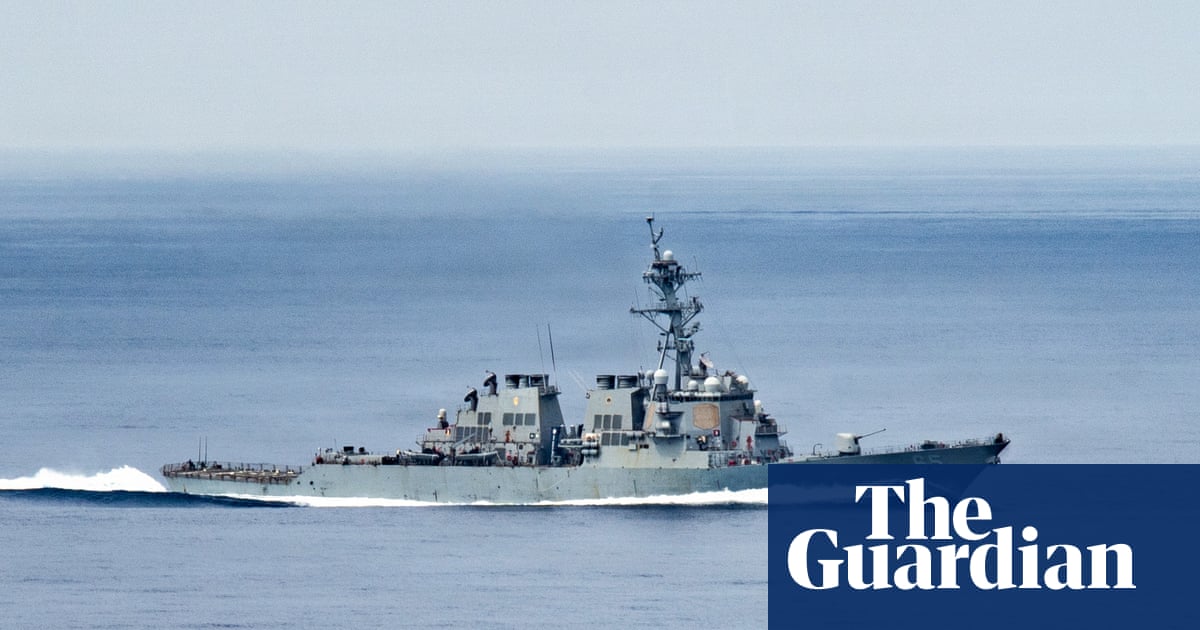
A U.S. guided missile destroyer reportedly spent four days adrift and without power in the South China Sea in July, raising concerns about the strain placed on deployed military members. The USS Benfold, an Arleigh Burke-class guided-missile destroyer that had been sailing with the George Washington aircraft carrier strike group, was reportedly towed to Subic Bay in the Philippines, according to US Naval Institute News, an independent military publication. The 10,000-ton destroyer lost power after what a U.S. 7th Fleet spokesman called “an engineering accident involving its generators,” resulting in a loss of power. That loss of power meant sailors were left without galley, bathroom and air conditioning services, Commander Matthew Comer told USNI News in a statement. Another ship, the USS Robert Smalls, the cruiser attached to the strike group, had to help provide meals to the crew. Comer said the Benfield lost power on July 24 and was towed on July 28. Power was restored two days later. “There were no injuries to the crew, who demonstrated resilience, courage, professionalism and unwavering steadfastness in their response,” Comer’s statement to USNI News said. The Guardian has contacted the 7th Fleet for comment. Separately, the Pentagon was ordered to scale back annual joint military exercises with South Korea as its war against Iran stretches the limits of U.S. aircraft carriers. Trump said on Sunday that he had instructed Pete Hegseth, the defense secretary, to “substantially reduce” joint military exercises with South Korea. The USS George Washington strike group was heading to the Middle East on Monday to relieve the USS Abraham Lincoln, an aircraft carrier that in recent days was the subject of reports by Navy Times and Stars and Stripes about multiple attempts by sailors to jump overboard after more than 200 days without a port stop. That has led Democratic lawmakers and military families to demand that the Trump administration answer questions about low morale, mental health problems and living conditions of crew members. Sen. Rubén Gallego, an Arizona Democrat and retired Marine, said Sunday on ABC News that the problems arose from the war with Iran that the Trump administration started in February but has been unable to resolve. The Lincoln was originally deployed to the Indo-Pacific before being ordered to sail to the Middle East in January. “The deeper, deeper problem here is that this administration didn’t plan for this war, didn’t plan how to get out of this war and didn’t really understand how this war was going to escalate,” he said. Hegseth has rejected the accounts, calling them “completely distorted.” “We make sure every ship, every crew, every captain has everything we can give them at every moment,” Newsmax said, adding that sailors in “austere conditions with fewer port stops” were doing an “incredible” job. Meanwhile, the navy said: “Based on the information available to the command, we have not identified an increase in suicidal ideation or suicide attempts reported aboard the ship.” The security of our nation.” In an op-ed published by the Wall Street Journal on Sunday, Adm. Brad Cooper, commander of U.S. Central Command, said he had been aboard the Lincoln in the Arabian Gulf a day earlier and addressed the sailors. Cooper said he had made the trip to “see how his more than 4,000 service members are doing and to thank them for their extraordinary resilience in the face of constant pressure” and called it “an amazing visit.” realities facing our deployed forces” and said that what he found “is that many elements of those stories are old news.” “The crew is tired, but they continue to fire at full speed,” he wrote. “History will record this deployment as one of the most operationally intensive and consequential of the modern era.” In a Monday X post, Cooper said that of the Navy’s 11 active aircraft carriers, Lincoln has one of the lowest numbers of mental health-related cases. “This doesn’t mean everything is perfect,” he wrote. “Find any of the nearly 4 million Navy veterans today and they will likely tell you that long-term sea service is not for everyone. It is exceptionally challenging and difficult, and each of us, including myself, reacts to stressors in different ways.” feeling of betrayal,” the sister of a Lincoln crew member said in that report. “These are frustrating, false and careless comments, and they are going to have many consequences for my brother.”