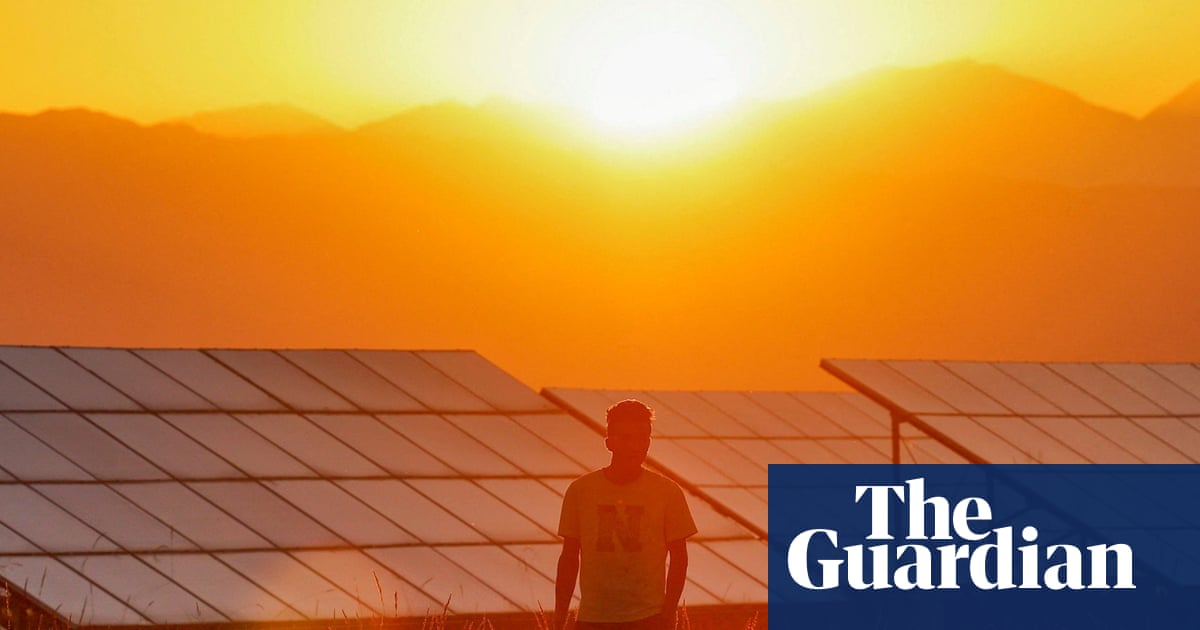
China is leading the world’s shift away from fossil fuels, and the rest of the world (including the United States) must now follow, former US Secretary of State John Kerry told The Guardian, as police observers wonder exactly how China will approach this year’s climate summit. As Cop31 gets underway (this year the climate conference is in Türkiye), there is much speculation about whether China will finally take on the leadership role it has long avoided. In its latest “five-year plan” adopted in March 2026, China pledged for the first time to “actively participate in and lead global climate governance.” Cop31 could provide the first signs that Beijing is willing to put that rhetoric into practice, something it has historically been reluctant to do. Green energy is a vital component of the export engine that has kept China’s sluggish post-pandemic economy going. The success of its exports contrasts with its inability to significantly boost overall domestic consumption, a structural weakness that has persistently bothered leaders. In 2025, clean technology exports exceeded $220 billion and should grow again this year; The world’s largest emitter is now the world’s leading provider of clean energy technology. China accounts for around 85% of the solar supply chain production capacity and 80% of the lithium-ion battery, and by 2025, almost 75% of electric cars will be made there.Electric cars imported from China at Southampton docks, UK. Photograph: Filby Photography/Alamy China’s smart moves now would position it as a key player in a future electro-state world order, persuade its rivals to cooperate and solidify its influence in the global south. Meanwhile, other countries, including the United States under Donald Trump, have lagged far behind. Kerry said they would lose out economically – as well as putting the climate in greater danger – unless they too embrace low-carbon energy and rapid electrification. “The only country that has accelerated enormously is China. The rest of the world is stumbling along while Mother Nature sends us more powerful signals every week, every day,” he said.[China] They suddenly realized that they were too dependent on oil and gas from elsewhere and decided they needed to be independent. Other countries, since the war in Iran and since the Strait of Hormuz was disrupted, have made a similar decision and are acting independently. There has been a massive increase in the deployment of renewable energy. Thank you, Donald Trump.” For autocratic states without free and fair elections, seeing the economic benefits reaped by China would be the spur to adopt low-carbon growth, he added. “They will see where the market is going and recognize where the cheaper alternatives are. Even they can read a spreadsheet and understand where costs are exorbitant. [in fossil fuels]”Right now, renewables along with storage, along with some transition gas, are cheaper and more effective than simply turning to fossil fuels.” He added: “The market has made its decision and globally it is moving towards electrons and electrostate status. People will turn to electricity and try to make it as clean as possible. That is the option that I see being implemented in many different places. It is unstoppable.” John Kerry, then special envoy for climate, speaking in Washington in 2024. Photograph: Jacquelyn Martin/AP China has already said it wants Cop31 to discuss the free flow of green technology against a backdrop of “intensified” geopolitical conflicts, widely seen as a reference to US and EU tariffs on items such as electric vehicles and Chinese solar products. Li Shuo of the Asia Society Policy Institute (ASPI) puts it this way: “In a world where climate was once considered a constraint on growth, China is increasingly faced with a singular question: Will it take a leadership role not out of obligation, but out of self-interest? 2024, a Carbon Brief analysis shows. Beijing sees the energy transition as “fundamental to economic modernization and energy security, with important implications for international influence,” said Kevin Tu of the Institute for Energy Studies. from Oxford. The wars in Ukraine and the Middle East and their effect on oil and gas supplies have only hardened that stance. The conflicts have also highlighted the geopolitical implications of a planetary shift towards green energy. “doer and ambitious working for the cause of global development” and state media frequently show Chinese renewable projects in countries ranging from Indonesia to Pakistan and Kenya. The value of green energy deals in China’s Belt and Road initiative in the first half of 2026 has already surpassed the total for all of 2025, a recent analysis showed. Those countries could be useful allies if China can bring the issue of tariffs into the picture. South Africa and other developing countries concerned about the costs and effects of climate-related trade measures on market access,” Tu said. According to ASPI’s Kate Logan, China has an aversion to prescriptive external targets, but is also trying to navigate the divergent interests of its global south partners. Yixian Sun, professor of sustainable governance at the University of Bath, said: “I still think there is a gap between Chinese policymakers’ views on the role China can play in global climate governance and the international expectations about the influence China should exert.” He says: “They have to be prepared to accept China’s leadership, and I don’t think this is the case, especially for countries in the global north.” Analysts will be watching China’s actions around climate finance commitments and support for a “just transition”, a framework designed to guarantee workers’ rights and livelihoods in the move away from fossil fuels. They will also look for signs that Beijing will bid for Cop33 in 2028; Logan, “China would be happy with a police officer who doesn’t necessarily produce something monumental, but gets a relatively cooperative result… so there’s no major drama.”