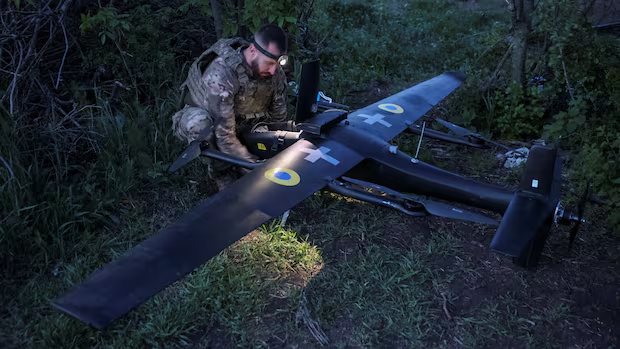
Listen to this articleEstimated 4 minutesThe audio version of this article is generated using AI-based technology. Pronunciation errors may occur. We are working with our partners to continually review and improve results. U.N.-backed talks this week on regulating AI in warfare ended Saturday, with nations agreeing to continue discussions but without a consensus on developing firm rules on how to control deadly autonomous weapons. Proponents of the regulations, including UN Secretary-General António Guterres, had called for a legally binding treaty within a short period of time on AI weapons, such as drones, that could identify and kill without human involvement. Discussions took place from Monday to Friday at a meeting of the Convention on Certain Conventional Weapons in Geneva. More than 100 countries that are part of the convention, including Canada, were expected to participate. Although most countries supported working toward the treaty, some military powers such as the United States and Russia resisted committing to binding rules that would limit them in developing high-tech weapons. This resulted in a watered-down agreement to “work out” a possible agreement on lethal autonomous weapons systems by 2028. Izumi Nakamitsu, the UN high representative for disarmament affairs, hailed a “significant achievement” but acknowledged a “glass half full or half empty” scenario, citing Guterres’s hopes for a legally binding agreement this year. However, some advocacy groups lamented the blocking of stronger language at a time when AI is increasingly becoming a factor. in deadly strikes. “States have agreed that it is enough to simply talk about it, for the 14th year, while these weapons enable atrocities,” said Max Tegmark, a machine learning specialist at the Massachusetts Institute of Technology and founder of the Future of Life Institute. Superpowers resist binding rules The result is disappointing but expected, said Branka Marijan, senior fellow at the Center for International Governance Innovation and senior researcher at the peace organization Project Plowshares. Marijan says military superpowers like the United States and Russia have resisted legally binding rules. “There is a real problem of political will here. There is simply no political will among the major militaries to have legally binding instruments and strict laws,” he said. AI is increasingly being used in conflicts around the world to gain the advantage in battle. Both Russia and Ukraine are using AI to track targets and plan attacks in the war entering its fifth year. In Ukraine, there are reports that autonomous drones operated by Russia have killed civilians, while Ukraine has also tested these types of weapons. The United States has made a major effort to increase the use of AI in combat and is testing advanced combat drones that fly themselves. SEE | The future of AI-powered military weapons: AI drone warfare is here. Should Canada participate? Governments are spending billions on the autonomous arms race. Should Canada join? For The National, CBC’s Jennifer Yoon examines the future of AI-powered military weapons, what they mean for international humanitarian law and where Canada fits in. The need for regulation has become more urgent as the world sees this “incredibly dangerous move” toward the development and deployment of increasingly capable autonomous weapons systems, without safety barriers, Marijan said. “I think there are extreme scenarios, but there are very immediate risks and concerns when you think about the fact that every country could deploy these systems now and there are no real limitations,” he said. CBC News has contacted Global Affairs Canada and the Department of National Defense for comment. In a statement sent to CBC News earlier this month, the Department of National Defense said the Canadian Armed Forces supports the development of autonomous functionality on the condition that it is “operated within a responsible chain of human command and control and is committed to upholding the reliable and lawful use of such weapons systems.” Canada was among countries that agreed to a declaration on how to govern the use of artificial intelligence in warfare at a military AI summit held in Spain in February. In 2025, Canada also supported a UN resolution calling on countries to lay the groundwork for possible negotiations on a treaty regulating the use of lethal autonomous weapons systems. The U.N.’s Nakamitsu called on countries to start working toward a deal as soon as Monday and “start thinking about how to become as strong as possible.” [an] instrument to prohibit and regulate lethal autonomous weapons systems”.