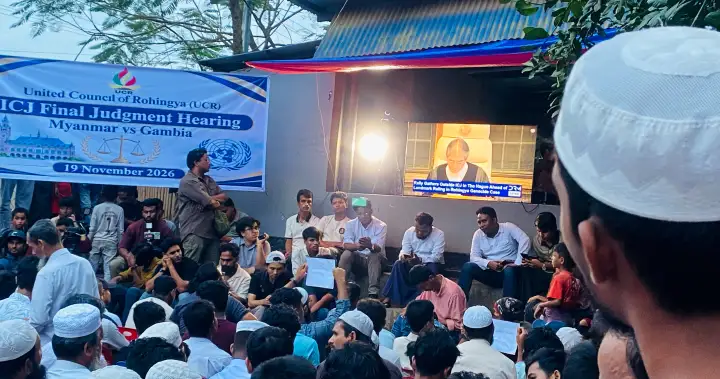
Myanmar’s government on Friday dismissed a landmark ruling by the United Nations top court that found the country guilty of genocide against its Rohingya minority as “unjust,” while opponents called on the international community to live up to its obligations to ensure justice is done. Khine Khine Soe, a spokesman for President Min Aung Hlaing, noted that the judges had only voted nine to six on Thursday to find that Myanmar committed genocide against the Rohingya Muslim minority in a brutal military operation in 2017. “Not all 15 judges agreed with the decision,” he told reporters in the capital, Naypyitaw. “So it wasn’t a unanimous decision. I would say it was unfair.” The ruling by the Hague-based International Court of Justice (ICJ) was the first time the court ruled that a state committed genocide. Myanmar’s government has denied the allegation, saying it acted against insurgents in the 2017 military operation in northern Rakhine state. Story continues below ad 2:47 World Court begins hearing on Myanmar Rohingya genocide case 2017 military crackdown killed thousands The case centered on the military’s so-called “clearance operations” in Rakhine state in 2017, when Aung San Suu Kyi’s democratically elected government was in power. Min Aung Hlaing, who was commander-in-chief at the time, seized power from Suu Kyi in 2021 and has since consolidated his control of the government, being elected president earlier this year in a vote that critics say was neither free nor fair. Story continues below ad The country is now embroiled in a bloody civil war, with pro-democracy and other militias fighting the military. Get daily national news Get daily Canadian news delivered to your inbox so you never miss the day’s top stories. The militant Arakan Rohingya Salvation Army, or ARSA, whose 2017 attacks on government outposts in Rakhine state sparked the Myanmar military’s devastating crackdown, called the ruling an “important step toward justice” in a statement on Telegram. The court said evidence showed Myanmar forces killed about 10,000 Rohingya in the campaign in which the military was accused of committing mass rape and murder, and razed thousands of homes. 1.2 million Rohingya refugees now live in Bangladesh, mainly in overcrowded camps across the Cox’s Bazar district, where they endure harsh conditions marked by fire risks, infectious diseases, monsoon landslides, inadequate sanitation and strict work restrictions. Activists say the ruling is a first step. Nay San Lwin, an activist with the Arakan Rohingya National Council, who now lives outside Myanmar, said this was just the “first victory on our path to the final: returning to our homeland and living there in peace and dignity.” “Without action and support from the international community, the court’s order will remain nothing more than a declaration,” he told The Associated Press. “Each country must help in any way it can.” ARSA stressed that refugees must be allowed to return home safely and that those responsible must face justice. “We call on the United Nations and the international community to ensure that Myanmar complies with the Court’s ruling and that justice does not remain on paper,” the group said in a statement signed by “Ustad Khalid Junun,” described as its chief of general staff. More on the world More videos The Rohingya Solidarity Organization, or RSO, a rival militant group, issued a similar statement. ARSA and RSO have been sidelined since 2017 due to repression by Myanmar authorities and infighting. They are now engaged in three-way fighting in Rakhine, where the Arakan Army, a Buddhist-dominated group seeking autonomy for the state, is fighting the Myanmar army but has also been accused of attacking the Rohingya. The Arakan Army did not respond to a request for comment on the court decision. Obstacles to Rohingya return In its ruling, the court ordered Myanmar to commit to allowing the Rohingya “a safe, voluntary and dignified return to their place of residence.” It also ordered Myanmar to investigate, prosecute and punish people who have committed genocidal acts and pay compensation to the Rohingya. The amount will be decided in subsequent court proceedings. Khine Khine Soe did not address those demands, but Myanmar was generally considered unlikely to comply. He said Myanmar would respond once it reviewed the extensive court documents. “Since this is an international case, we will make our position known,” he said. He also questioned the court’s jurisdiction to impose conditions, referring to a statement Thursday by U.S. President Donald Trump, Russian President Vladimir Putin and Chinese leader Xi Jinping at their historic trilateral meeting in China, in which they said that “the International Criminal Court and other similar bodies should not abuse their jurisdiction.” “The main point is that the ICC and similar international institutions must not abuse their judicial authority.” Khine Khine Soe told reporters. “Given that three (of) the world’s major nations have issued statements on this matter… you can think about it yourselves.” Chinese Foreign Ministry spokesperson Guo Jiakun said on Friday that while the country was willing to “play a constructive role in advancing the repatriation of displaced people from Rakhine State,” China is concerned about issues such as overreaching of jurisdiction and broad interpretations, and we believe such practices are not conducive to the resolution of disputes. The Unity Government, the main organization coordinating opposition to military rule in Myanmar since the military’s takeover in 2021, welcomed the ICJ ruling and said it respected the court’s authority and its ruling. He also stressed that the pursuit of justice for the Rohingya must be accompanied by efforts to end ongoing military violence against civilians across Myanmar.