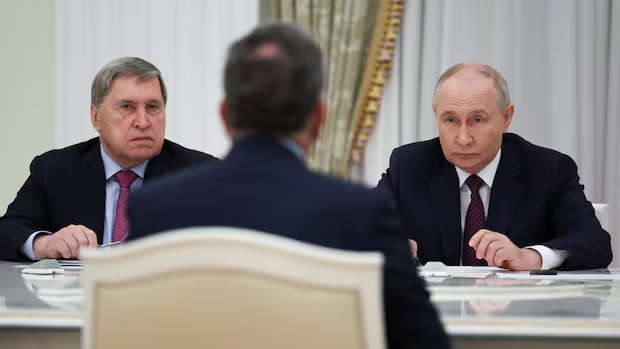
Listen to this articleDear 5 minutesThe audio version of this article is generated using AI-based technology. Pronunciation errors may occur. We are working with our partners to continually review and improve results. U.S. President Donald Trump’s envoys met with President Vladimir Putin on Thursday as Washington sought new momentum in peace efforts after two days of U.S.-brokered negotiations between Russian and Ukrainian delegations. Steve Witkoff and Jared Kushner, who is also Trump’s son-in-law, mediated the talks in Abu Dhabi, the capital of the United Arab Emirates, the first direct discussions between representatives of Moscow and kyiv in nine months in a push for peace. The two days of talks that ended Wednesday produced no major breakthroughs, apart from an agreement to exchange a large number of prisoners, the exact number of which has yet to be announced. Kushner and Witkoff met with Putin at the Kremlin and plan to fly later to Dublin, Ireland, for talks with Ukrainian President Volodymyr Zelenskyy, as Moscow’s full-scale invasion approaches the five-year mark. Kushner said one of the goals of the meeting with Putin was to get the Russians the United States and Zelenskyy want Europe to appoint a single person to negotiate with Moscow. But Moscow does not want European countries involved in direct negotiations, complaining that they are financing and supplying Ukraine’s war effort. Europeans are concerned about Russia’s behavior and broader intentions on the continent, and whether the United States will be too accommodating to the Kremlin’s demands.LISTEN | Reuters correspondent Dan Peleschuk on Ukraine conscription controversies: Front Burner 21:55 Ukrainian conscription in the crosshairs Last week, more than 100 people rioted outside a compound near kyiv that was being used by the Ukrainian National Guard, alleging that the army was abusing new recruits inside. Videos of the incident have gone viral and unverified accusations of a “neo-Nazi torture chamber” have spread on social media. Evidence is now emerging that this incident may not have been as organic as it seemed, that it may have been orchestrated by provocateurs. But it has highlighted the very real anger in Ukraine over the use of conscription. Today we’ll take a look at recruitment practices in Ukraine and the backlash against them, with Dan Peleschuk, Reuters correspondent based in kyiv. For Front Burner transcripts, visit: https://www.cbc.ca/radio/frontburner/transcripts [https://www.cbc.ca/radio/frontburner/transcripts]Putin warns again against European troops Many in Europe see Moscow’s inclusion in discussions about postwar European security as an unwanted concession to Putin, who has described NATO’s eastward expansion as a major threat to Russia’s security. Putin has demanded that transatlantic alliance troops withdraw from Russia’s borders. Some analysts say negotiators may be seeking to grant Russia concessions on NATO strategy in exchange for peace in Ukraine, a possibility that alarms European leaders. Putin reaffirmed to US envoys Moscow’s rejection of any presence of European troops in Ukraine in a post-war scenario, saying that Russia sees them as a threat to its security and warns that they would be legitimate targets. He also said Russia views its border with Ukraine as the line of control, a reference to Moscow’s claim to the four Ukrainian regions that Moscow annexed in 2022 but never fully captured. Zelenskyy is in Dublin for a meeting of more than 40 European countries that also includes NATO Secretary General Mark Rutte. Canadian Prime Minister Mark Carney was also present. Rutte said the United States, Europe and Ukraine are “very aligned” on what security guarantees should look like, following a meeting in Paris in January. “But now, of course, we need the peace agreement, or at least a ceasefire,” Rutte said. Ukrainian President Volodymyr Zelenskyy, with French President Emmanuel Macron, center, and Canadian Prime Minister Mark Carney as they pose for a photo with other leaders at the European Political Community (EPC) Summit in Dublin, Ireland, on Thursday. (Peter Morrison/The Associated Press) Zelenskyy called the proposed prisoner exchange a positive step, but also insisted that Ukraine would not hand over Russian-occupied territory in exchange for peace. Russia and Ukraine have occasionally exchanged prisoners, but both sides remain too far apart on their terms to agree to a deal. Amid negotiations, fighting continues along the 1,200 kilometer front line. The attacks aim to deny civilians heat, electricity and running water, undermining public morale in what kyiv calls a “weaponization of winter.” Zelenskyy says Starshield service disrupted again Ukraine is experiencing another slowdown in the U.S. Starshield system — SpaceX’s military-grade version of the Starlink satellite internet service — which the country needs to defend against Russian attacks, Zelenskyy said Thursday on social media. Military units have recorded “significant disruptions,” including speed restrictions limiting their drones to 161 kilometers per hour, Zelenskyy said. He added that a military investigation established that the restrictions were not random errors. Ukraine uses Starlink and Starshield to intercept Russian drones and launch its own medium- and long-range attacks. Last month, limits on Ukrainian drone speeds severely disrupted operations and alarmed officials in kyiv who fear U.S. support could wane. Firefighters work Thursday at an apartment building in kyiv that was damaged after a Russian drone attack. (Gleb Garanich/Reuters) SpaceX Chief Executive Elon Musk acknowledged that his company had limited Starlink Internet service in Ukraine for about a week, saying the system could not be used for offensive attacks against Russia. Zelenskyy said in Dublin that speed limits cover operations in Russian-occupied parts of Ukraine and that kyiv is trying to find out from U.S. officials what is going on. “If someone in the United States is making decisions that basically treat Ukrainian territory as if it were not Ukrainian, then this tells us where things are going,” he said. Russia’s Defense Ministry said its air defenses shot down 71 Ukrainian drones overnight. Its forces attacked a drone manufacturing plant in kyiv and three other facilities producing missile fuel and drone components in the area around the Ukrainian capital, the ministry said. Russia launched missiles and 123 drones, 73 of them aircraft-powered drones, into Ukraine overnight, the Ukrainian air force said. Attacks were recorded in 17 locations, he said.