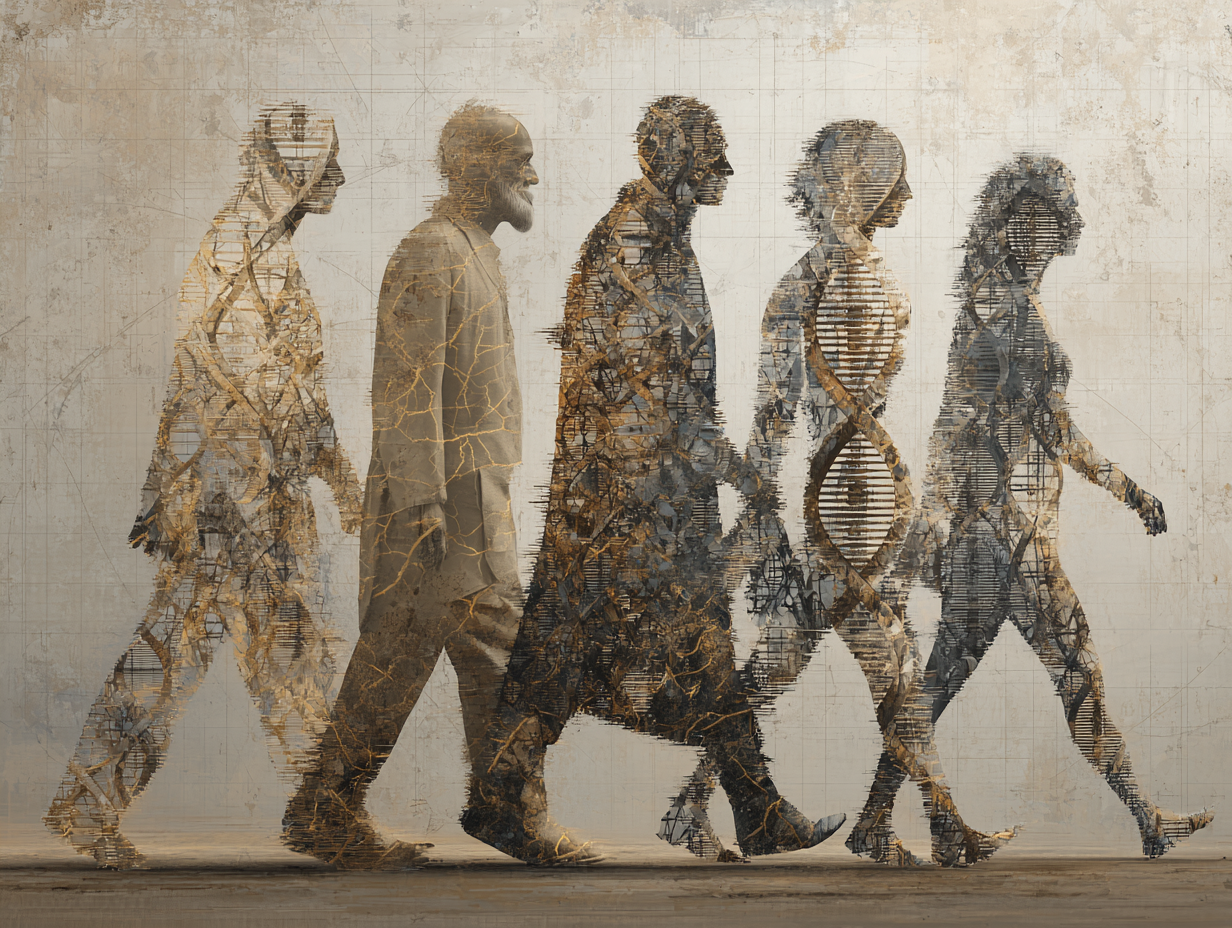
AI generated illustration. Credit: ZME Science/Midjourney. Some scientists say humans may be entering a new phase of evolution, one in which culture is becoming more powerful than genes in shaping our survival and future. At the heart of that idea is a provocative idea from University of Maine researchers Timothy Waring and Zachary Wood. They argue that cultural systems, from medicine and education to technology and institutions, are increasingly doing the adaptive work that natural selection alone once did. But a subsequent peer-reviewed critique questions whether this really amounts to an evolutionary transition comparable to the emergence of multicellular life or eusocial insects. So what’s going on? Cultural change over genetic change In their 2025 paper published in BioScience, Waring and Wood present a surprising hypothesis: Humans may no longer be evolving primarily by genetic means, but increasingly through cultural inheritance. They argue that cultural systems, agricultural techniques, legal institutions, medicine, and technology can respond to many adaptive problems much more quickly than genetic evolution. “Human evolution appears to be changing course,” Waring said when the paper was published. “Culture is driving evolution at a pace that genes simply cannot match,” says Wood, underscoring the argument that technological and cultural advances can adapt to environmental challenges in a fraction of the time it would take genetic mutations to do the same. ×Thank you! One more thing… Please check your inbox and confirm your subscription. Perform medical interventions such as glasses or cesarean sections. These are cultural solutions that can change the consequences of biological variation without waiting for genetic mutations to spread throughout the population. Waring and Wood argue that such adaptations can therefore “prevent” genetic evolution. Their article offers cesarean sections and reproductive medicine as examples where cultural practices can alter or relax genetic selection. A coupled evolutionary transition in heredity and individuality caused by the role of culture in long-term human evolution is characterized by a positive feedback between the power of culturally organized groups and the adaptive capacity of culture in relation to genetic evolution. Credit: Waring and Wood. The shift from genetic to cultural evolution may not be as sudden or dramatic as flipping a switch. It is a gradual process that has been underway for thousands of years. From the rise of agriculture to the development of modern institutions, culture has been a major driving force in human history. But what Waring and Wood propose is that this trend is accelerating, to the point that culturally inherited solutions increasingly intervene before genetic adaptation has a chance to do so. The affirmation of the superorganism Cultural inheritance is not parallel or analogous to genetic inheritance. While genetic material is physically replicated and transmitted directly, cultural memory is not replicated or transmitted. Instead, cultural traits are transmitted through their influence on the observable phenotype (e.g., behavior) and active processes of inference and imitation on the part of the learner. Credit: Waring and Wood. The boldest part of Waring and Wood’s argument is that humans may be moving toward something resembling a cultural “superorganism.” As people become increasingly dependent on shared institutions, technologies, and systems of cooperation, they suggest that the group could become a more important adaptive unit. In that sense, human societies could begin to resemble highly integrated biological collectives, such as colonies of ants or bees, where survival depends largely on the functioning of the whole. While the concept of human cultural evolution is not entirely new, the idea that we are witnessing something that changes the very nature of what it means to be human is much more ambitious. Waring and Wood suggest that the change in heredity may be accompanied by a change in human individuality. Basically, just as previously independent cells integrated into multicellular organisms, they propose that culturally organized human groups could take on an increasingly important evolutionary role. Human societies certainly display some suggestive features: extensive cooperation among unrelated people, elaborate divisions of labor, specialized institutions, and dependence on shared infrastructure. The BioScience article argues that an increasing fraction of human life is mediated by culturally evolved group-level practices and technology. But whether this turns a society into an evolutionary “individual” is exactly where the scientific disagreement begins. In October 2025, another researcher, Nejad Kourki, published a peer-reviewed critique of attempts to apply the framework of evolutionary transitions in individuality to human societies. Their central objection is that the evolutionary biological transition into individuality (ETI) does not simply involve cooperation, specialization, or dependence. The newly formed collective also becomes an entity that reproduces and participates in natural selection at the higher level. Human societies, he maintains, generally do not possess this autonomous reproduction at the group level. From that point of view, a nation, institution, or society could behave like an organism without literally becoming an evolutionary individual analogous to a multicellular animal or an ant colony. The future of human evolution: a cultural superorganism? Waring and Wood are aware of this long-standing problem. His hypothesis attempts to circumvent it by arguing that humans are undergoing a special transition in both heredity and individuality. Cultural inheritance can accumulate adaptive information at the group level even without the type of group genetic selection found in classical biological transitions. “We may be entering a future in which cultural evolution is so advanced that it begins to control not only the environment we live in, but also the very way we reproduce and evolve,” Waring says. While this is still debated, the implications of the duo hypothesis are far-reaching. If human survival and well-being increasingly depend on the cultural systems around us, what happens to individual genetic evolution? Researchers envision a possible long-term trajectory in which culture takes on an increasing role in determining human outcomes. Genetic engineering and assisted reproductive technologies already show one way in which cultural institutions can directly intervene in biological reproduction, although these technologies themselves depend on a highly specialized scientific and social infrastructure. But none of this proves that humanity is destined to become a superorganism. Even Waring and Wood explicitly describe the future part of their proposal as speculative and say that whether such a transition will ever be completed is beyond current scientific ability. They also emphasize that nothing in human evolution makes the outcome inevitable. But Nejad Kourki’s view is that the ETI framework itself may simply be the wrong explanatory tool for sociocultural change, even if human history contains genuine “major transitions” in organization, technology, and cooperation. No one knows what comes next. Waring and Wood originally outlined a program to quantitatively test their hypothesis. Their proposed measures ask, among other things, how much heritable phenotypic variation is increasingly attributable to culture rather than genes and to what extent individual evolutionary success depends on group-level systems. That empirical phase remains a work in progress. During a 2026 fellowship at the Konrad Lorenz Institute, Waring described a project aimed at developing formal models, testing the theory with modern, deep-time data sets, and designing unbiased estimates of those transition metrics. The accompanying talk acknowledged that empirical research on human evolutionary transitions remains limited. This is important because many of the observations invoked by the theory (increasing social complexity, reliance on medicine, declining fertility, expansion of institutions) may have multiple explanations. Demonstrating that these trends occur is not, by itself, sufficient to establish that they are manifestations of a global evolutionary transition. ETII’s distinctive predictions have yet to outperform competing explanations. Waring and Wood also caution that evolutionary language should not be confused with moral progress. His article explicitly rejects treating technologically richer nation-states as “more evolved” or a hypothetical cultural superorganism as ethically superior. “We’re not suggesting that richer societies with better technology are ‘better’ than others,” Wood says. “Culture evolves in both positive and negative directions, and it is important not to assume that this transition will always result in a fairer or more equitable society.” Ultimately, the theory remains intriguing for the same reason it remains unsolved. Culture clearly changes the environments in which human genes succeed or fail, and human lives depend to an extraordinary degree on knowledge and institutions inherited from other people. What remains undecided is whether these events mark a true transition in evolutionary individuality, or whether the superorganism is a useful metaphor being asked to do too much biological work. Updated September 25, 2026: This article was originally published on September 19, 2025. It has been revised to include a subsequent peer-reviewed critique on the application of evolutionary transition theory to human societies, the status of ongoing efforts to test the hypothesis empirically, and additional context on comparisons between cultural and biological rates of change.