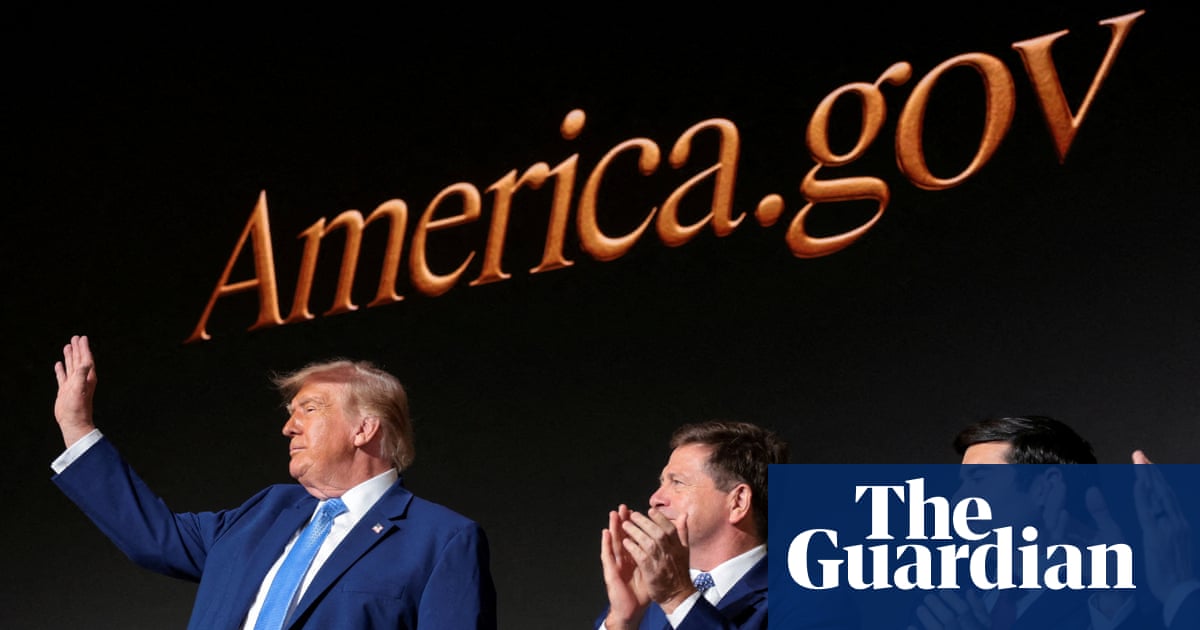
Donald Trump, in a development that could almost come from a Greek tragedy, appears to have invented something that is willing to do what no one in his orbit will: tell him the truth. The president launched America.gov on Tuesday, an artificial intelligence platform that the White House says will make it easier for Americans to interact with the federal government and eventually complete services like renewing passports and enrolling in Medicare. At the heart of the website is a chatbot. You introduce questions. It gives you answers. Unfortunately for Trump, America.gov – which, according to the executive order he signed, is a place where Americans can “receive accurate answers” to all kinds of questions – is providing the kind of answers he won’t want to hear. He’s willing to debunk his false claims about all sorts of things, including election fraud, inflation, and the impact of wind turbines on whales. I would really recommend trying it, like I did on Tuesday. I started by asking Trump’s star product: Who won the 2020 election? Trump famously and wrongly maintains that it does. America.gov has no time for such claims. “Joseph R Biden Jr won the 2020 US presidential election,” the robot said, before listing the number of electoral college votes Biden won with. Below, I tested some of Trump’s most recent claims. This week the president said that people were “twice as rich as [they] They were a short time ago.” Does America.gov agree? “No. “Federal Reserve data does not show that the wealth of American households has doubled since January 20, 2025,” it said. “The Fed’s Economic Well-being of American Households in 2025 found that 73% of adults are ‘doing well’ or ‘living comfortably,’ unchanged from recent years, not a doubling of typical household finances.” Again, America.gov disagreed with its creator. “No. The Bureau of Labor Statistics (BLS) Consumer Price Index data does not show that January 20, 2021, and January 20, 2025 saw the worst inflation in U.S. history.” There are many more examples. Trump’s bot denied his claim, made in a recent speech to the United Nations, that the United States and Venezuela have 60% of the world’s oil. He said there was no widespread voter fraud in the U.S. election. 2020, in contrast to Trump’s repeated statements: The bot refuted Trump’s claim, made when he launched America.gov on Tuesday, that no president other than him had refused to accept a government salary. It was also happy to weigh in on issues that might seem trivial but are close to Trump’s heart, for example, attendance at his inauguration in 2017. At the time, Trump’s team said it had attracted “the largest audience ever to witness one.” inauguration, period, both in person and around the world.” a This Week in TrumplandA deep dive into the policies, controversies and oddities surrounding the Trump administration after promoting the newsletterAmerica.gov said: “Official sources do not support that [2017] had the largest in-person crowd of any US inauguration… The Joint Congressional Committee on Inaugural Ceremonies lists Barack Obama’s January 20, 2009 ceremony as having the largest attendance of any presidential inauguration in US history and the largest attendance of any event in the history of Washington, DC. I don’t find that wind turbines (‘windmills’) drive whales ‘crazy.'” He added, to be completely clear, that windmills don’t “drive whales crazy.” So who do you believe? A president who, according to the Washington Post, made 30,573 false or misleading claims during his first term? Or his artificial intelligence platform, which taps 29,000 websites to formulate its answers? Americans encouraged to use what Trump himself has hailed as “the ultimate product” can make their own decisions.