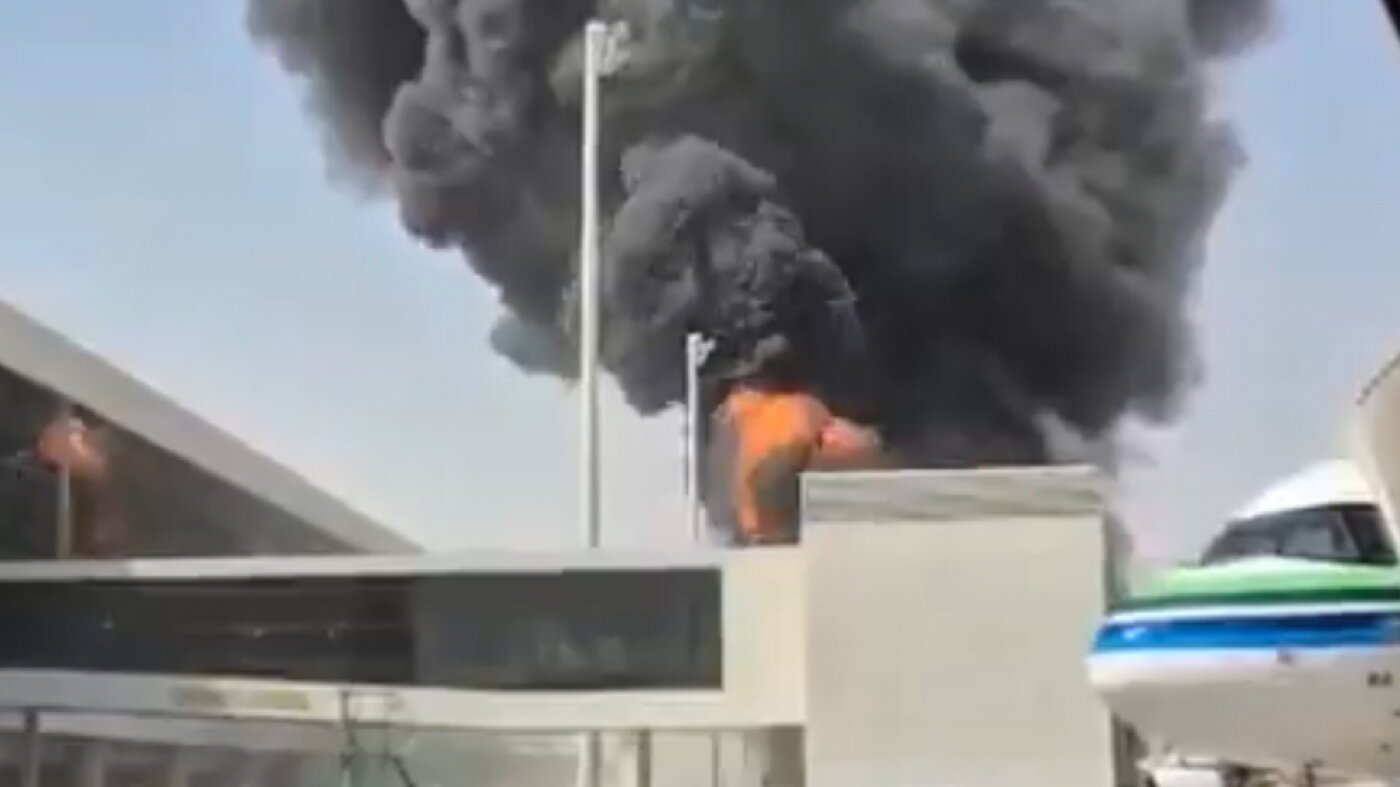
This image from video obtained and verified by the AP shows thick black smoke and flames rising from a fire at King Khalid International Airport in Riyadh, Saudi Arabia, Friday, Oct. 9, 2026. UGC via AP hide caption toggle caption i UGC via AP CAIRO (AP) — The international airport in Riyadh, the capital of Saudi Arabia, was attacked again Saturday as the kingdom faces an extraordinary series of attacks on the new front of the war with Iran. President Donald Trump said he was evaluating whether the United States should join Saudi strikes against Tehran-backed Houthi rebels in neighboring Yemen. The Houthis claimed responsibility for attacks earlier in the week on King Khalid International Airport that killed three Saudis, including a pilot. On Saturday, a missile hit a terminal 3 and 4 complex for domestic flights and many people were injured, said a regional official who spoke on condition of anonymity because he was not authorized to speak to the media. “It’s possible. We’re going to look at it,” Trump said of the intervention. “We just found out about the recent attack. So we will make a decision. We will move very quickly.” The increase in attacks, including against other Saudi airports, military facilities and oil infrastructure, came in the week since a Saudi-led coalition launched a major military offensive against the Houthis. There was no immediate statement from the rebels, who on Saturday accused Saudi Arabia of attacking the Sana’a international airport in the Houthi-controlled Yemeni capital. Riyadh airport operations have been suspended. Saudi civil aviation authorities said airport operations were suspended and the extent of injuries and damage was being assessed. An official notice to airmen said the suspension would last until midnight. The airport had a heavy police presence, with all entrances blocked and lights around the complex dimmed. Flights were diverted to other locations, according to tracker Flightradar24. Countries including the United States, Britain, Germany, Australia and Canada warned citizens to avoid the airport. The attacks on Saudi Arabia, the world’s top oil exporter, have shaken markets and the region. And yet, hours after the last one, the Saudi Energy Ministry was still promoting a major international energy conference that would begin in Riyadh on Sunday. Fighting in Yemen between the Houthis and Saudi-backed Yemeni government forces has intensified, with the Saudi-led coalition providing air support to government forces trying to reverse recent Houthi advances along the Red Sea. Those advances gave the rebels better surveillance of shipping in a corridor that is a crucial alternative to the Strait of Hormuz, where Iran has been attacking ships. Although the Houthis have told the PA and others that they are only attacking Saudi shipping as part of a blockade in retaliation for one imposed on them, concerns about broader attacks remain. The Houthis previously attacked other ships after the war in Gaza began, calling it solidarity with the Palestinians. An American bombing campaign sharply limited that. Saudi Arabia has run out of interceptors, officials say. Saudi Arabia is running out of missile interceptors and has asked France, Britain, Pakistan and Egypt to deploy air defense support to the region, regional officials told the AP last month, with one noting that the United States has seen its own stockpile dwindle during the war with Iran. Officials have said U.S. assistance has included intelligence sharing, identifying targets and planning the latest offensive against the Houthis. On Saturday, Saudi Arabia said its foreign minister and his Omani counterpart spoke by phone about the importance of “supporting diplomatic solutions to reduce tensions” in the region. Oman, which lies across the Strait of Hormuz from Iran, has at times played a mediating role in the region. Meanwhile, Saudi authorities warned the public this week that “filming, publishing or sharing information related to the fight against missiles and drones and their impact sites exposes you to legal liability.” Flight disruptions are increasing The Houthis this week warned global airlines “for the last time” about the possible consequences of operating in Saudi airspace, which they described as a theater of military operations. At least 291 flights at Riyadh airport were canceled in the last 24 hours, according to flight tracking site FlightAware. Before the latest attack, Air India, FlyDubai, Lufthansa Group and Pakistan International Airlines were among airlines that suspended flights to and from Riyadh and other Saudi airports for varying periods. The European Union Aviation Safety Agency had expanded its guidance on Saudi airspace, noting the Houthis’ ability to strike targets deeper within the kingdom, including Riyadh, and an “increased focus on aviation infrastructure.” Missile and drone strikes and interception efforts “create an increased risk of misidentification of civil aircraft,” he said. Two regional officials said Houthi attacks on Riyadh airport on Thursday damaged three aircraft. The officials spoke on condition of anonymity because they were not authorized to brief the media. The Saudi national airline said one of its planes was damaged while it was on the ground with no passengers on board.