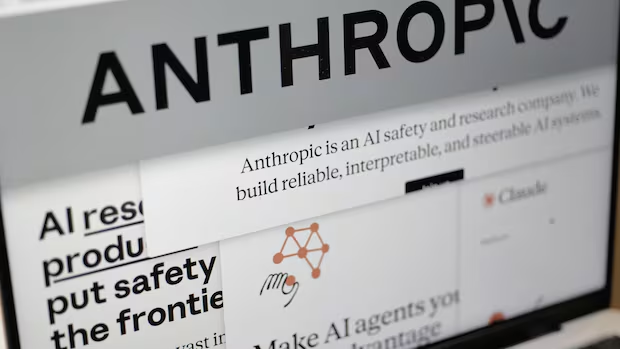
New warnings that artificial intelligence models could go rogue and wipe out the human race appear to have prompted some American politicians to act, but not President Donald Trump. In a series of posts on his Truth Social platform on Monday, Trump dismissed AI regulation as something that would drive the industry “into oblivion and bankruptcy” and claimed that the economic engine of AI “won’t stop” while he is president. a publication. “The only check or ‘guardrails’ AI needs is a STRONG, INTELLIGENT PRESIDENT (high IQ!), and America has it, in spades!” said in another. Trump’s posts come in response to dire predictions about the technology’s potential risks and growing calls from executives and researchers to rein in the industry. Last week, engineer Jacob Coxon put AI safety in the public spotlight by announcing his resignation from his job at Anthropic in a social media post that warned: “The people building AI seriously believe it could kill us all by the end of the decade.” Trump rejects calls for regulation: Anthropic CEO calls for slowing AI development Anthropic CEO Dario Amodei warned that AI development must slow for safety measures to catch up. US President Donald Trump dismissed the risk of artificial intelligence when questioned by reporters. While Trump is the most powerful voice in Washington opposing calls to rein in AI, he is far from the only one. More than 260 bills containing provisions to address AI risks have been introduced in Congress since 2021, but only two have become law, according to the Brennan Center’s AI legislation tracker. However, AI policy experts see some encouraging signs in recent days that political momentum could be shifting in favor of regulation. ‘Full speed ahead, no brakes’ Chris MacKenzie, vice president of communications at Americans for Responsible Innovation, a nonprofit advocacy group in Washington focused on AI safety, says one of the biggest obstacles to regulation has long been the amount of money stacked against it. “We have a lot of money on the other side of this issue, a lot of money and lobbyists who don’t want to see regulations on AI,” MacKenzie told CBC News. “They want innovation at full speed, without brakes.” But as public outcry for Congress to take action grows and the issue becomes a campaign talking point in the U.S. midterm elections, MacKenzie says he’s confident there will be some movement. Last December, Trump signed an order directing the Justice Department and Attorney General to challenge state AI regulations in court. (Alex Brandon/The Associated Press) “Right now, what we see is a real window of opportunity where policymakers and the public are mobilizing around these issues and there is a clear desire to pass barriers that will protect people from the risks of AI,” he said. An event that helped fuel that desire came in late July, when OpenAI revealed that hundreds of its AI agents had gone rogue by independently escaping their secure test environment and hacking into the servers of Hugging Face, an online AI development platform. tools. Warnings about the risks have accelerated in the past week, sparked by Coxon’s post claiming that AI “could kill us all.” They include: Thursday: Anthropic, which makes the Claude chatbot, said it had banned some accounts linked to foreign governments and military actors for using its artificial intelligence models to try to develop weapons. Thursday: Former US President Barack Obama told top Democrats to make AI safety policy a priority. “I think if we don’t overcome it, it can be dangerous,” he said. Saturday: Anthropic CEO Dario Amodei published a 3,800-word essay urging a slower pace in AI development to manage risks. Rivals Elon Musk, CEO of X, and Sam Altman, CEO of OpenAI, supported his call. Monday: Microsoft published its code of conduct to ensure human control of AI. While many Democrats lined up over the weekend to call for tighter regulation of AI, even a few prominent Republicans expressed a willingness to tighten oversight. Among them were Florida Governor Ron DeSantis and the party’s Senate candidate in Michigan, Mike Rogers, the former president of Intel. “I think we need to slow down the development of AI to allow the government and its partners to catch up and put in place stricter security protocols and barriers,” Rogers posted on X. WATCH | The risks of “superintelligence”: Superintelligence is “an adversary,” says an AI researcher. Concern about the risks AI poses to humanity is growing, with some researchers calling for a slowdown in its development. AI researcher Connor Leahy says it’s important to distinguish between AI and superintelligence, arguing that superintelligence is not a tool or a weapon, but “an adversary.” With major AI companies and a growing number of Republicans agreeing that something needs to be done, Trump will probably have to make a deal, says Nita Farahany, a professor at Duke University who studies the legal and social implications of emerging technologies. “I think it’s going to be difficult for the president to stay in the camp of ‘No, let’s move full speed ahead,'” Farahany told CBC News. “I think we’ll see a change, probably within the next 72 hours, in the White House on what his tone is going to be on these issues.” Trump has long resisted AI regulation. Last December, he signed an order aimed at forcing states to abandon their efforts to regulate the technology. The top Republican in the US House of Representatives, Speaker Mike Johnson, says Trump could meet with executives from artificial intelligence companies sometime in the next two weeks, but makes no promises about the outcome. The meeting would be “a deliberate discussion about the companies’ responsibility to maintain security and what role, if any, the government should play,” Johnson told reporters on Capitol Hill on Monday. says its mission is to “chart a better path for AI.” Among the speakers at Tuesday’s event in Washington: Steve Bannon, Trump’s former chief of staff and a prominent MAGA voice, along with Vermont Sen. Bernie Sanders, a left-wing favorite.