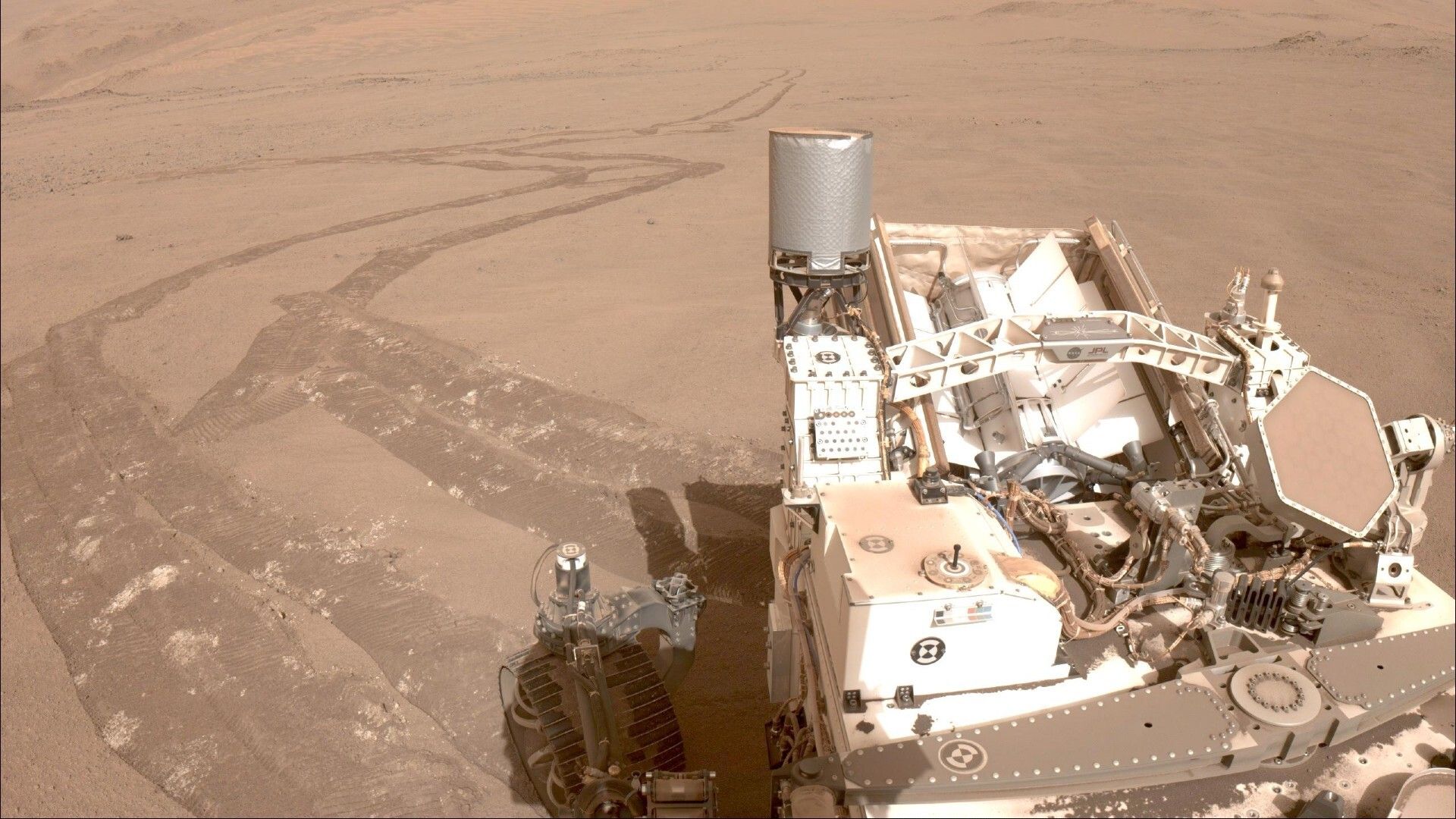
Follow Add us as a preferred source on Google Newsletter Subscribe to our newsletter Two of NASA’s Mars explorers are sidelined by technical glitches at the moment. The Perseverance rover and Mars Odyssey orbiter have withdrawn from scientific work due to technical problems, NASA announced Thursday (Nov. 19). NASA hopes that both will be able to return to work on Mars at the end of November. Communication problems for PerseverancePerseverance landed inside Mars’ Jezero Crater in February 2021, tasked with assessing the area’s potential to support past life and collecting dozens of samples for future return to Earth. He has done all this and more. The Perseverance team has determined that Jezero hosted a potentially habitable lake billions of years ago. And the car-sized rover has found a host of complex organic compounds in Martian rock, some of which could be signs of life (although testing this hypothesis fully will likely require bringing Perseverance’s samples back to Earth for analysis, scientists emphasize). Additionally, Perseverance just set a new distance record for driving outside of Earth, surpassing the mark set by its smaller cousin, NASA’s Opportunity rover (28.06 miles or 45.16 kilometers). Perseverance broke that record on October 11. However, just 19 days later, the mission team noticed a problem: the rover’s main UHF downlink radio, which it uses to send information to Earth, via data relay. satellites in Mars orbit – they could not send their usual “beats” to the main computer. Perseverance detected this problem autonomously and reacted as it was programmed to do: the six-wheeled robot switched to its backup UHF radio and entered a protective “safe mode,” shutting down all non-essential systems. The rover team recovered Perseverance from safe mode, but soon noticed another problem: “The backup UHF radio was transmitting at approximately half its expected power,” NASA officials wrote in an update Thursday. Perseverance’s handlers also stopped using that backup radio; The rover now communicates directly with Earth (without the aid of relay orbiters), sending signals to NASA’s Deep Space Network satellite dishes through its high-gain antenna. What to read next This path features lower data rates and the mission team wants to prioritize the delivery of diagnostic information. Therefore, they paused Perseverance’s scientific work, which includes observations made by its various cameras. The glitch may be disappointing to devoted Perseverance fans, many of whom have already noticed that the mission’s website has not uploaded any new raw images since November 7. But there’s no reason to panic, according to NASA. “The rover is stable and communicating with the team,” agency officials wrote in Thursday’s update. “The team is hopeful that the rover can return to science by the end of November, and NASA will provide more updates in the future as the team works on the issue.” Artist’s illustration of NASA’s Mars Odyssey orbiter orbiting the Red Planet. (Image credit: NASA/JPL-Caltech) Mars Odyssey loses another reaction wheel Mars Odyssey’s problem may be more serious: The orbiter, which arrived at the Red Planet in October 2001, recently lost the use of one of its reaction wheels. Odyssey has four reaction wheels, which help the spacecraft maintain its orientation in space. Three of the four must work to do this job, and Odyssey already lost a reaction wheel in 2013. This latest problem arose on November 4, when Odyssey entered safe mode. The orbiter remained in this protective posture until November 6 while mission team members diagnosed and resolved the problem. They have made some progress, and at one point managed to get the faulty wheel to move when commanded. “Further testing is underway to confirm whether the wheel is recoverable,” NASA officials wrote in Thursday’s update. Although it has been out of safe mode for two weeks, Odyssey has not yet resumed its scientific or data transmission work. (The orbiter has long helped NASA’s Mars surface craft send information back to Earth.) “The goal is for Odyssey to return to science and relay operations upon concluding these tests and analyzes during the last week of November, and NASA will provide future updates on status and schedule as the team learns more,” agency officials wrote in the update. If the reaction wheel is not recoverable, Odyssey’s days are numbered. The mission team will have to orient the orbiter using only its thrusters, and Odyssey has enough hydrazine fuel left to do so for a month or two, according to NASA. Odyssey’s mission has been a great success, regardless of what happens to the reaction wheel. The orbiter has operated on Mars longer than any other spacecraft and has made a number of important scientific contributions. “Odyssey created the first global maps detailing the composition of the Martian surface, which have become critical to Mars geologists,” NASA officials wrote in Thursday’s update. m) of the surface, including buried ice that could be useful for the first astronauts on Mars.