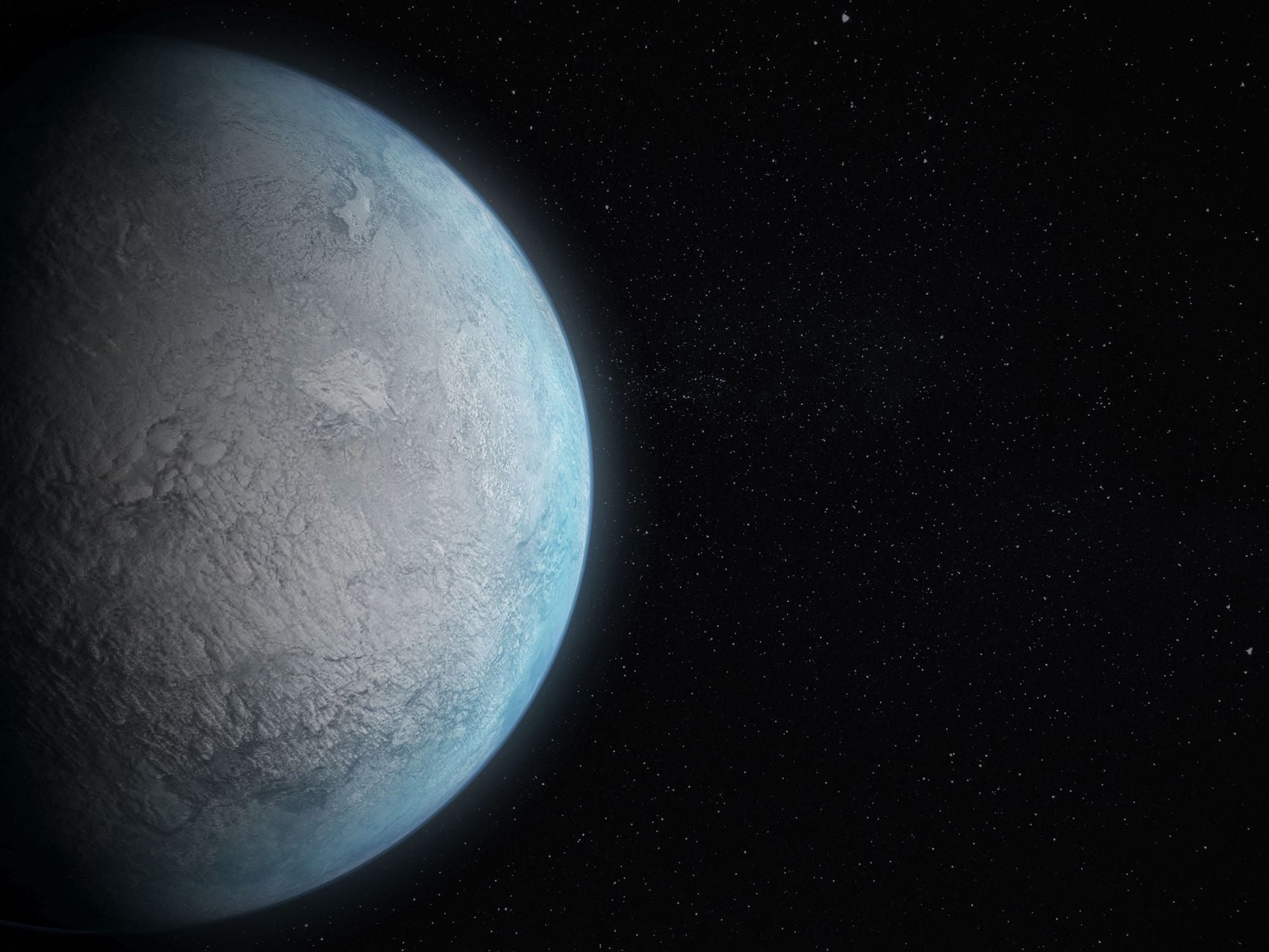
Neptune has 16 known moons, but hardly any conventional lunar system. Triton alone contains more than 99 percent of the satellite system’s mass, traveling backwards around the planet and leaving only a compact collection of small inner moons, faint rings and distant, irregular companions. That peculiar architecture has long signaled an ancient catastrophe. Triton probably formed elsewhere in the outer Solar System and was captured by Neptune, entering an orbit that destabilized the moons already there. Observations from the James Webb Space Telescope now give that dynamical reconstruction compositional proof. A Science Advances study published on July 29, 2026 found hydrated minerals on three inner moons and rings that appear to come from the interior of much larger bodies. A separate study by Webb published in May argues that Nereid may be the only original moon that escaped virtually intact. The result is not a photograph of Triton destroying Neptune’s first family of satellites. It is a history compiled from current orbits, infrared spectra and computer simulations. Each part carries a different type of uncertainty. Neptune’s lunar system looks like a sequel. The four giant planets are expected to form regular satellites within disks of gas and dust that surround them when they are young. Jupiter, Saturn, and Uranus still possess substantial families of moons that move in broadly ordered, prograde orbits near the equatorial planes of their planets. Neptune is different. Its largest moon, Triton, follows an orbit inclined at about 157 degrees, making it retrograde. As SpaceDaily has previously explained, Triton’s reverse motion and similarities to Pluto strongly suggest that it originated as an independent outer world of the Solar System. Capture is not as simple as Neptune pulling on a passing object. A free body typically accelerates toward a planet and then departs with enough energy to escape. Triton had to lose orbital energy, perhaps through an exchange involving a former binary companion. The precise capture route is not yet resolved, but its current orbit makes it very difficult to sustain an origin next to Neptune. Once captured, Triton would probably have occupied a much broader and more eccentric path than the one he occupies now. That orbit would repeatedly pass through the realm where Neptune’s original regular moons were expected to rotate. How a captured world could erase a family A large body moving in an elongated retrograde orbit is an efficient source of disorder. Repeated gravitational encounters with native moons could stretch their orbits until they intersect, ejecting some from the Neptune system and sending others into collisions. The destruction would also help transform Triton. Collisions and gravitational interactions with a debris disk could remove energy from its orbit, while tides generated within Triton and Neptune gradually reduced their eccentricity. The moon eventually settled into the narrow, nearly circular orbit seen today. Today’s inner moons could form from its consequences. The fragments would collide, lose energy, and gather into new bodies piled up in rubble. Neptune’s dusty rings could represent finer material from the same altered reservoir, later reshaped by further impacts and tidal evolution. This general scenario predates Webb. What he was missing was direct information about what the small interior moons are made of. Its weakness and proximity to bright Neptune made useful spectroscopy from Earth extremely difficult. Webb found material that small moons should not produce. Ryleigh Davis and her colleagues used Webb’s near-infrared spectrograph to observe Proteus, Larissa, and Galatea, along with combined light from Neptune’s rings. The three moons are among seven small satellites orbiting inside Triton. All three moons and rings showed broad and deep absorption of around three micrometers, showing the presence of hydroxyl-containing material. Interestingly, the spectra lacked the familiar bands expected from exposed water ice, even though icy material is common in this part of the Solar System. Larissa, Galatea and the rings also showed more marked absorption at 2.72 micrometers. Its shape is diagnostic of magnesium-rich phyllosilicates, a family of clay minerals that are produced when liquid water reacts with silicate rock. Proteus shared the broader hydrated signature but did not show the same strong clay band. These tiny moons are too cold and small to have sustained the prolonged internal water-rock reactions necessary to create so much altered material. Therefore, minerals appear older than the bodies that contain them. The main interpretation is that Neptune once had much larger icy moons. The heat of its formation and the radioactive elements allowed some of the ice to melt, water to alter the rocks, and the moons to differentiate into layers. When those bodies were destroyed, the material normally buried inside was exposed. A fraction later it accreted again into small moons and rings. What the July result establishes and what it does not establish Spectral detections are observations. The destroyed moons and their reconstruction are an inference that connects those minerals with the known dynamics of Triton’s capture. This inference is compelling because Triton already provides an event capable of demolishing a primordial satellite system. It explains Neptune’s missing large regular moons, the orbital evolution of Triton, the existence of a debris-rich internal system, and recently discovered deep interior minerals with a connected history. It is not the only story still allowed. The researchers point out that a large distinct Kuiper Belt object could have passed too close to Neptune and been torn apart by the tides. If that body had ever held liquid water inside, its remains could also contain phyllosilicates. The study also did not look at each inner moon individually. His compositional conclusions come from Proteus, Larissa, Galatea and Ring Light. Extending the same origin to the entire internal family is a system-level interpretation supported by dynamics, not a separate clay detection on each moon. SpaceDaily’s previous examination of Webb’s result took a closer look at why the clay acts as a record of dissipated heat. The broader meaning is that moons may be second-generation objects assembled from first-generation interiors. Nereid may be the only moon that escaped Nereid appears, at first, to belong to a different population. It travels in the most eccentric orbit of any known moon, moving almost seven times farther from Neptune at its most distant point than at its closest. These long, distant paths are often associated with objects captured by a planet. However, Nereid is a strange irregular satellite. With a radius of about 175 kilometers, it is unusually large, unusually close to its planet and unusually eccentric compared to other moons in that class. Its relatively bright, water-ice-rich surface had also withstood easy comparison with typical captured Kuiper Belt objects. Matthew Belyakov and his colleagues combined a near-infrared spectrum from Webb with dynamical simulations in a separate Science Advances paper published on May 20, 2026. They concluded that Nereid’s composition is inconsistent with the captured origin commonly assigned to it. The team then launched simulated native moons into regular orbits before allowing a newly captured Triton to disturb them. Triton cleared most of the model satellite system, but could push a survivor onto a path within about 10 percent of Nereid’s current semimajor axis and closest approach. This offers a coherent alternative: the Nereid formed around Neptune, avoided destruction, and was thrown into its extreme orbit during the arrival of Triton. It would be an intact exile from the system that produced the debris that now orbits closer to the planet. “Perhaps” remains essential The Nereid result does not establish a single biography. A specter can make an origin less plausible without identifying the moon’s birthplace beyond a doubt. A simulation that reproduces an orbit demonstrates a viable path, not proof that nature followed it. Therefore, the two 2026 documents are complementary and not interchangeable. The July study found signs of extensive aqueous alteration in material from the moon’s interior and rings. The May study found that Nereid’s composition and orbit may adapt to a displaced native survivor. Together they describe two possible outcomes of a catastrophe, but each conclusion is based on its own evidence. There are also survivors only in a limited sense. Nereid can preserve an original moon intact, while inner moons could preserve the original material after catastrophic processing. Neither is an intact time capsule. The surfaces are altered by impacts, radiation and the long evolution of the Neptune system. A story still waiting for an orbiter NASA’s current overview lists 16 known Neptunian moons, but only one spacecraft has seen any of them up close. Voyager 2 crossed the system in August 1989 and had hours for detailed observations rather than the years available to an orbiter. Webb has transformed the problem by separating faint infrared signatures next to a distant, bright planet. Still, laboratory spectra of candidate minerals at outer Solar System temperatures are needed to identify the remaining unknown absorptions. More observations could test whether the other inner moons share the same altered material and whether Nereid’s surface is uniform. A Neptune orbiter could map the compositions of individual moons, refine their masses and densities, study the rings as part of the same evolving debris system, and measure the Nereid during repeated encounters. Such data could distinguish a Triton-made debris disk from a disturbed intruder more decisively than remote specters alone. For now, Neptune’s moons have a plausible family history in two ways. Near the planet are small worlds that may have been rebuilt from shattered interiors. Further away is an eccentric moon that may have survived the destruction in its entirety. Triton is the likely interloper linking both stories, but Webb has provided evidence for the reconstruction, not the final verdict. About this articleThis article is for general information and reflection. It is not professional advice. For your specific situation, consult a qualified professional.