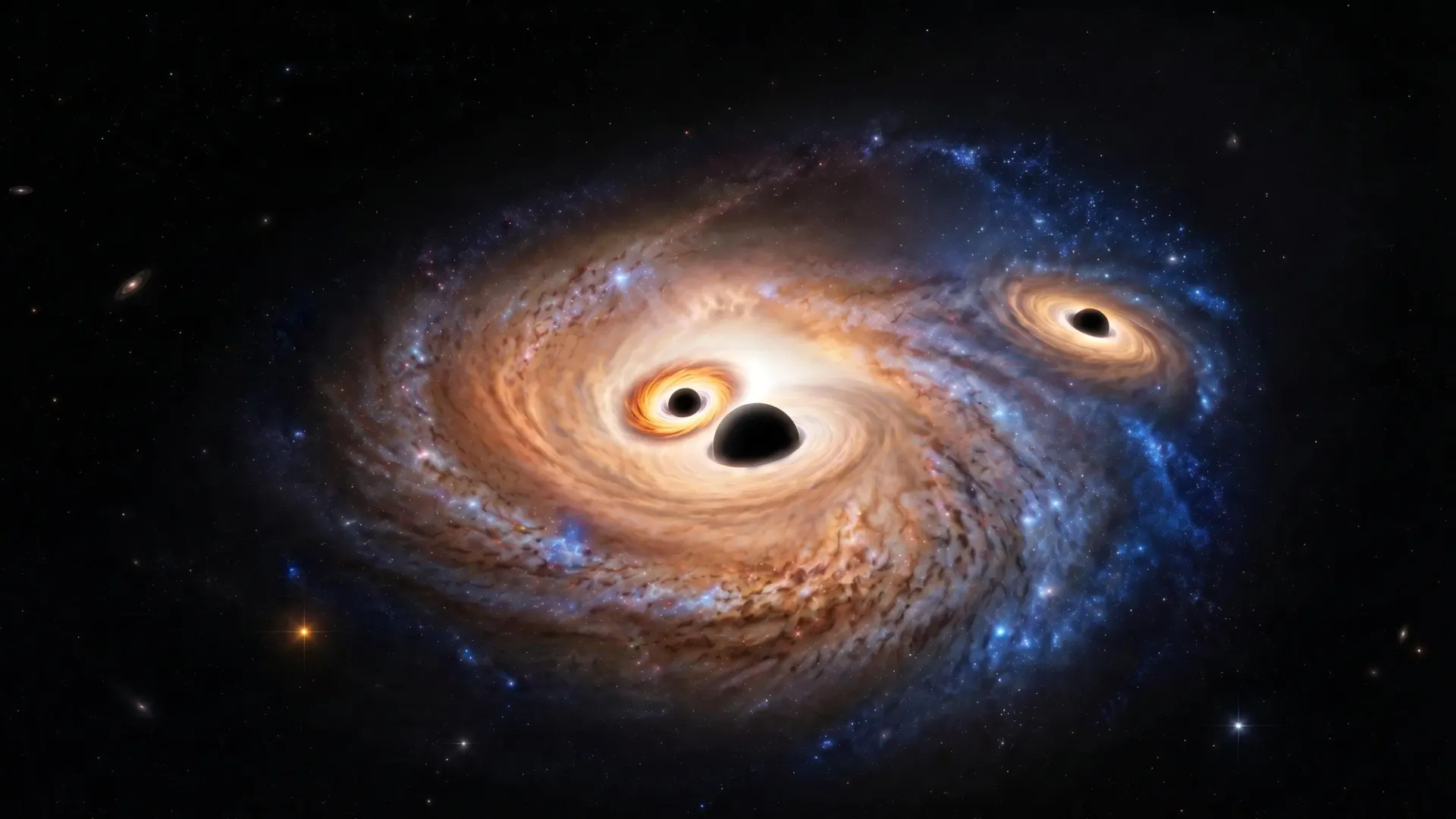
Astronomers have discovered three actively feeding supermassive black holes in a single galaxy more than 12.5 billion light years from Earth. The discovery, made by an international research team led by the Max Planck Institute for Extraterrestrial Physics (MPE), offers a rare glimpse into how huge black holes grew and interacted during the early stages of the universe. The black holes are located in a galaxy known as J0148-4214. All three are actively accreting matter, which spirals toward them through disks of gas and other surrounding materials. Because the galaxy is so distant, its light has traveled through space for about 12.5 billion years before reaching Earth. This means that astronomers are observing it as it existed just 1.2 billion years after the Big Bang. Over such vast distances, the expansion of the universe stretches light to longer, redder wavelengths. Astronomers measure this effect using a property called redshift. For J0148-4214, the researchers measured a redshift of z=5.02, allowing them to determine its remarkable distance. Three black holes in an ancient galaxy “This is the first evidence of three active black holes in a single galaxy in the distant Universe,” says Hannah Übler, research group leader at the MPE and lead author of the study. Two of the black holes lie near the center of the galaxy, separated by a projected distance of just 620 light years. The third is much further away, approximately 5,500 light years from the center. The discovery provides important evidence about how massive black holes formed in the young universe. “This suggests that processes in the early Universe were efficient at bringing together massive black holes, setting the stage for the massive black hole mergers we hope to detect with future gravitational wave observatories,” says Übler. Astronomers believe that galaxy collisions and mergers were common during the early history of the universe. As galaxies combine, their central black holes could also get closer and eventually merge. These mergers would produce increasingly massive black holes at the centers of newly formed galaxies, which could help explain how some grew to enormous sizes so soon after the Big Bang. How Astronomers Spotted Hidden Black Holes Researchers identified the three black holes by examining distinctive patterns in the light emitted by hydrogen gas. Near a black hole, powerful gravitational forces cause gas to move at extremely high speeds. These motions leave recognizable signatures in the light spectrum, allowing astronomers to detect black hole activity even when the objects themselves cannot be seen directly. At the center of J0148-4214, the team found a particularly complicated hydrogen emission pattern. The best explanation was the presence of two closely spaced black holes rather than a single source. To distinguish them, scientists used a precise measurement technique called spectroastrometry. By tracking subtle changes in the positions of spectral emissions across the galaxy, they were able to identify the locations of both central black holes, although the telescope was unable to resolve them as two separate points of light. The observations also revealed the third active black hole in the outer region of the galaxy. Three black holes with strikingly different masses The three black holes vary dramatically in size. According to researchers’ calculations, their masses are approximately 80 million, 600,000 and 2 million times that of the Sun. Surprisingly, the largest black hole is not the most aggressive feeding one. Its smaller neighbor, with a mass of about 600,000 suns, is accreting matter at a much faster rate. In fact, its estimated feeding rate exceeds the maximum predicted by basic black hole growth models (the Eddington limit). This unusually rapid growth may offer clues about how some black holes became extraordinarily massive during the relatively short time available in the early universe. “The JWST data allowed us not only to identify the three black holes, but also to estimate their masses, accretion rates and the stellar mass of the galaxy,” says Dr. Giovanni Mazzolari, second author of the study and MPE researcher. “We found a total stellar mass of about 1.3 billion suns, and black holes account for a significant fraction of that mass.” An ancient black hole merger is underway The two black holes near the center of the galaxy are expected to merge in the next few hundred million years. Their eventual collision could help produce an even more massive black hole, illustrating a process that may have been essential to the growth of the universe’s first cosmic giants. “These results are extremely interesting,” adds Roberto Maiolino, professor at the University of Cambridge and co-author of the study. “They suggest that the merger of black holes may be an additional and rapid route for their rapid growth in the early Universe.” The third black hole presents another intriguing puzzle. Located far outside the center of the galaxy, it could be a remnant of a previous merger that was pushed outward by a powerful gravitational recoil. Such a boost can occur when merging black holes emit gravitational waves unevenly, sending the resulting black hole in the opposite direction. Another possibility is that the third black hole is gradually moving towards the center of the galaxy, where it could eventually interact with the other two. James Webb reveals black holes that might otherwise remain hidden The discovery highlights the remarkable capabilities of the James Webb Space Telescope (JWST) for studying black holes in distant galaxies. In particular, the findings demonstrate the importance of integral field spectroscopy, which allows astronomers to examine how light and its spectral signatures vary in different parts of a galaxy. Using Webb’s near-infrared spectrograph in its integral field spectroscopy (NIRSpec-IFS) mode, the researchers were able to separate signals that would otherwise have appeared to come from a single black hole. Without that detailed spatial information, astronomers would likely have identified only one of the galaxy’s three active black holes. The results suggest that other distant galaxies may contain multiple growing black holes that have not been detected. Finding more of these hidden systems could help scientists reconstruct the history of black hole mergers and better understand how the universe produced its most massive black holes so early in cosmic history.