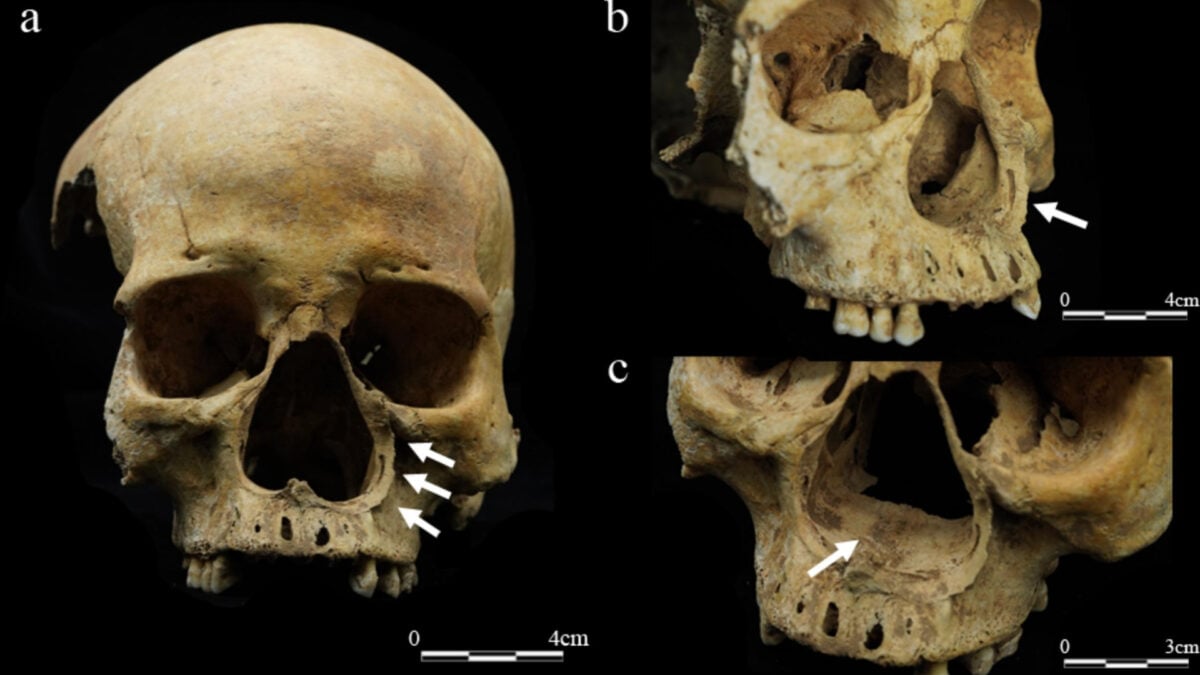
Literary records indicate that ancient China had five types of physical punishments. These included nasal amputation, although researchers had yet to find archaeological evidence of criminals subjected to this punishment… until now. In 2018, a team of Chinese archaeologists inspected an ancient cemetery in Sanmexia, Henan province. Of the many samples they recovered, one female stood out from the rest. Not only was she buried face down, but her facial skeleton also showed signs of damage and healing around the nose, indicating that her face was disfigured in some way, probably around the nose. Although other reasons (such as an unfortunate accident) cannot be ruled out, so far it seems more likely that the woman underwent an intentional nasal amputation. The team recently published their findings in the Journal of Archaeological Science: Reports. “This discovery surprised me,” study co-author Qian Wang told Gizmodo. Although nasal amputation was recognized as part of the “Five Punishments” of ancient China, scientists had yet to find scientific evidence of something that supposedly happened in history, added Wang, a paleoanthropologist at Texas A&M University. The Five Punishments According to the article, mention of the Five Punishments appears in historical records as early as 2070 BC. On a scale ranging from (comparatively) minor crimes to major crimes, these penalties included permanent tattoos, nasal amputation, cutting off the back of each foot, castration, and a death sentence. The corresponding crimes varied throughout history; For example, according to the study, nose amputation could be ordered for cattle theft, desertion or embezzlement. Of course, ancient China was far from the only civilization at the time with gruesome physical punishments. And, like their contemporaries, Chinese dynasties eventually eliminated many of the most violent punishments. However, as records indicate, some aspects of corporal punishment persisted, at least until between the Yuan and Ming dynasties, according to the study. Scarred for life Sima Qian was supposedly castrated and lived to complete his iconic historical volumes. © Wikimedia Commons Previous archaeological discoveries have suggested that people survived these painful procedures, Wang explained. For example, Wang was previously involved in the discovery of two ancient Chinese skeletons with amputated legs. Sima Qian, a legendary historian of the Han Dynasty, was apparently castrated and survived to tell the tale. “Therefore, we believed that there was a patient care procedure for post-release management to stop bleeding, prevent infection and reduce pain,” Wang explained. Consequently, this woman “should have received a certain level of medical and health care to stop bleeding, prevent infection and increase survivability.” In fact, signs of healing and bone spurs around the skeleton’s nose-sized holes support this idea, as well as the interpretation that the injury occurred while the woman was alive. The individual was also buried face down with only a bronze fork and not inside a family or community grave, Wang added. This probably means it was “discarded after death,” he said. The mystery remains however, Wang noted that the study had a couple of limitations. For one thing, it is currently impossible to conduct a comparative study of the skeleton, since, assuming the team’s interpretation is correct, this finding is the only known case of nasal amputation in China. The tomb also had no tombstone or inscriptions, and the medical literature of the Yuan Dynasty is limited. The tomb and skeletons at the Sanzhiyuan site. © Wang et al., 2026 These represent obstacles to determining the exact details of the woman’s life or the medical procedures that helped her survive after surgery, Wang said. But the discovery is part of a larger project, he added, so there is a chance we will find more avenues of research in this area. “Many more skeletons will be examined for disease and trauma in the future,” he concluded. “Hopefully more similar cases will be found in the future in a clearer archaeological context.”