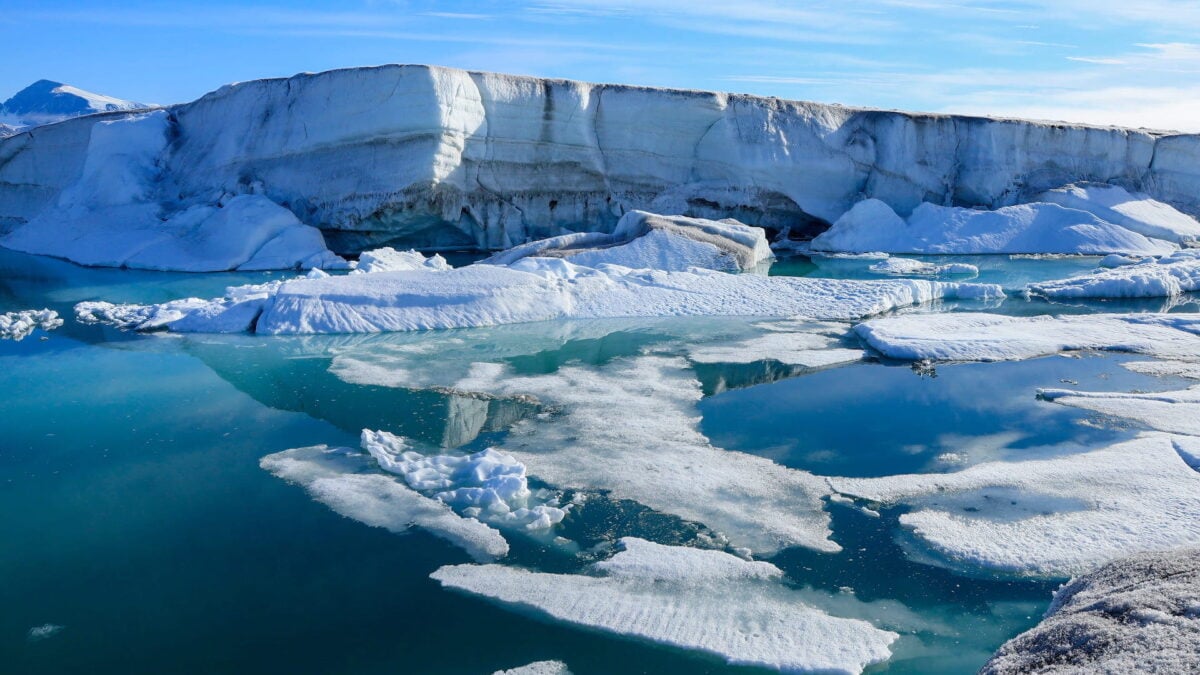
In July 2020, a gigantic Arctic shelf collapsed in Canada, losing more than 40% of its surface in just two days. The Milne Ice Sheet acted like a dam, trapping a layer of fresh water over the Arctic Ocean. A few months after its dissolution, that freshwater lake flowed into the ocean and disappeared completely. In a new study, a team of scientists reconstructed the death of Canada’s last epishelf lake as rising temperatures take their toll on the unique Arctic ecosystem. The findings, published in the journal Scientific Reports, highlight the loss of Milne Fiord Lake as a sign of the vulnerability of Arctic sea ice to climate warming. Washwater Epishelf lakes are rare bodies of fresh water that float directly on top of the ocean’s densest salt water. The fresh water is trapped in place by a floating ice shelf. A unique ecosystem forms in the lake, with freshwater organisms thriving near the surface, while marine species live in the ocean. Milne Fiord Epishelf Lake, located on northern Ellesmere Island in Nunavut, was the last large epishelf lake still standing in the Canadian Arctic. The lake was formed when the Milne Ice Sheet created a dam that blocked the mouth of the fjord and meltwater from the glaciers built up behind it. The Milne Ice Sheet was once the last completely intact ice in the Canadian Arctic, but it sadly collapsed six years ago and shrank by about 30 square miles (80 square kilometers). With the collapse of the ice sheet, Lake Epishelf didn’t stand a chance. “The Epishelf lakes are notable because a freshwater ecosystem lies directly above a marine one, separated only by a thin boundary between freshwater and saltwater,” Andrew Hamilton, an Arctic oceanographer at the University of Alberta and co-author of the study, said in a statement. “When the ice shelf broke up, that unique ecological structure disappeared. It was the last of its kind in Canada.” Chronicle of the disappearance The scientists behind the new study used satellite images, field observations and ocean measurements to chronicle the lake’s drainage. The team had been monitoring changes in the ice sheet since 2011, tracking its accelerated transformation amid warming temperatures. “The ice shelf and lake had been thinning for decades, but the 2020 breakup was the last straw,” Jérémie Bonneau, professor of civil and hydraulic engineering at Laval University and co-author of the study, said in a statement. “The lake dried up in a few months.” By autumn 2020, the lake and its unique ecosystem had completely disappeared. The ice sheet that contained Lake Epishelf will not recover under the current climate trajectory, the study notes. “These systems took thousands of years to form and were lost within months,” Bonneau said. “On any human time scale, they’re not coming back.” The team remembers drilling into the lake’s outlet channel beneath the ice shelf in 2017 and seeing “a robust marine ecosystem with brittle stars, sea anemones, scallops, etc., all living in complete darkness in a channel at the base of the ice shelf,” Hamilton said. “My kids will never see that kind of ice shelf and lake system in their lifetime. It’s the end of an era.”