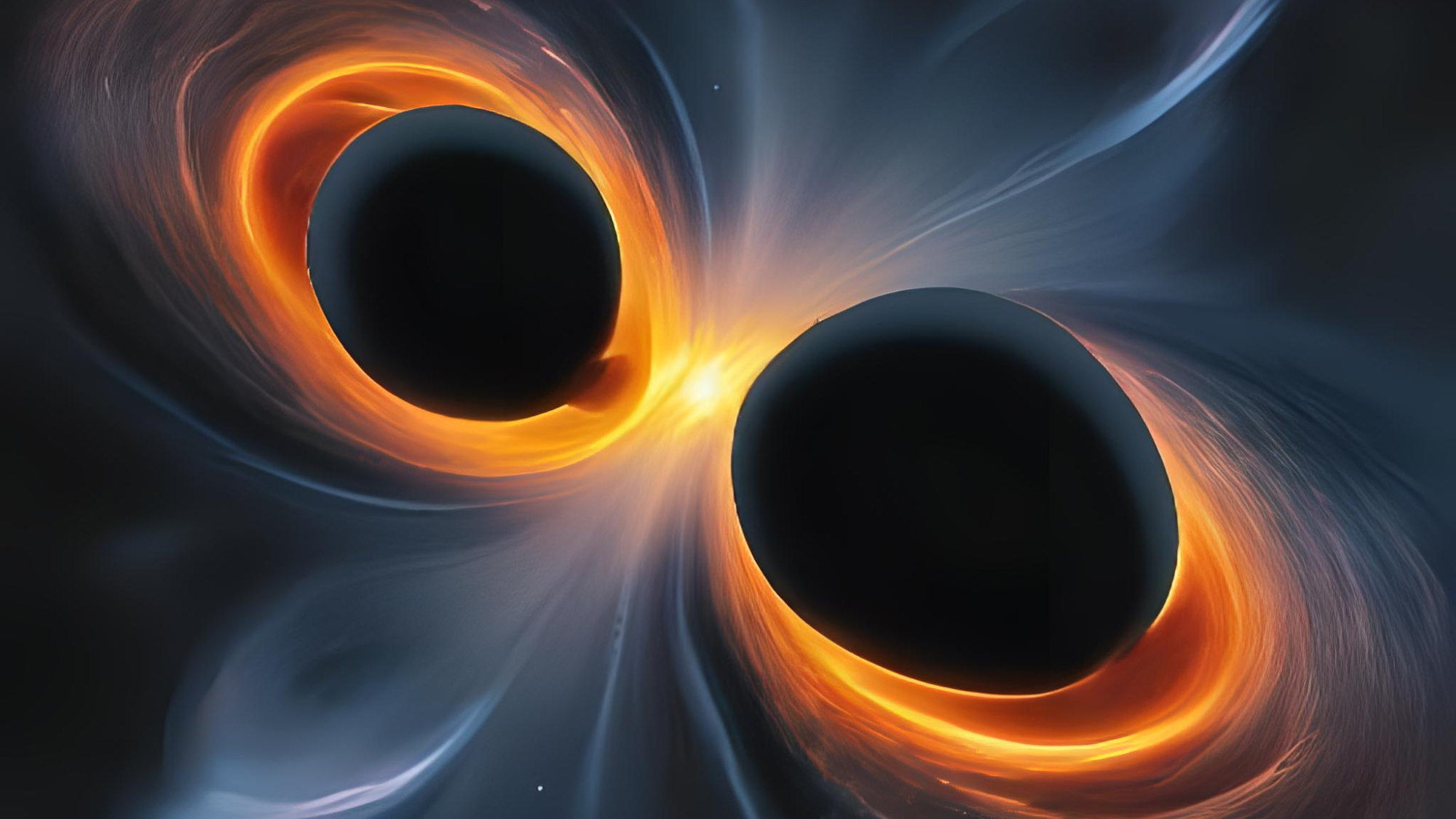
A “forbidden” merger between two massive black holes may not have been as impossible as previously thought. This is according to new research that suggests the black holes involved were smaller than expected. On November 23, 2023, the gravitational wave detector LIGO (Laser Interferometer Gravitational Wave Observatory) detected small ripples in space-time caused by the merger of two black holes. The incredible thing about this signal, designated GW231123, is that it appeared to be the result of a black hole with 140 times the mass of the Sun colliding with another that has 100 solar masses. This caught attention among researchers because standard models of stellar evolution struggle to explain such massive black holes, especially those that appeared to spin as fast as these two. Meanwhile, scientists have been trying to explain how such a strange black hole binary could form. The team behind this new research suggests that it doesn’t need to be explained at all. They think that the masses of these black holes were an illusion. The key to this illusion is a phenomenon called gravitational lensing, first predicted by Albert Einstein’s 1915 theory of gravity, general relativity, which also first predicted the existence of gravitational waves. This theory says that objects with mass cause the curvature of space and time, united as a four-dimensional entity called “spacetime.” The more mass an object has, the greater the curvature and, because gravity arises from this curvature, the greater the gravitational influence. Gravitational lensing occurs when light from a background object passes through a massive foreground object. The foreground object can warp the fabric of space-time in such a way that the path of light is curved. This means that light from the same background source can reach Earth at different times, depending on how much that light was bent. You may like This difference in travel time can magnify a background source, and has been used to great effect to observe distant, ancient galaxies that are normally too faint to be seen. This research team believes the effect also applies to gravitational waves, suggesting that the GW231123 signal is an example of gravitational waves in space-time that made black holes appear larger than they actually are. “Like light, gravitational waves can also be deflected, magnified and split into multiple signals by massive objects,” team member Miguel Zumalacárregui, group leader in the Department of Astrophysical and Cosmological Relativity at the Albert Einstein Institute (AEI), said in a statement. “In the case of gravitational waves, diffraction and interference effects give us an additional way to identify and study lensing signals.” A diagram (not to scale) of how gravitational lensing works. (Image credit: NASA, ESA and L. Calçada) To investigate this possibility, the team developed a mathematical model of gravitational lensing and created software powerful and fast enough to analyze it. “If we assume that GW231123 was deflected and distorted by a compact object of around 190 to 850 solar masses, or by an extended structure such as a globular cluster, we can understand the large masses observed,” said team member Srashti Goyal, based at the AEI at the time of the research. “In addition, the lens interpretation does not require unusually high turns.” What to read next When the team modeled the event with that consideration in mind, they discovered that the merger involved a system with a mass of 140 solar masses, rather than the 240 solar mass system initially theorized. A simulation of a black hole merger. (Image credit: NASA Goddard Space Flight Center) The team is not sure which massive object is responsible for capturing the GW231123 gravitational wave signal. But no matter what it is, if the team is right, the lens could be something pretty special. “The nature of the lens remains a big mystery in our analysis, as individual compact lenses with between 100 and 1,000 solar masses should be extremely rare,” Zumalacárregui said. “Future work will need to establish whether such lenses can form, or whether an array of lighter objects, including stars, can explain this event.” The team cannot yet say conclusively whether GW231123 is the first gravitational wave signal captured by gravitational lenses. Finding future signals of this type will require improvements in the sensitivity of detectors like LIGO. Although even before that happens, research points to the usefulness of gravitational wave astronomy for studying some of the most violent events in the universe. The team’s research was published August 25 in Astrophysical Journal Letters.