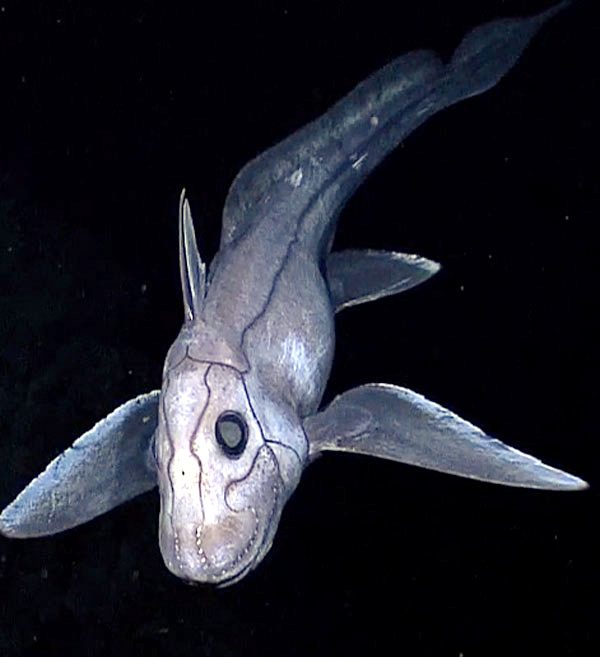
Deep in the ocean there is an ancient fish that glides by flapping its pectoral fins instead of waving its rat tail. They resemble a shark but with larger eyes, a more prominent snout, and only one visible gill opening. These are chimeras, also known as ghost sharks, rat fish and rabbit fish. They diverged from sharks and rays about 400 million years ago, but around 50 species can still be found in our seas today. What is a chimera? Also known as ghost sharks, chimeras are not true sharks, but they are very similar to sharks and rays and have a common ancestor: these cartilaginous fish diverged from elasmobranchs about 400 million years ago. There are around 50 known species of chimeras but, because they tend to live in very deep waters, scientists still have a lot to discover about them. How do they look? Chimeras look like a lot of different animals, which might explain why they have so many common names. These strange fish have large eyes and pale, sometimes almost translucent skin, which makes them look quite creepy, hence why they are sometimes called ghost sharks or ghost fish. They have long, thin tails like those of a rodent (they are also known as ratfish) and prominent front teeth like those of a bunny (you guessed it, they are also sometimes known as rabbitfish). The combination of all these different characteristics is also why they are called chimeras. The name is a nod to the Chimera from Greek mythology: a mix of a lion, a goat and a fire-breathing snake. How big are chimeras? They measure between 60 cm and 2 meters in length depending on the species and usually weigh up to about 4 kg. Where do chimeras live? Chimeras live in all oceans except the polar regions. Although some species can be found in shallower waters, they typically live hundreds or thousands of meters deep. Because they feed on animals that hide on the seafloor, ghost sharks spend most of their lives near the seafloor, usually between 200 and 2,600 meters. What do they eat? They find and catch small animals hidden at the bottom of the sea, such as crabs, worms and sea urchins. How do chimeras hunt? Chimeras have a prominent snout covered in electroreceptors. Like sharks, this network of sensory pores, known as ampullae of Lorenzini, can pick up small electrical currents in the water and help the animal detect hidden prey. Because many of their prey are invertebrates with hard exoskeletons, these fish have three pairs of strong tooth plates designed to crush shells. True sharks constantly lose their teeth throughout their lives and grow new ones to replace them. But chimeras continue to grow tooth plates throughout their lives to repair the wear caused by grinding hard shells. How do they reproduce? Like some shark species, ghost sharks lay eggs. The strangest thing about his reproduction is located right in the center of his forehead. Male chimeras have a retractile organ called the tenaculum in their heads. This small bump is covered in small, tooth-like scales called denticles that help the male hold on to the female during mating. Are they dangerous for humans? Generally not. Chances are you’ll never see one of these deep-sea ghost sharks in your life, and if you did, they’d be much more interested in biting their usual prey (small critters that live on the sea floor) than in bothering to target you. However, they will defend themselves if necessary. Deep-sea fishermen have been injured by the sharp, poisonous spines of these fish, and the wounds sometimes need to be treated with general anesthesia. Are they under threat? Yes. A 2024 report highlighted that a third of sharks, rays and chimeras around the world are threatened with extinction, largely due to overfishing. Although there isn’t much data on the conservation status of these little-studied animals, some scientists worry that populations may be struggling.