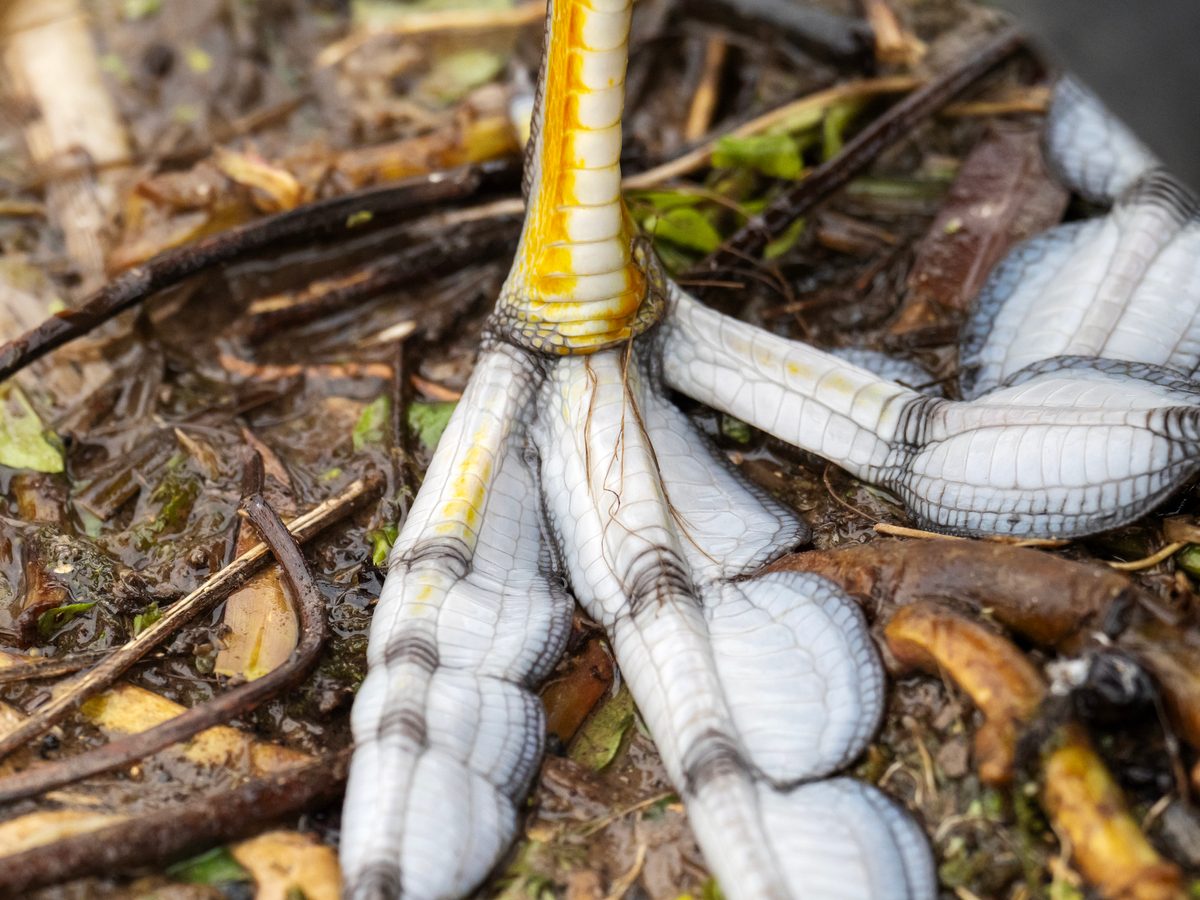
All shapes and sizes in the animal kingdom are beautiful in their own way, but some of these bird legs look like cartoons drawn by a child… Here are 5 of the strangest bird legs. African Jacana Nick Dale/Getty Images These wading birds increase their reach in the wetlands of sub-Saharan Africa by using their extraordinarily long toes, with equally long nails, to walk on floating aquatic vegetation. The wide spread of its feet distributes its weight so that the plants do not give way beneath them, and its extended claws grasp the stems to propel itself. If they fall, they are good swimmers and often employ that tactic to evade predators, especially as chicks. But fishing and catching insects is easier while standing on a lily pad. Coot Marieke Peche/Getty Images If there are legs that don’t look like they belong to the animal they appear to be attached to, it’s the coot’s appendages. Pale gray on the undersides with yellow legs and a black body, with curious lobed fins surrounding the toes, they look like a child’s attempt to draw feet with a thick, clumsy marker. But they serve the coot well because, unlike a duck’s webbed foot that propels it through the water but makes it uncomfortable to walk on land, these feet work well as oars but are also flexible on land so the bird can walk elegantly and quickly along the river bank. Ostrich James Duffy/Getty Images These large birds are unique in the avian world because they only have two toes on each foot. All other birds have three or four, depending on the species. The toes consist of a large one with a nail that looks almost like a hoof, to dig in and grip the ground, and a small, bulbous one without a nail, which acts as a stabilizer. Together they help propel the ostrich forward at high speeds and for long periods of time. It is not unusual to record birds traveling at more than 35 miles per hour (56 km/h) for half an hour at a time. Woodpecker dwi septiyana/Getty Images Unlike most other birds, woodpeckers spend most of their time clinging vertically to tree trunks rather than perching on branches or walking on the ground. Hence their specialist feet, which, instead of having three toes pointing forward and one backward, have two facing forward and two facing back. This gives them a more secure grip on the bark for climbing. This arrangement of the fingers is called a zygodactyl and in the avian world it is only shared with parrots, owls, cuckoos and ospreys; the latter uses its two-forward, two-hind toe setup to good effect to carry a slippery fish back to the nest. Blue-footed booby Arthur Morris/Getty Images The surprising feature of this seabird is revealed in the name. While other birds may have pale blue-gray legs, this species of booby has more vibrant turquoise to aquamarine ones. Its legs are a good indicator of the bird’s health: the brighter the blue, the more robust the booby. This is particularly important in males looking for a mate, as knowing that their chick will inherit good, healthy genes is the important factor in the female’s choice of mate. The males take advantage of this fact and use their feet as a central element in their mating displays, shaking them and strutting to show them off. The blue coloration is caused by the carotenoid pigments it ingests from its fresh fish diet. These are the same pigments that color the legs of a flamingo, but due to the particular arrangement of collagens in the booby’s skin, their legs and feet appear blue instead of pink.