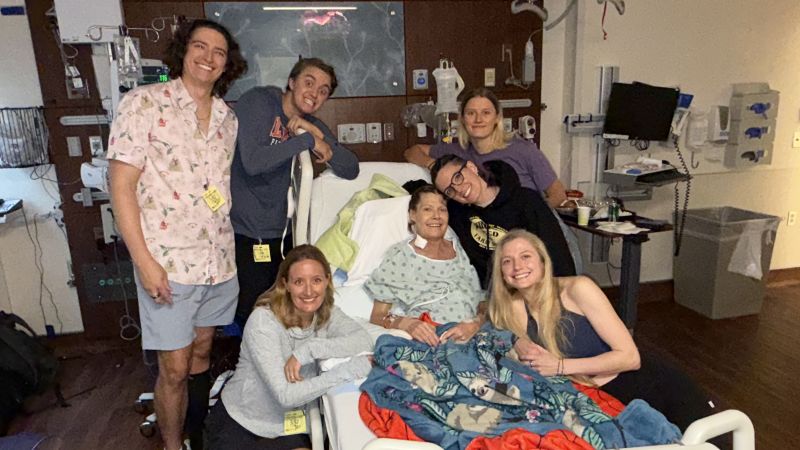
Dr. Annette Wagner always knew that her arteries could fail her.
One morning last year, while in her clinic with a patient, the pediatric dermatologist felt “breathtaking” and “excruciating” pain in her chest.
She told the nurse, whom she’d worked with for 25 years, to call 911 and get her a wheelchair.
Wagner has Loeys-Dietz syndrome, a disorder that affects the blood vessels and the aorta, the largest artery in the body, weakening the connective tissue in its walls.
Because of work she had done decades earlier to understand her family’s long history of health problems, she knew exactly what was happening: an aortic dissection, a life-threatening tear in the inner layer of the artery.
“What had happened in the room is, I started to dissect,” said Wagner, who was 64 at the time. “That means instead of the blood going through the main aorta and down the main channel, it began to dissect through the wall of the aorta so that a large portion of my body’s blood was going through the wall, which is abnormally thin because of the connective tissue defect to begin with.”
Months of surgeries and treatment followed, but she wasn’t the only person in her family to have open-heart surgery.
In the next six months, with Wagner’s urging, three of her children would have procedures to avoid the same situation.
Decades before her dissection, Wagner had kicked off her own quest for answers.
Wagner’s brother had an aortic root dissection in 1993, at the age of 38, and died of a second dissection at the age of 60. Her father and grandfather also died from dissections at 77 and 37, respectively.
She initially thought her family might be predisposed to Marfan syndrome, a connective tissue disorder that affects the aorta, because of the young age of her brother’s first dissection.
The day of her brother’s first dissection, Wagner had an echocardiogram and learned that her aortic root was dilated, meaning she could also be at risk.
She decided to get to the bottom of what was happening in her family. In the early ’90s, she returned to where she grew up, in rural Nova Scotia, and took blood and skin biopsies from over 40 relatives from both sides of her family. She then sent the samples to Houston, where a lab funded by the US National Institutes of Health was studying the cause of aortic aneurysms.
“Then, going forward, I just made sure that everybody had their aortic roots looked at,” Wagner said. “It was hard to figure out what was going on, but it’s pretty clear in my immediate family, like my sisters and brothers, that my brother had it.”
In 2011, Wagner got word that the lab had found a gene dubbed SMAD3.
She had a mutation in the gene, as did three of her six children. It turned out to be a cause of Loeys-Dietz.
About 1 in 50,000 people has Loeys-Dietz, but it may be undercounted because the diagnosis can be missed.
“It was so wonderful to know that we had a diagnosis,” she said.
Even with that clarity, the path forward came with its own challenges.
Last year, at the local hospital, a surgeon put a patch on Wagner’s dissected aorta. But in the ICU shortly after, her heart stopped, and she was put on life support with a pump to help move blood through her heart.
Wagner was transferred to Northwestern Memorial Hospital with her chest open. Doctors performed a cardiac lavage — using warm fluid to keep her body temperature from getting too low — and she was kept on life support for two weeks.
A doctor told her there were so many people in the lobby to support her, he couldn’t even get into her room.
“It turned out half of Chicago was praying,” Wagner said. “All of Westchester, where I work, I mean, they were having prayer vigils. All my family came in from everywhere. There were literally, I’m not joking, like 50, 60 people in the waiting room at all times for that period.”
She was discharged on July 22 for rehabilitation. Wagner said she didn’t have any lasting mental effects from the loss of blood while on life support, but she did lose the tips of her thumb and index finger.
She was home for only three days in September before her heart began to fail and was readmitted to Northwestern.
That’s where “the big surgery was done,” Wagner said.
The first surgery didn’t address many issues, said Dr. Christopher Mehta, a cardiothoracic surgeon at Northwestern, leaving Wagner in heart failure and putting her at risk of a rupture in her aorta. He replaced her ascending aorta and aortic arch, two sections of the aorta that carry blood throughout the body. He also replaced the aortic root, the first section of the artery, as well as the aortic valve, which lives in the root.
Because the tear even went into Wagner’s coronary arteries, Mehta took veins from her legs to form a new conduit for blood. Lastly, her tricuspid valve — one of the four heart valves — was leaking, so he had to repair it using a ring.
Wagner still has a tear in the aorta that carries blood through the chest and abdomen into her femoral artery in her right leg, but doctors are unsure whether she’d survive another surgery.
Aafter all those procedures, more lay ahead for Wagner’s family.
Two days after coming out of a coma at Northwestern Memorial Hospital, Wagner found herself in the room with her three kids who have Loeys-Dietz.
“I just called them to the foot of the bed and I said, ‘There’s a reason that I survived this, and the reason is because if I didn’t, you three would not get your surgery, because no one would consent to do prophylactic surgery on us till we got to 45, and it’s clear that in this type of Loeys-Dietz, that’s too late. You need to do it before then,’” she said. “So I looked at them and I said, ‘You need to all have a graft of your aorta.’”
Her younger son, Gavin, then 28, said he’d go first. Kirstin, 37, said she’d go second, and Charlie, 33, agreed to go third. All three had the same procedure, “right down to the same materials put in,” Wagner said.
“It was the ultimate privilege to be able to be there for them and with them during something that difficult,” she said. “It’s hard for me to talk about giving your kids something this awful.”
Dr. Elizabeth McNally, director of the Cardiovascular Genetics program at the Bluhm Cardiovascular Institute at Northwestern Medicine, first met Wagner in 2015 for clinical genetic testing to confirm the lab’s results. She has followed Wagner since then – and her children once they no longer saw a pediatric cardiologist – to do yearly imaging on their aortas using MRI scans and echocardiograms. They also have their blood pressure monitored and take blood pressure medication as preventative measures.
Doctors measure the aorta right as it comes out of the heart to determine whether it’s enlarging and if they need to move into surgery. Wagner’s aorta wasn’t especially large, McNally said, but people with Loeys-Dietz can have a dissection even with smaller aortas.
“Some people do reach the size where we start to say, ‘Hey, the risk of getting this aorta repaired is much safer to take that risk than the risk of dissection,’” McNally said. “That’s always what we’re trying to balance, which is the relatively rare risks of dissection and the rare risks of things going wrong with surgery.”
When Wagner’s aorta dissected, it measured 4.2 centimeters, Mehta said. Her children’s aortas were at 4.1 centimeters at the time — a “compelling reason” for them to have a procedure to avoid the same surgeries their mother had.
Mehta did the surgeries on Gavin and Charlie, replacing the aneurysms around the aortic valves with synthetic grafts and preserving their own aortic valves. Kirstin had surgery in Paris, where she lives.
“Once you’ve removed that aneurysmal aorta, you’ve removed the risk of aortic dissection,” Mehta said.
Gavin Wagner was young when he learned about Loeys-Dietz and didn’t think much of it until a few years ago, when he had a panic attack and began to worry about his heart. After seeing his mother have an aortic dissection and her procedures, he “wanted to get it done.”
Gavin was in and out of the hospital in four days in December, with a standard three-month recovery. He couldn’t do much for the first six to eight weeks, and then he went to cardiac rehabilitation to build strength. Almost a year after the operation, Gavin says, he’s “felt great for months now.”
The disorder also didn’t seem like a big deal to Charlie Wagner until his mother had an aortic dissection. It was a “rude awakening about the severity of what we were dealing with and what we may have to do to prevent that from happening to us,” he said of his siblings.
Charlie’s procedure went well, but when he got home, he began to have “very constant, severe migraines” and photosensitivity issues, with lethargy and pain around his chest. He had inflammation of the sac around his heart, turning his three-month recovery into six months. Now nine months post-op, Charlie feels “100% back.”
And having the surgery washed away a “cloud of fear, anticipating something like what my mother went through.”
McNally, from Bluhm Cardiovascular Institute, said the main lesson is that people need to know their family medical history.
“That was what helped Annette know that her family was at risk, was that she was very aware of her family’s history and in fact, probably why they got involved in the research many years before that, because they had a couple family members who had this problem,” McNally said.
Going through the surgery alongside his siblings “meant everything” to Charlie. He, his siblings and their mother even have a group chat called Loeys-Dietz where they share their experiences.
“We’re all really family-oriented, and we care a lot about each other, and being there for family and knowing that this was something that we were all going to go through together made it much more digestible,” Charlie said.
It was “really terrifying” to watch his mother go through her dissection and multiple subsequent surgeries, but he feels fortunate to know about his family’s medical history.
“I don’t really consider myself religious, but I feel blessed that not only she was able to survive and fight through her condition, but that we as a family are educated in our own family medical history and could be proactive about all of this and learn from it and chase after it and sort of prepare ourselves for the future,” Charlie said.
Wagner said that having all her children home for the holidays this year, happy and healthy, will be the “biggest celebration.”
“My world was falling apart last summer, and I had another chance,” she said. “So one of my goals is not just to make sure my children are protected as much as I can but also to get together with my cardiologist and try and put together as much information as we can find on SMAD3.”
The children have decided it will be the end of the gene mutation in their family. One of her sons is doing IVF to avoid passing it down to his children.
“That’s the power of modern medicine and living in Chicago and having opportunities,” Wagner said. “And we are so blessed, in a million ways.”