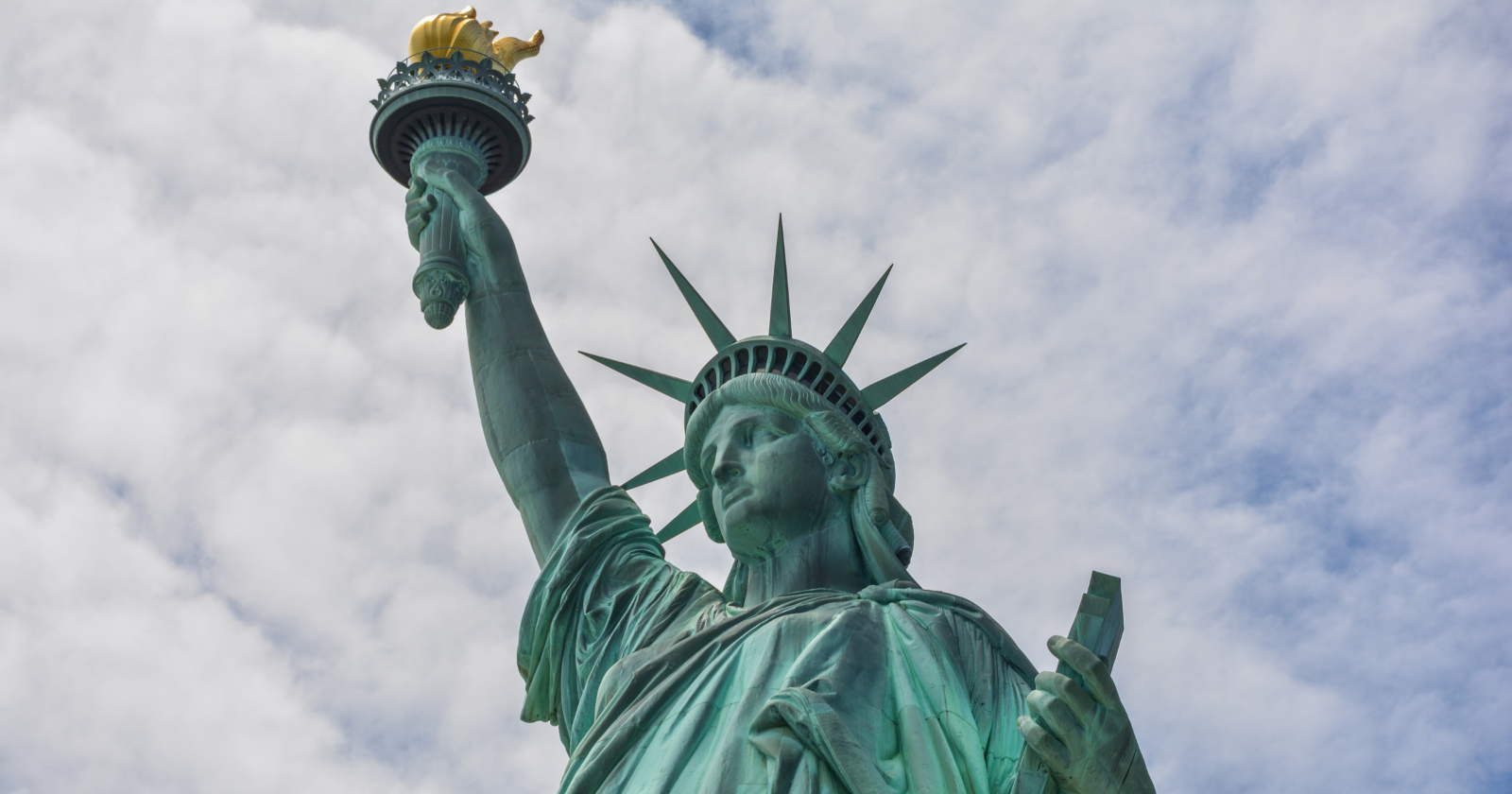
Every year, millions of people visit the Statue of Liberty, and a lucky fraction, with advance reservation, climb the 162 steps to its crown. What no one can do (what no one has done as a member of the public for 110 years) is to continue up, through the raised right arm, up the narrow 40-foot staircase to the torch. The torch balcony, the true summit of the statue, has been closed since 1916. Neither for safety inspections nor for renovations. It is closed due to an act of war on American soil, one most Americans have never heard of, carried out more than a year before the United States entered World War I. Two in the morning, July 30, 1916. The target was Black Tom, a mile-long promontory and railroad terminus jutting into New York Harbor from Jersey City, just behind the Statue of Liberty. In 1916, the neutral United States was selling ammunition to Britain and France in bulk, and Black Tom was the funnel: on the night in question, its warehouses, railcars, and barges contained approximately two million pounds of ammunition and explosives, awaiting transit to Allied lines. Imperial Germany, unable to stop the trade diplomatically, had built a sabotage network inside the United States to burn it down. Shortly after 2 a.m. on July 30, 1916, small fires broke out at the terminal (started, decades of investigation showed, by German agents) and at 2:08 the depot exploded in one of the largest man-made explosions the world had yet seen. It has been estimated that the explosion was equivalent to a magnitude 5 earthquake. It was felt as far away as Philadelphia and Maryland. Thousands of windows shattered in lower Manhattan and Jersey City; shrapnel and debris rained down on the port; Immigrants detained at Ellis Island had to be evacuated when fragments hit buildings. The Jersey Journal building’s clock stopped at 2:12, keeping the time of the explosion for decades. Surprisingly, the confirmed death toll was small: a handful of people, including a railroad guard and a baby who flew out of its crib, a mercy due entirely to the timing. The statue receives shrapnel. The Statue of Liberty was just half a mile from the explosion, in front of it. The explosion threw pieces of steel against the statue and its island, spattering the copper skin; The damage, concentrated on the raised arm of the torch, was assessed at around $100,000, well over $2 million today. The arm had always been the statue’s engineering weak point; Its internal structure had been assembled slightly out of alignment in 1886, and officials had long watched the torch’s rise nervously. Shrapnel settled the issue. The staircase to the torch was closed to the public that year, and the closure simply never ended: during the statue’s remodeling in 1938, during the centennial restoration of the 1980s, during every crown reopening, including closures that lasted years after 9/11, and during subsequent renovations. The crown always came back. The torch never did. There is a wrinkle even in what “the torch” now means. The battered original (its flame rebuilt with glass panels in a 1916 repair by Gutzon Borglum, the future sculptor of Mount Rushmore, who largely managed to let in the rain) was eventually dismantled during the 1984-86 restoration and replaced by a new copper flame gilded with gold leaf. The 1886 original is located at ground level in the Statue of Liberty Museum, where visitors can finally stand next to the balcony that their great-great-grandparents could climb. The only people who climb the ladder of the new torch are National Park Service personnel, to service the lights; A webcam on the balcony shows everyone else the view. Germany pays, in the end Black Tom’s other long tail was legal. Proving state-directed sabotage required decades of investigation through the German-American Joint Claims Commission, tangled in denials, falsified evidence, and the small complication of a World War II. Germany was formally declared responsible in 1939; A $50 million settlement was agreed to in 1953 and final installments were not paid until 1979, sixty-three years after the fires were lit. Black Tom itself was absorbed by a landfill and is now a corner of Liberty State Park, marked by a modest plaque and a circle of flags that most hikers pass by. Which leaves the statue itself as the most visible monument of the event. The Black Tom explosion is a true historical hinge: it pushed Congress toward espionage legislation and helped shape the American intelligence apparatus, but its clearest legacy is subtractive: a lost experience. The most famous statue on Earth has an observation deck that has been closed for 110 years and counting, sealed by an attack prior to the country’s entry into the war to which it belonged. Each photograph of Liberty holding her torch over the harbor includes, without labeling, the damage of the war: not a mark on the copper, but the emptiness of the balcony: a room closed in 1916 by men working for the Kaiser and never reopened. About this articleThis article is for general information and reflection. It is not professional advice. For your specific situation, consult a qualified professional. Follow Space Daily on Google Add us as a preferred source for more Space Daily reporting on Google. Add as preferred source A personal measure of deep time See what has changed in the universe since you were born. Start with a date. Get a personal, detailed journey through everything that kept moving after you arrived. Six measurements obtained. No predictions. No astrology. Standards Space Daily articles are edited and fact-checked before publication. We use artificial intelligence tools in the newsroom. See our editorial standards and masthead.