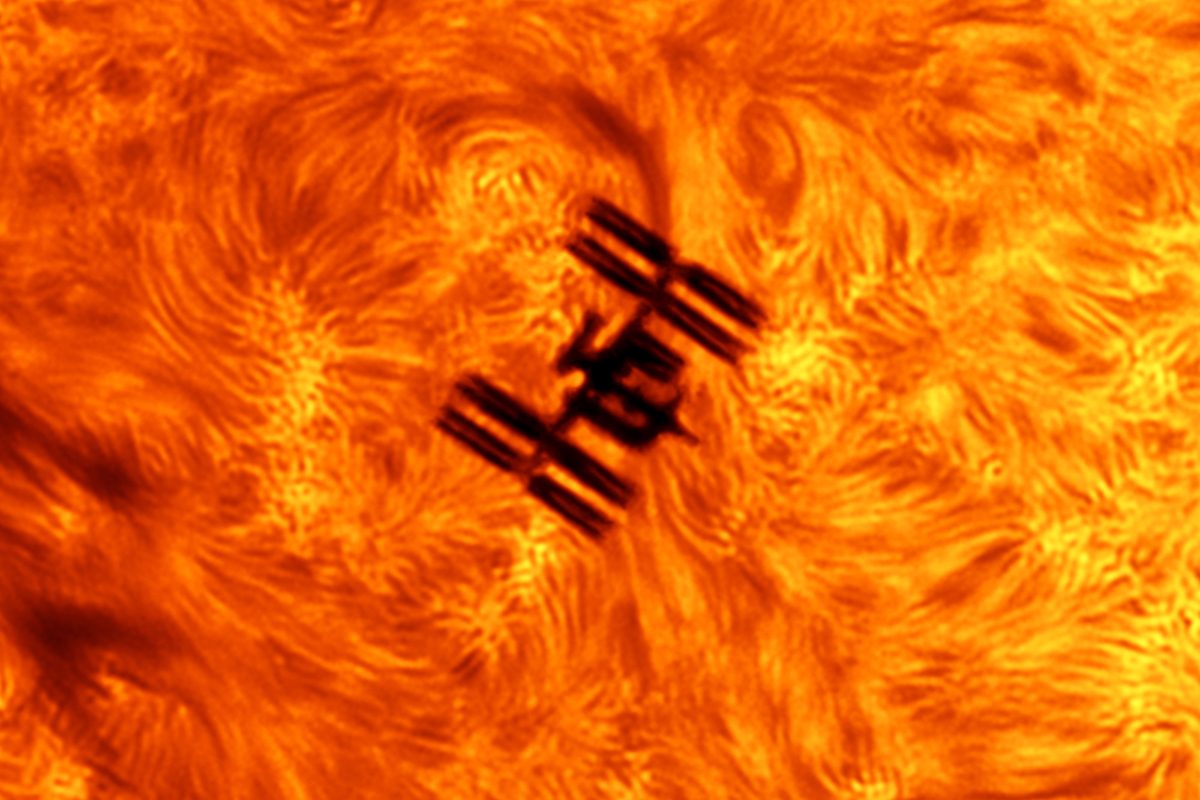
Have you ever seen the International Space Station in the night sky? Well, what about the International Space Station passing in front of the Sun? Of course, this is not something we would recommend, as looking at the Sun could seriously damage your eyesight. So it’s best left to expert astrophotographers like Tianyao Yang, who captured this spectacular view of an ISS solar transit (the space station passing in front of the Sun) from Lianyungang, Jiangsu, China, August 1, 2026. Credit: Toshi Omagari, August 12, 2026 An ISS solar transit, captured by Tianyao Yang, Lianyungang, Jiangsu, China, August 1, 2026. Equipment: Player One Apollo-M Mini camera, Sky-Watcher Heliostar 100Ha solar telescope, iOptron HAE18C mount. Exposure: 0.0003.” Software: AutoStakkert!, ImPPG, Photoshop Additionally, Tianyao also managed to capture two active regions of sunspot groups on the surface of the Sun at the same time. As spectacular as an engineering achievement of the ISS is, it is absolutely dwarfed by the ferocity of our host star. “Plan the alignment for this shot of the International Space Station crossing the active regions AR4498 and AR4500 “It was a tense waiting game,” says Tianyao. “With only a 0.58-second window, I was holding my breath, but seeing the sharp silhouette of the ISS appear on my screen was immensely satisfying.” A solar transit of the ISS, captured by Tianyao Yang, Lianyungang, Jiangsu, China, August 1, 2026. Equipment: Player One Apollo-M mini camera, Sky-Watcher Heliostar 100Ha solar telescope, mount iOptron HAE18C. Exposure: 0.0003”. Software: AutoStakkert!, ImPPG, Photoshop So how did you do it? “Capturing the ISS transiting a specific active region requires double calculations,” says Tianyao. “I look up real-time hydrogen-alpha solar images from the Global Oscillation Network Group (GONG) and rotate them to align with celestial north for the exact transit time. “Combining this with orbital data for the space station allows me to locate the Earth path where the ISS passes through the sunspots. “I then use a global shutter sensor and high-speed capture to freeze that moment without distortion.” See more of Tianyao’s work via her Instagram channel @tythunder17. Capture Details Camera: Player One Apollo-M Mini Camera Telescope: Sky-Watcher Heliostar 100Ha Solar Telescope Mount: iOptron HAE18C Mount Exposure: 0.0003″ Software: AutoStakkert!, ImPPG, Photoshop Are you an astrophotographer? Send us your best images by sending an email to contactus@skyatnightmagazine.com