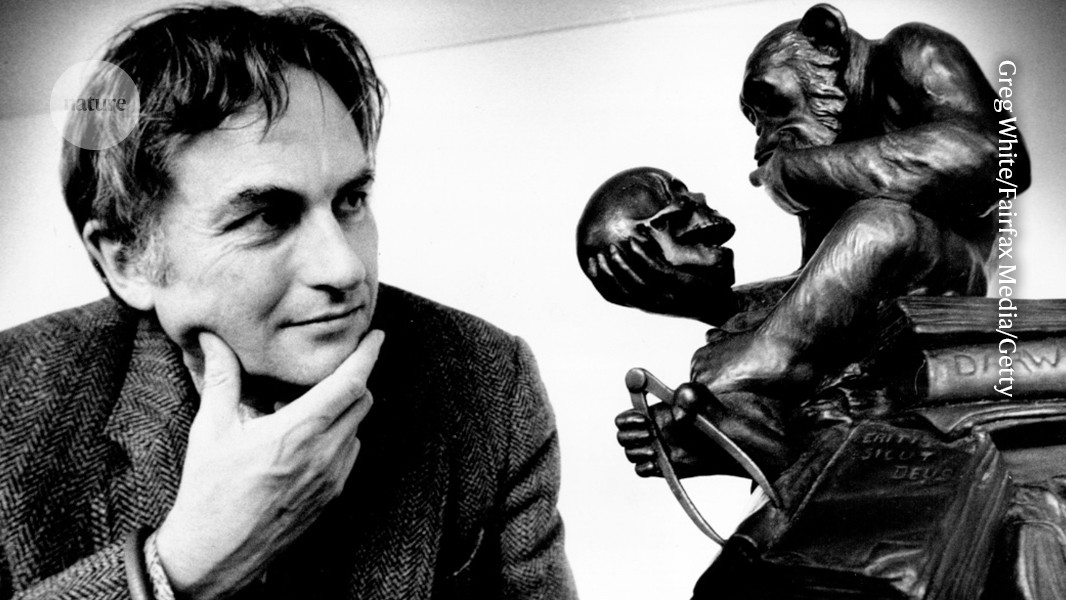
I first read The Selfish Gene in the 1980s, when I was a graduate student in neurobiology and animal behavior. I admired the clarity with which biologist Richard Dawkins distilled mid-20th century work in evolutionary biology. The central idea of the book, published in 1976, was tremendously simple: that a living organism is just a way for a gene to produce more organisms that can pass the gene from generation to generation. Dawkins’ ideas followed the mainstream of sociobiology. It was a popular book that covered exactly the kind of ideas my teachers were already teaching. Rereading it now, with decades of scholarship in the history of biology under my belt, it seems less benign. The determinism built into the “gene view” in the book worries me, as does the passivity of the organism in Dawkins’ narrative: a “vehicle,” a mere “replicator.” The implication: that traits like aggression are hardwired into people. Fortunately, in the last two decades, new tools, new models, and scholars from many disciplines have begun to embrace the complex reality of biology. Readers seeking an understanding of life on Earth today would do better to seek out books that take a broader view. Genecentric Visions The selfish gene was the apotheosis of the “modern evolutionary synthesis.” That theory uses mathematics to quantify the evolution of species at the population level, through changes in the frequency of different versions of genes, known as alleles, over time and space. Dawkins wrote in The Selfish Gene that the gene view was “implicit” in the 1930s writings of modern synthesis pioneer (and eugenicist) Ronald Fisher and his contemporaries, but was made “explicit” by evolutionary biologists George Williams and William Hamilton, in the 1960s. “To me,” he wrote, “his view had a visionary quality. But I found his expressions too laconic, not sufficiently frank.” The selfish gene, then, takes ideas to the extreme. Richard Dawkins’ The Book of the Dead is haunted by ghosts of works past. The modern synthesis combines two branches of evolutionary biology and genetics: neo-Darwinian evolution and Mendelian genetics. Neo-Darwinian evolution was established in the 1890s by biologist August Weismann in his book Die Keimplasma (The Germ Plasma). The book is based on On the Origin of Species, in which Charles Darwin describes a central principle: organisms evolve over many generations through an internal process called natural selection. This is the Darwinism of the first edition of On the Origin of Species, published in 1859. However, over five successive editions, published between then and 1872, Darwin had given increasing credence to the “effects of use and disuse”: the idea, associated with the naturalist Jean-Baptiste Lamarck, that characteristics acquired during the life of an organism can be inherited. Darwin wrote, for example, about the blind cave fish (Astyanax mexicanus). Their ancestors had eyes when they first entered a lightless cave. But after not being used for generations, the eyes degenerated and the change gradually became hereditary. Darwin saw no reason why his theories could not accommodate such phenomena. He did not speculate on the mechanisms. Today, an evolutionary biologist might argue that any animal that invested less energy than its neighbors in creating a complex but useless structure, such as an unused eye, would have excess energy to devote to, say, larger gonads or defending its territory, and thus gain a survival advantage. For Weismann, however, incorporating use and disuse into Darwinism was a dangerous step toward teleology and risked ceding biological change to bishops and mystics. He proposed that only germ plasm (the material carried in sperm and eggs) passed from parents to children. Nothing external could affect what was transmitted. Trays containing the entire human genome, divided into more than 20,000 DNA fragments. Credit: James King-Holmes/SPL The second field that constitutes the modern synthesis, Mendelian genetics, was invented not by Gregor Mendel, the 19th-century monk for whom the field is named, but by the naturalist William Bateson, in his strange and brilliant 1902 book, Mendel’s Principles of Inheritance: A Defense. Mendel conducted experiments crossing peas and in 1866 published a paper describing the rules governing how traits were passed on: how many offspring from a cross of green and yellow peas would be green and how many would be yellow, for example. We now know that only some traits, controlled by individual genes, follow the simplistic patterns he observed. The conservative Mendel claimed to have found only one law “valid for Pisum” (the genus of peas); Bateson claimed that all inheritance followed Mendel’s laws. Bateson’s book was “a defense” against the theories of his rival and former best friend, Walter Weldon, who maintained that such clear and simple laws do not describe how nature works. Weldon noted that traits such as height vary continuously, in a bell-shaped normal distribution. He argued that such traits are the result of many factors, both hereditary and environmental. In the end, as historian Gregory Radick has argued, Mendelism became the universally accepted form of inheritance more for practical reasons than because it captured an essential truth. It is easy to teach and methodologically simple. The new biology Both components of the modern synthesis focus on the gene as the sole determinant of heredity. Both halves achieved essentially universal acceptance long before Dawkins appeared: the salivation and arrogance of the field’s defenders kept challenges and alternatives at bay. To a historian, this universal acceptance sounds close to ideology. Fortunately, since The Selfish Gene was published, scientists’ understanding of the basic mechanisms that drive evolution has changed dramatically.