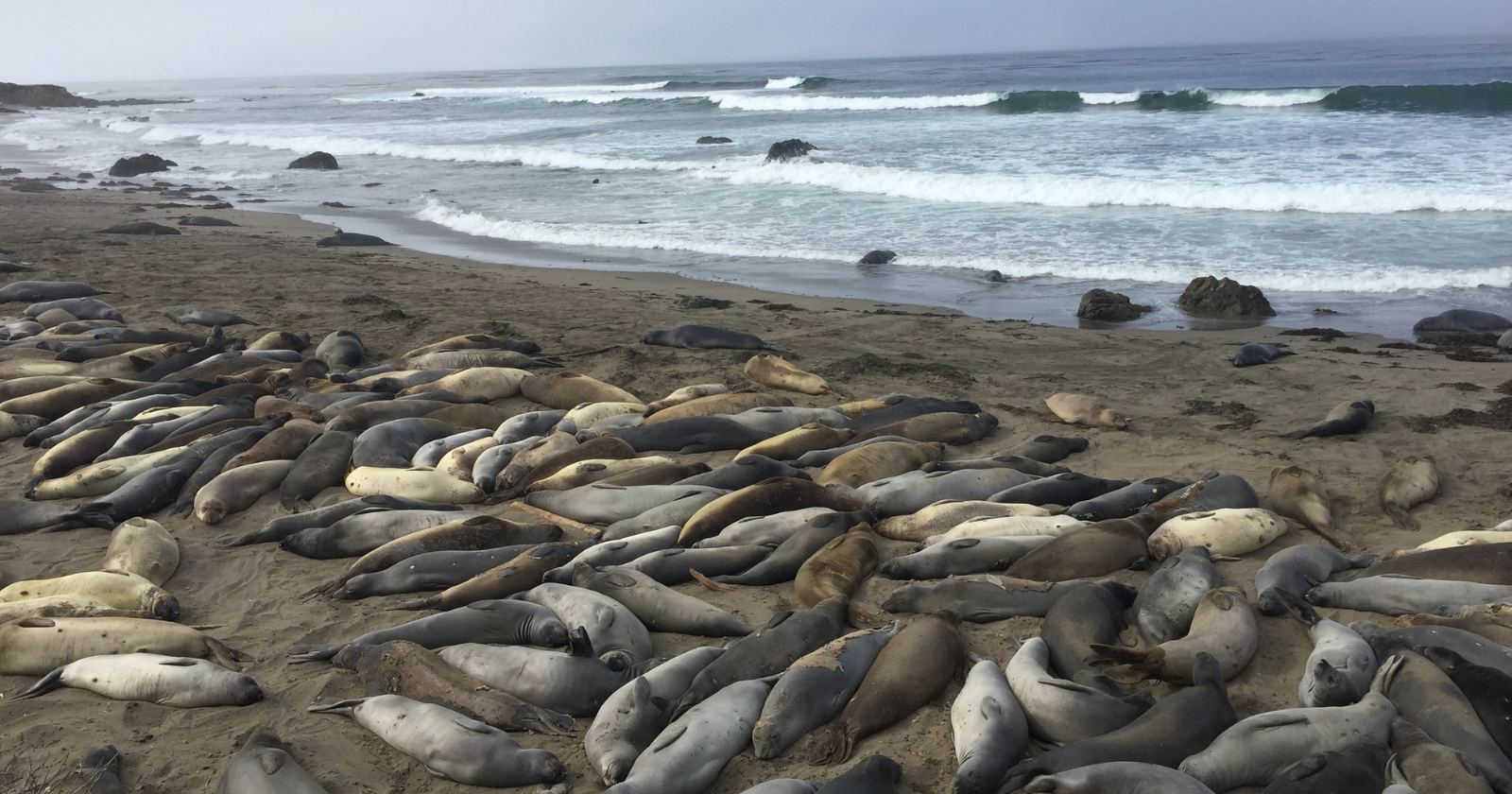
Halfway between San Francisco and Los Angeles, Highway 1 runs 18 miles through a landscape that makes no sense in the year 2026: open cattle country stretching from the Santa Lucia Mountains to an undeveloped Pacific coast, punctuated by almost nothing but a castle on a hill. This is the Hearst Ranch, Rancho Piedra Blanca, 128 square miles that George Hearst began building in 1865, where his son William Randolph built La Cuesta Encantada, the hilltop palace now visited by three-quarters of a million people a year. The ranch is the largest livestock operation on the California coast, home to more than a thousand species of plants and animals, including, in one of its rarest census lines, wild zebras descended from W.R. Hearst’s private zoo, still grazing in the hills eighty years after the fences failed. For most of the late 20th century, it was assumed that none of this would survive. The complex that almost continued to exist Starting in the mid-1960s, Hearst Corporation spent three decades considering development plans for the property, and they were not modest. The vision of the 1960s was of a complete resort town in San Simeon; By the 1990s, the proposition had matured into a tourist destination: hundreds of hotel rooms, a golf course, the standard machinery to turn the last empty stretch of the Central Coast into the rest of the Central Coast. The fights were long and bitter: county hearings, the Coastal Commission, decades of them. And then, instead of winning or losing, the family changed the game. In February 2005, Governor Schwarzenegger announced the closing of one of the most ambitious land deals in American conservation: for a total package of $95 million in public funds and tax credits (a fraction of the land’s development value), Hearst Corporation, the American Land Conservancy, and the California Rangeland Trust closed the ranch. The structure had two halves. The coastal strip west of Highway 1 (beaches, bluffs, approximately 13 miles of coastline plus easements completing an 18-mile segment of the California Coastal Trail) passed to the state for public access. And along the 80,000 acres of ranch land east of the highway was a conservation easement, the largest in California history, permanently removing virtually all development rights while the ranching operation continued. The resort town died in escrow; the cows stayed; the family still owns and works the land that they will now never be able to subdivide. Tenants who moved in early. The elephant seals, for their part, had not waited for the procedures. In November 1990, while battles over development were still being fought, a few dozen northern elephant seals landed on a beach near the Piedras Blancas Lighthouse on the ranch’s shoreline, a few miles offshore from the castle. Elephant seals had been hunted to near extinction a century earlier (reduced to a single surviving colony) and as the recovering population expanded northward, it needed what mainland California almost didn’t offer: long, empty beaches with no one on them. The Hearst Waterfront, which was vacant by a family that had gone 30 years without building its resort, was the only such vacancy on the market. The first calf was born in 1992. The colony was composed as the recovered species to which it belongs, and today thousands of elephant seals mate, molt, fight and give birth in Piedras Blancas each year: a colony of tens of thousands throughout the season, one of the largest on the Pacific coast and, unlike the island or New Year’s colonies, which only require permission, it is visible to anyone who stops – a boardwalk runs along the cliff. and drivers on Highway 1 watch two-ton bulls duel. from a few dozen feet away. Sequence matters and does not favor anyone’s planning. The seals came before serfdom; They colonized an accident: a coast that remained empty due to indecision, litigation and the slow work of the Coastal Commission. What the 2005 agreement did was turn the accident into a guarantee. If some version of the resort had been built, the colony’s beach today would be someone’s ocean view on the back nine. What the family really built There is a clear family irony behind all this. William Randolph Hearst was the great purchaser of the 20th century (of newspapers, art, animals and dismantled European rooms equivalent to a castle) and the ranch was the setting for the construction. The most consequential act of his heirs on the same land was a legally binding promise not to build anything. That promise now underpins everything the tour is famous for: the uninterrupted view from the castle terraces, the herds of zebra, the coastal path inching along the coast and the December spectacle of a seal-carpeted beach four meters under a road with nowhere to look but beautiful. The complex would have had a good history: thirty years, maybe fifty. The term of the easement is forever, and its first full generation of beneficiaries is already on the ground, five thousand puppies a year, bellowing in the sand that the golf course never had. About this articleThis article is for general information and reflection. It is not professional advice. For your specific situation, consult a qualified professional. Follow Space Daily on Google Add us as a preferred source for more Space Daily reporting on Google. Add as preferred source A personal measure of deep time See what has changed in the universe since you were born. Start with a date. Get a personal, detailed journey through everything that kept moving after you arrived. Six measurements obtained. No predictions. No astrology. Standards Space Daily articles are edited and fact-checked before publication. We use artificial intelligence tools in the newsroom. See our editorial standards and masthead.