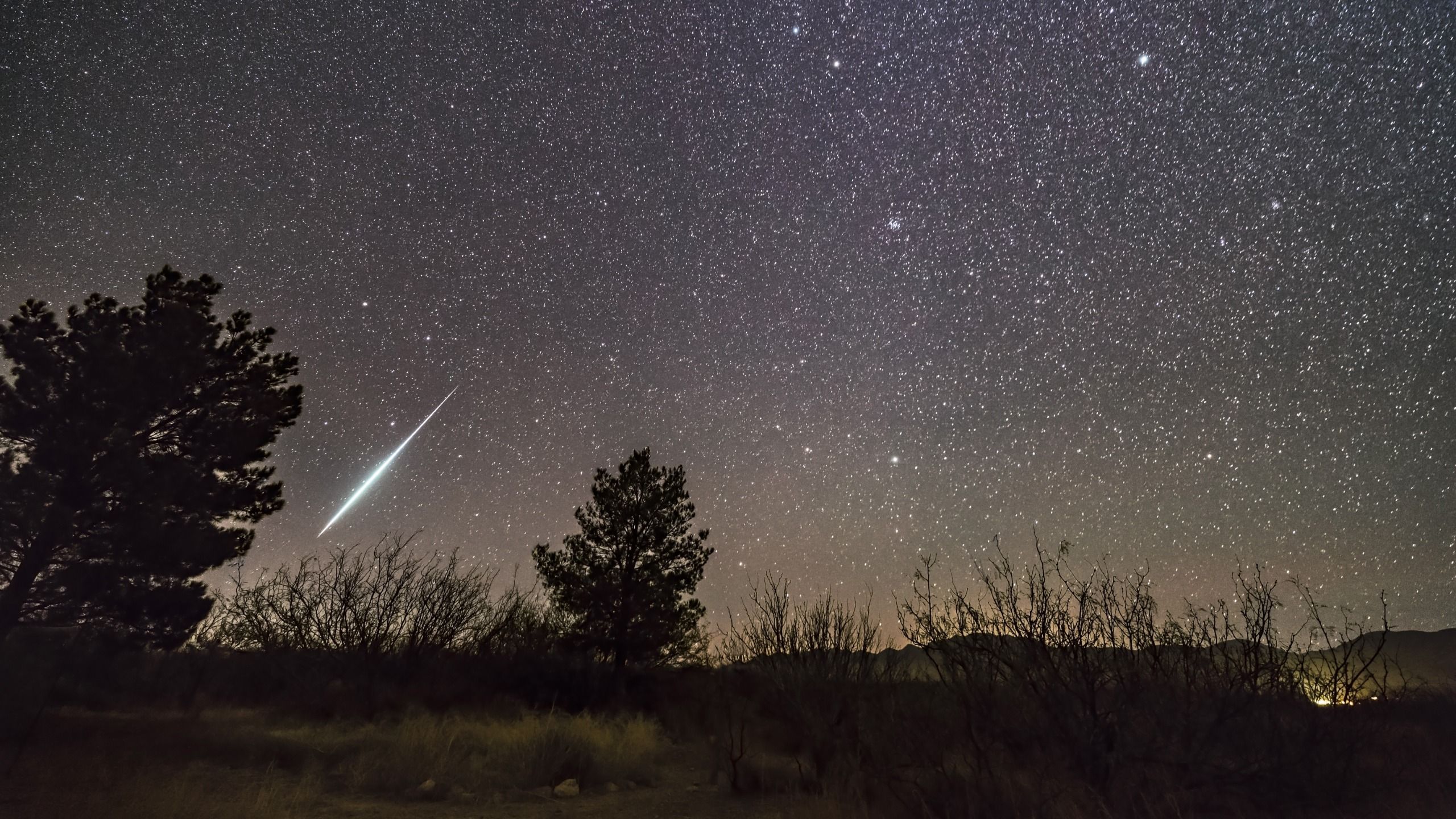
They don’t produce anything like the torrent of “shooting stars” associated with August’s Perseids or December’s Geminids, but the Taurid meteor showers have something else going for them: fireballs. The Taurids are famous for occasionally producing exceptionally bright, slow-moving meteors that can dramatically streak across the night sky from September to December. As an added bonus, they are visible from both the northern and southern hemispheres. This is because they appear to emanate from the constellation Taurus, which lies near the ecliptic, the apparent path the Sun follows across the sky as the Earth orbits around it. The Taurids are actually two closely related showers: the Southern Taurids and the Northern Taurids, whose activity overlaps in late October and November. That’s why they’re informally known to skywatchers as the “Halloween fireballs.” The broad overlapping peaks make the Taurids focus less on observing a particular night and more on monitoring the night sky for several weeks. Both have their radiant points (the place in the night sky where their “shooting stars” appear to come from) near the famous Pleiades open star cluster (M45) in the constellation Taurus. There’s another tantalizing reason to observe the Taurids in 2026: Moonlight will cause little interference around the main peaks. When are the Southern Taurids? The Southern Taurids are already underway. According to the American Meteor Society, they are active from September 20 to November 20, with two distinct components. The annual component peaks around October 14, while a component particularly associated with fireballs peaks during the night of November 4-5. That’s the night you should hang around if you hope to see one of the “Halloween fireballs.” You may like However, don’t expect a conventional meteor storm. The Southern Taurids have an average zenith hourly velocity of about five meteors per hour. ZHR describes how many meteors an observer could theoretically see under ideal conditions with the shower’s radiant directly overhead. In practice, observers see less, so this is not an opportunity to gather friends for a special spectacle, as is the case with the Perseids. However, what the Southern Taurids lack in quantity, they can make up for in quality. Its meteors crash into Earth’s atmosphere at about 27 kilometers (17 miles) per second. This is relatively slow for a meteor, which helps make some Taurids eye-catching as they travel across the sky. You don’t see a Taurid meteor; you look at it. Cloud permitting, conditions should be favorable around November 4-5. The moon will be absent most of the night, rising a couple of hours before dawn as a waning crescent with 17% illumination, too dim to affect meteor visibility. When are the Northern Taurids? The Northern Taurids start later, activating on October 20 and continuing until December 10, according to the American Meteor Society. They are expected to peak during the night of November 11-12. Again, rates are low (about five meteors per hour under ideal conditions), but fireballs are possible. Northern Taurid meteors enter the atmosphere at about 18 miles (29 km) per second, as slowly as their southern counterparts. What to read next Viewing conditions at the summit should be excellent. The moon will be a thin crescent crescent illuminated at 5% and will be virtually absent from the night sky during the night of November 11-12, leaving the night dark. The distinction between the two Taurid showers isn’t particularly important if you’re simply standing outside waiting to see a fireball. In late October and early November, both currents are active at the same time, potentially producing around 10 Taurids per hour in clear, moonless conditions. The radiating points of both the Southern Taurids and the Northern Taurids are near the Pleiades (M45). (Image credit: Starry Night) Why are Taurids called ‘Halloween fireballs’? The nickname comes partly from time. Their highs are also broader than sharp. According to EarthSky, the Taurids tend to “wander” during the period, becoming particularly noticeable when the two branches overlap from late October to early November: Halloween. It is also a reference to its tendency to produce fireballs, exceptionally bright meteors caused when larger pieces of space debris plunge into Earth’s atmosphere. Some years are considerably better for Taurid fireballs than others, and it is impossible to know for sure in advance. EarthSky notes that enhanced displays occurred in 2008, 2015, and 2022, when Earth found larger concentrations of debris within the stream. Don’t expect a repeat in 2026, however: the next predicted Taurid fireball swarm isn’t expected until 2032. That doesn’t mean there won’t be fireballs this year, just that an unusually high number isn’t predicted. Comet 2P/Encke seen by NASA’s Messenger spacecraft in 2013. (Image credit: NASA/Johns Hopkins University Applied Physics Laboratory/Carnegie Institution of Washington) What causes Taurid meteor showers? Both Taurid meteor showers are linked to Comet 2P/Encke, a 4.8-kilometer (three-mile) wide comet that orbits the Sun every 3.25 years—the shortest known cometary orbit. according to NASA. However, the Taurids belong to a much larger complex of dust, rocks, comets and asteroids, possibly created when a much larger object broke up thousands of years ago. Each fall, Earth passes through different parts of this expanding debris stream, producing the overlapping Northern and Southern Taurids and occasionally larger fragments that create spectacular fireballs. How to View the Taurid Meteor Showers Both showers appear to originate in Taurus, a constellation that rises during the afternoon and rises higher in the sky as the night progresses. Around midnight, Taurus is well placed for many observers. However, it is not necessary to find Taurus. Meteors can appear anywhere in the sky and looking directly at the radiant can mean seeing shorter meteor trails. The best advice is to treat this period as a good time for naked-eye stargazing, applying the usual rules: find a spot away from bright lights with as wide a view of the sky as possible, and give your eyes about 20 minutes to adjust to the darkness. Binoculars and telescopes will restrict your field of view and make meteor observation impossible. Above all, be patient. The Taurids are slow burners in every sense: low rates, slow-moving meteors, and weeks of activity. But if one of those meteors turns out to be a bright fireball, it could easily be one of the most memorable “shooting stars” seen all year.