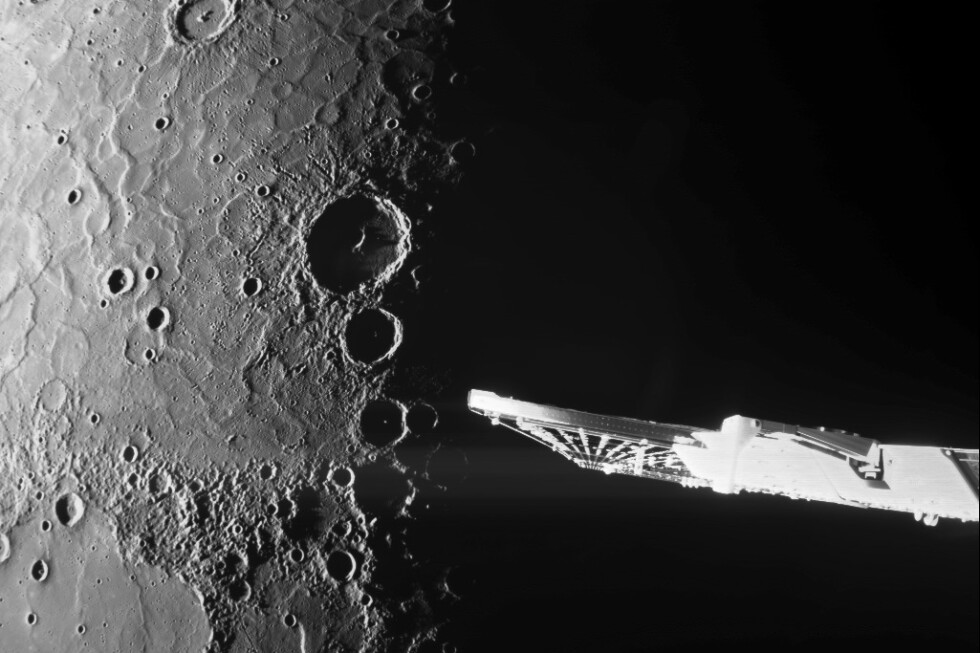
CAPE CANAVERAL, Fla. (AP) — Two Mercury-bound spacecraft left their mothership behind Thursday and headed for the home stretch of their nearly decade-long journey to the solar system’s smallest and closest planet to the Sun. The linked European and Japanese spacecraft separated as planned from their cruise, but controllers had to wait an anxious two hours for confirmation via radio signals. The crucial operation was broadcast from the European Space Agency’s control center in Germany, more than 200 million kilometers (124 million miles) away. “It’s a brilliant moment,” said the project’s lead scientist, Geraint Jones. If all goes well, the joint spacecraft known as BepiColombo will enter orbit around Mercury in November and separate in December to map and study the entire planet from different altitudes. As of Thursday, the spacecraft still had 3.3 million kilometers (2 million miles) left before reaching its destination. Launched in 2018, the BepiColombo mission is named after the Italian mathematician who participated in NASA’s Mariner 10 mission to Mercury in the 1970s. Only one other spacecraft, NASA’s Messenger, has explored the mystifying, scorching planet that’s just slightly larger than our moon. “How small Mercury is and it still holds some of the biggest mysteries of our solar system,” mission director Santa Martínez said earlier this week. Jones added: “There is still a lot to learn.” BepiColombo has already traveled more than 10 billion kilometers (6 billion miles) on its indirect route, according to Martínez. It took nine planetary flybys to reduce its energy enough to become trapped in Mercury’s orbit. The last flyby, in January 2025, returned stunning photographs of Mercury’s impact craters and volcanic plains. Starting next spring, a series of scientific instruments aboard European and Japanese spacecraft will study the magnetic field enveloping Mercury, the planet’s dense interior and geological processes on the surface, including voids or depressions that scientists believe are being eaten away by minerals vaporizing from rocks. It is a strange world of contrasts. On a planet where the temperature can exceed 800 degrees Fahrenheit (427 degrees Celsius), the poles are frigid with deep craters, permanently shadowed and filled with ice. Given Mercury’s proximity to the sun, engineers had to design the spacecraft to withstand “extremely harsh” conditions, said Ignacio Tanco, head of mission operations for the European Space Agency. “It’s essentially equivalent to operating with a very hot pizza oven on your back,” he said. Scientific observations should begin next spring, and the European Space Agency will cover most of the mission’s $2 billion (€1.7 billion) cost.___Associated Press science and health coverage receives financial support from the AP Fund for Journalism and private foundations. AP is solely responsible for all content. Find AP’s standards for working with philanthropic organizations, a list of supporters and funded coverage areas at AP.org.