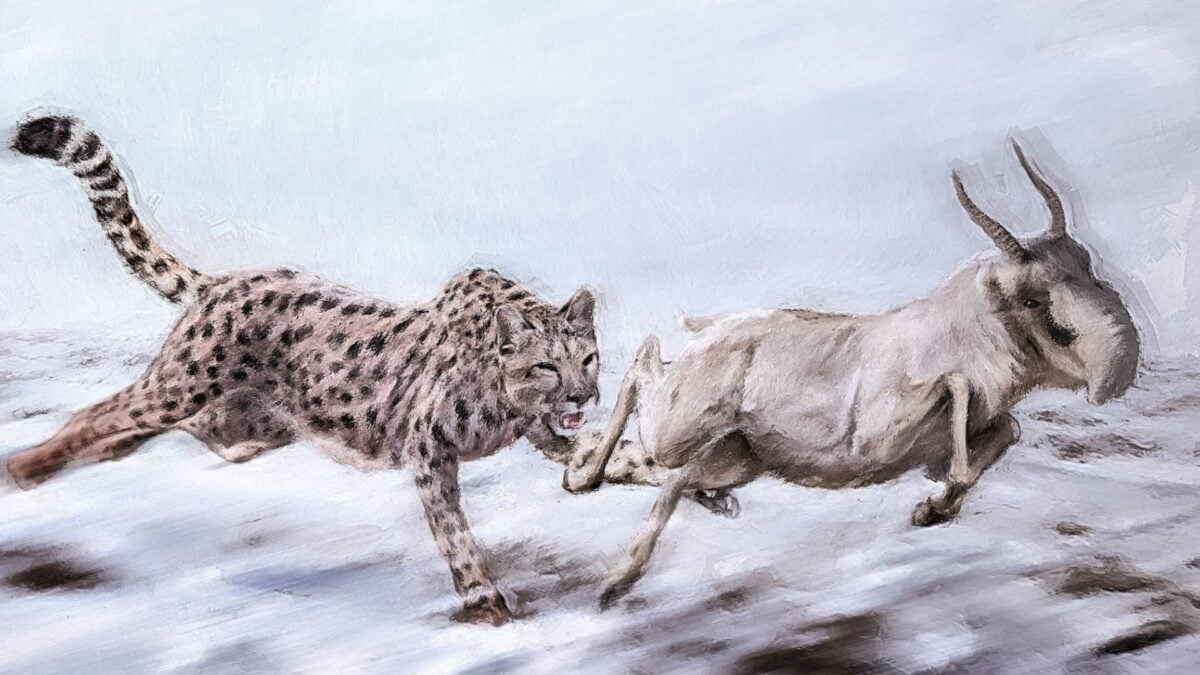
Miracinonyx trumani, an extinct big cat commonly known as the American cheetah, lived in North America during the Pleistocene. Its nickname comes from its resemblance to modern cheetahs, including physical traits suitable for high-speed pursuit. But scientists’ understanding of this ancient predator has changed in recent years and now researchers have discovered surprising new details about the species. The findings, published today in the journal Current Biology, add to a growing body of evidence suggesting that this “cheetah” was not a cheetah after all. Rather, it was a highly adaptable relative of the puma. This new study also expands the range of M. trumani to the north. While populations in regions known today as Wyoming and Florida lived as generalist predators on temperate grasslands, populations in the Arctic Yukon (once part of Beringia, a prehistoric land bridge connecting Asia to North America during the last Ice Age) specialized in eating fish. Before this study, experts had no idea that M. trumani lived so far north. The fact that this population has created its own unique niche, feeding primarily on salmon and other fish to survive in a hostile ecosystem, speaks to its incredible adaptability. “Pleistocene Beringia is a really well-studied paleontological ecosystem, so it’s great to be able to add a new carnivore to a really well-studied ecosystem,” said lead author Molly Cassatt-Johnstone, Ph.D. candidate at the Paleogenomics Laboratory at the University of California, Santa Cruz, told Gizmodo. The Mystery of the American Cheetah When the American cheetah was first officially named and described in 1979, fossil evidence pointed to its strong convergent morphology, or shared characteristics, with modern cheetahs. For example, these ancient cats had elongated legs and large sinuses, both classic adaptations for chasing prey at high speeds, according to Cassatt-Johnstone. “That was the first understanding of this species,” he said. “We have an American cat that seems adapted to high-speed pursuit, so we have an American cheetah.” But as scientists dug deeper, their picture of this long-lost predator became more complicated. In 2005, researchers sequenced mitochondrial DNA from a M. trumani fossil found in Wyoming, creating the first genetic record of the American cheetah. However, their findings suggested that this species was more closely related to modern pumas than to cheetahs, “which evolutionarily makes sense,” Cassatt-Johnstone said. “Pumas are a New World lineage; they are found in the Americas. Cheetahs are from the Old World, meaning Asia and Africa, so there would have had to have been a migration event if they were more closely related to cheetahs,” he explained. Over the last decade, more studies have questioned the assumption that M. trumani was a specialized, high-speed predator. The findings published today confirm that this cat not only looked much less like a cheetah than scientists believed, but also probably has no modern analogue. A cat itself Cassatt-Johnstone and her colleagues analyzed ancient DNA and stable isotopes from big cat fossils found as far north as the Yukon. When researchers first received specimens between 23,000 and 31,000 years old, they thought they might be pumas, since paleontologists had found remains of those cats in the region before. “Our job was to discover what [species] belonged, and we were very surprised when we discovered that they were not pumas, they were American cheetahs,” Cassatt-Johnstone said. Until then, experts had not thought that this species lived in Beringia. Its presence there is particularly surprising given that the region was heading towards the Last Glacial Maximum, so the Arctic ecosystem was very different from that of the Lower 48. Genetic analysis confirmed that M. trumani was actually a sister species to the modern puma, having diverged from that lineage about 2.6 million years ago. Researchers now believe that its cheetah-like characteristics are a striking example of convergent evolution, when two unrelated species (in this case, M. trumani and the modern cheetah) evolve similar traits to survive in similar environments. From the fossils, the researchers reconstructed the diets of the animals. Those who lived in the Arctic specialized in eating fish, probably using their powerful forelimbs. to get them out of the water. “Reconstructing their diet was really amazing, and I think it really shows that these cats, like other cats or other living species today, are incredibly flexible,” Cassatt-Johnstone told them. While the debate over the lineage of M. trumani may be resolved, there are still unanswered questions. Cassatt-Johnstone hopes that future studies will delve into the evolutionary history of this species and the puma to determine if they coexisted in North America and if there was competitive overlap between them.