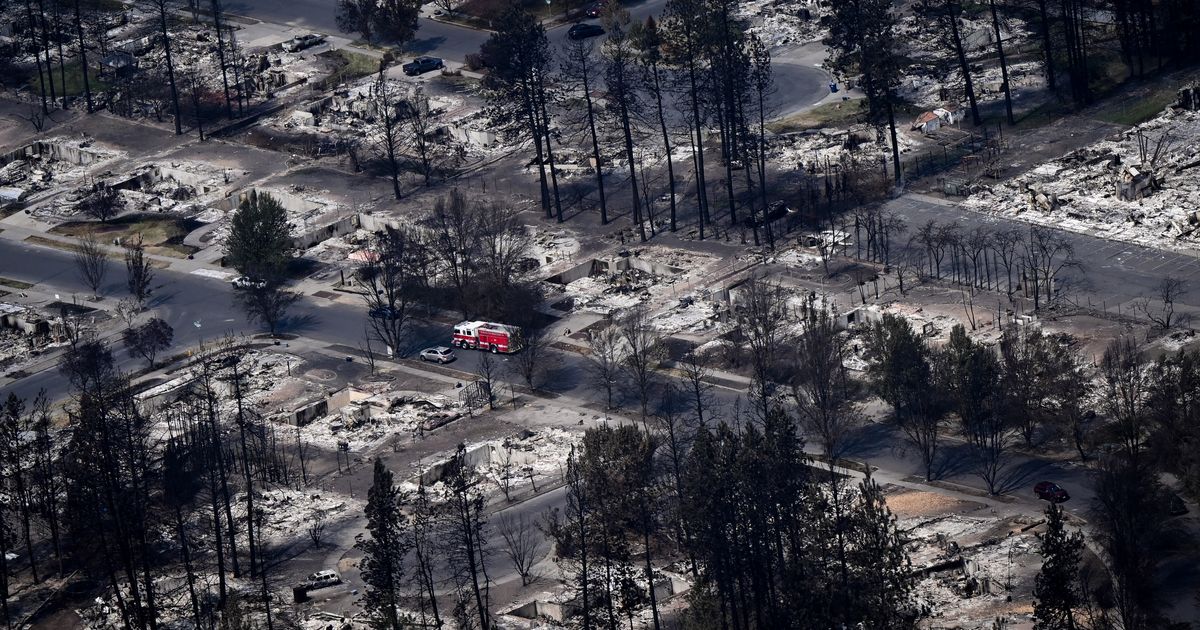
Roaring flames swept indiscriminately across Spokane County the week after August 1. The Old Trails, Autumn Lane and Fairview fires jumped valleys, razed dense ponderosa pines and climbed up and down hills and cliffs. They raised columns of smoke and burning embers. They left behind ash, charred wilderness and craters where houses once stood. More than 65,000 people fled their homes and stayed away for more than a week, leaving behind souvenirs, family heirlooms and medicine. Some livestock and pets were evacuated, but many were left behind. Firefighters across the region made few stops, inside areas of homes, as strong winds and dry conditions fueled the staggering damage. Experienced first responders braved the flames, many fighting for hours despite having little protective equipment, resources and sleep. In total, 833 structures were lost or damaged in what are now known as the Spokane Complex fires. Of those, 615 were from the Old Trails Fire, 160 from the Autumn Lane Fire and 58 from the Fairview Fire. On Friday, The Spokesman-Review boarded a 1978 Cessna with flight instructor Jon Griffin of Northwest Flight Service to get an aerial perspective of the aftermath. The two-hour flight marked what experienced firefighters, wildfire experts and local elected leaders have struggled to put into words in the nearly two weeks since flames ripped through neighborhoods in the northwest city of Spokane, burning homes and blackening recreational areas in the Little Spokane River Valley and leveling fields and forests near Mead. Griffin let out a soft gasp as he flew a few thousand feet above what little remains of the Indian Trails neighborhood on Friday. It was the first time he had boarded his plane to see the destruction in person. “Jesus,” Griffin said, his voice crackling through his headphones. “Could you look at that?” Autumn Lane Lake Spokane is three-quarters of a mile at its widest point. The distance appears significant from the sky. But as the Autumn Lane Fire burned through hundreds of acres of the northernmost tip of Riverside State Park and approached the water, it sent embers into the sky where winds exceeding 45 mph carried the lighters across the river, where they ignited brush and trees. The fire burned 5,700 acres, including Lookout Mountain. A thicket of trees that look like toothpicks seen in the air is all that remains of what had been a forest of tall ponderosa pines that guarded a strip of the southwest bank of the Spokane River. Across the river is Suncrest. Traces of some burned structures are scattered among the mostly standing houses of the rural community. In a normal cul-de-sac bordered by green gardens is a crater, all that remains of the house that once stood at the end. Patches of black, gray and white debris left by the fire spread everywhere. The algae bloom in Lake Spokane is a jolt of green across the landscape, framed by pink and red patches of flame retardant. Old Trails It’s a wonder how a house in the Indian Trails neighborhood still stands. On West Rifle Club Road, the neighborhood around Westgate Park resembles the chaos of a wildfire. Green courtyards and standing houses pile up near the ash-laden rubble of destroyed homes. The Old Trails Fire destroyed more homes than the other two combined after jumping the Spokane River, the first fire to do so on August 1. In total, more than 3,100 acres burned. Avista crews were in the area on Friday, their work trucks looking like matchboxes and dealing with damage on a monumental scale. Its crisp coat of glossy paint stands out among the carcasses of charcoal gray windowless cars littering the streets. Conditions could have allowed the Old Trails Fire to merge with Autumn Lane and engulf much more of the northwest corner of Spokane County. But a long, contiguous Pepto-Bismol-colored stain left by flame retardants separates the two across miles of roads, homes and power lines. It is proof of the important air support used to fight the fires. Griffin then flew further east. Fairview “Wow,” Griffin said. “Clear to the top of the plateau.” Peone Prairie is usually amber in August. Spring wheat is ready for harvest and farmers are receiving a second and third cut of alfalfa. The Fairview Fire left the prairie covered in a blanket of scraggly calico: large, burned black fields sit right next to untouched grain. In the agricultural area there are destroyed structures. The rural nature of the area likely helped prevent the fire from destroying more homes. Residents also played a role in protecting homes in the area. Tire tracks and overlapping cut stripes left by tractors and disc harrows when farmers scraped their own firebreaks. Closer to Spokane’s urban core, a lone orchard served as a splash of green in an otherwise scorched field. The fire reached Highway 395. On the other side of the hill, just out of sight of drivers, are the ashy white footprints of trees in the ground, marking exactly where they fell and burned. “I drove 395 just this week,” Griffin said. “I didn’t see all that.”