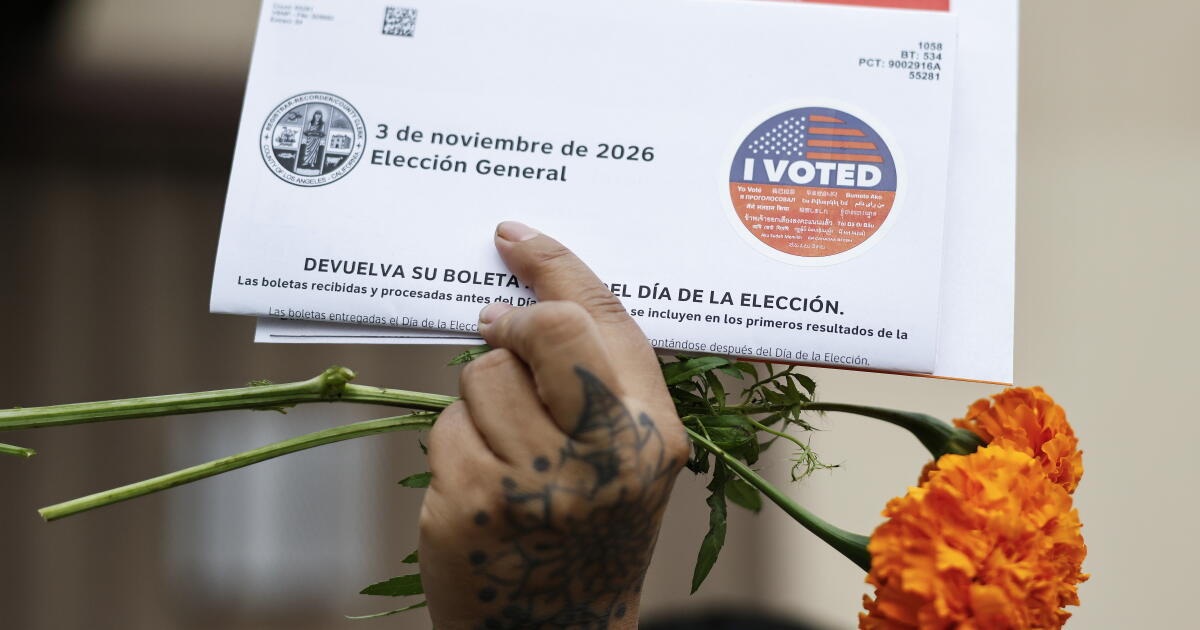
WASHINGTON — Acting quickly and emphatically, the Supreme Court on Monday rejected the Trump administration’s attempt to void the ballots of 20,000 California voters who the administration says may not be citizens. The justices dismissed the emergency appeal without comment or dissent, a rare rebuke for President Trump’s lawyers. Attorney General D. John Sauer appealed Monday, saying the court must “segregate” these California ballots before they are processed by state. and local election officials and counted. The appeal went to Judge Elena Kagan, who oversees the Ninth Circuit Court of Appeals. In the normal course, he could have asked California lawyers to respond. Instead, the court issued a one-line order: “The request for injunctive relief pending appeal filed before Justice Kagan and referred by her to the Court is denied. The ruling continued a series of losses in election-related litigation for the Trump administration in recent days, and marked a substantial rebuke to a signature campaign by the president and his supporters to impose the administration’s will in a state election as votes are counted. It was hailed by California leaders. “I am glad that “SCOTUS agrees that Trump’s attacks on California elections are BASELESS and UNCONSTITUTIONAL,” wrote Sen. Alex Padilla (D-Calif.) in X. “This latest decision should end the Administration’s attempt to disrupt California elections through emergency court orders. But our job is not done,” said California Attorney General Rob Bonta. “We will remain vigilant and continue to fight federal efforts to undermine our democracy.” The decision left no clear path forward for the Trump administration’s demands that ballots be set aside in time to prevent their counting, which Justice Department lawyers appeared to acknowledge. Shortly before the Supreme Court ruled, First Assistant U.S. Attorney Bill Essayli, the lead prosecutor in Los Angeles who argued The case before the lower district court, said the government’s lawsuit would be essentially “moot” if intervention were not immediate. “The time to act is now,” he said. The administration had previously lost before a federal judge in Los Angeles and twice in the Ninth Circuit Court of Appeals in San Francisco. Those judges said Trump’s lawyers were wrong about the Constitution (which reserved power over elections to the states and Congress, not the executive) and that their complaint came too late for this election. California Governor Gavin Newsom criticized the administration’s appeal as baseless after repeated defeats in the lower courts, and the government’s claim of an emergency as dubious given its own actions in recent days. “Trump and his administration have never understood what ‘NO’ means, and it seems that after being told ‘NO’ three times last week they are still not sure. “After sitting on this for over three days, they are now asking for ’emergency’ help on the eve of the election,” Newsom wrote on As of Sunday, more than 6.4 million votes had been cast, according to the office of California Secretary of State Shirley Weber. Those ballots are already being counted, according to California law. In mid-October, the Trump administration filed a lawsuit, saying federal courts should require California and Los Angeles County to “separate mail-in ballots from people identified by the federal government as likely noncitizens.” The lawsuit was filed just days after Justice Department officials gave Weber and Los Angeles County Recorder/County Clerk Dean Logan a 48-hour deadline to begin cooperating with federal authorities to set aside ballots for about 20,000 voters the administration had determined might not be citizens. Weber, Logan and a host of other voter advocacy groups and election experts have questioned the reliability of the administration’s list, which was compiled using a combination of voter data purchased in California and taken from commercial platforms, according to the administration. County officials and analysts at the UCLA Voting Rights Project have said the lists contain U.S. citizens and others who are not registered to vote. A Justice Department lawyer, in a separate case Monday, acknowledged that the lists have a “high error rate.” They emphasized that they are only asking that marked voters’ ballots be reserved while state and federal authorities work together to determine whether the voters are citizens, which they said could be accomplished relatively quickly if the state simply complied with their collaborative requests. They also said the courts’ emergency intervention was necessary because California law allows ballots to be counted before Election Day, and once a ballot is cast in person or removed from the mailing envelope, it cannot be segregated again from the vote total. Federal law says that within 90 days of an election, officials cannot “systematically remove the names of ineligible voters from official lists of eligible voters.” Separately, the Supreme Court has also repeatedly disapproved of “last-minute, court-ordered rule changes” related to elections. Federal laws are generally considered the “supreme law” and override conflicting state laws. state to vote and cast an illegal vote. But the electoral rules and procedures are different. The Constitution says that “the times, places, and manner of holding elections for Senators and Representatives shall be prescribed in each state,” unless Congress acts by law to “alter” its regulations. The Ninth Circuit judges in Friday’s opinion referenced that constitutional divide. “If the United States believes that different procedures are necessary for mail-in ballots, we believe it should take that suggestion to Congress, not the courts,” Judge Mark said. J. Bennett, appointed by Trump, and Gabriel P. Sánchez, appointed by Biden. Dissenting Judge Patrick J. Bumatay, a Trump appointee, called the administration’s proposal to separate the 20,000 ballots a “reasonable request” and a “modest remedy” to the problem of illegal voting. The majority cited a 2013 opinion written by the late Justice Antonin Scalia. responsibility for the mechanics of congressional elections,” unless Congress adopts a different rule. Scalia spoke for a 7-2 majority that rejected an Arizona law that required voters to show documentary proof of their citizenship when registering to vote. In the National Voter Registration Act of 1993, Congress said voters can register to vote by filling out a form and declaring under oath that they are citizens. California does the same under state law. Scalia said the federal voter registration law would not allow Arizona to adopt new, stricter rules. Dissenting, conservative Justices Clarence Thomas and Samuel A. Alito Jr. said they would go further to protect states from federal interference in elections. “Given the states’ exclusive authority to establish voter qualifications and determine whether those qualifications are met,” Thomas said, Arizona’s restriction should have been upheld. “The Constitution reserves to the states the power to decide who is qualified to vote in federal elections,” Alito added. “The Supreme Court should, and I believe it should. “Mar-a-Lago, which has been calling the shots on this, needs to understand this: Unless and until Congress provides clear legal guidance to the contrary, the Constitution reserves these decisions to the states.” Times staff writer Brittny Mejia contributed to this report.