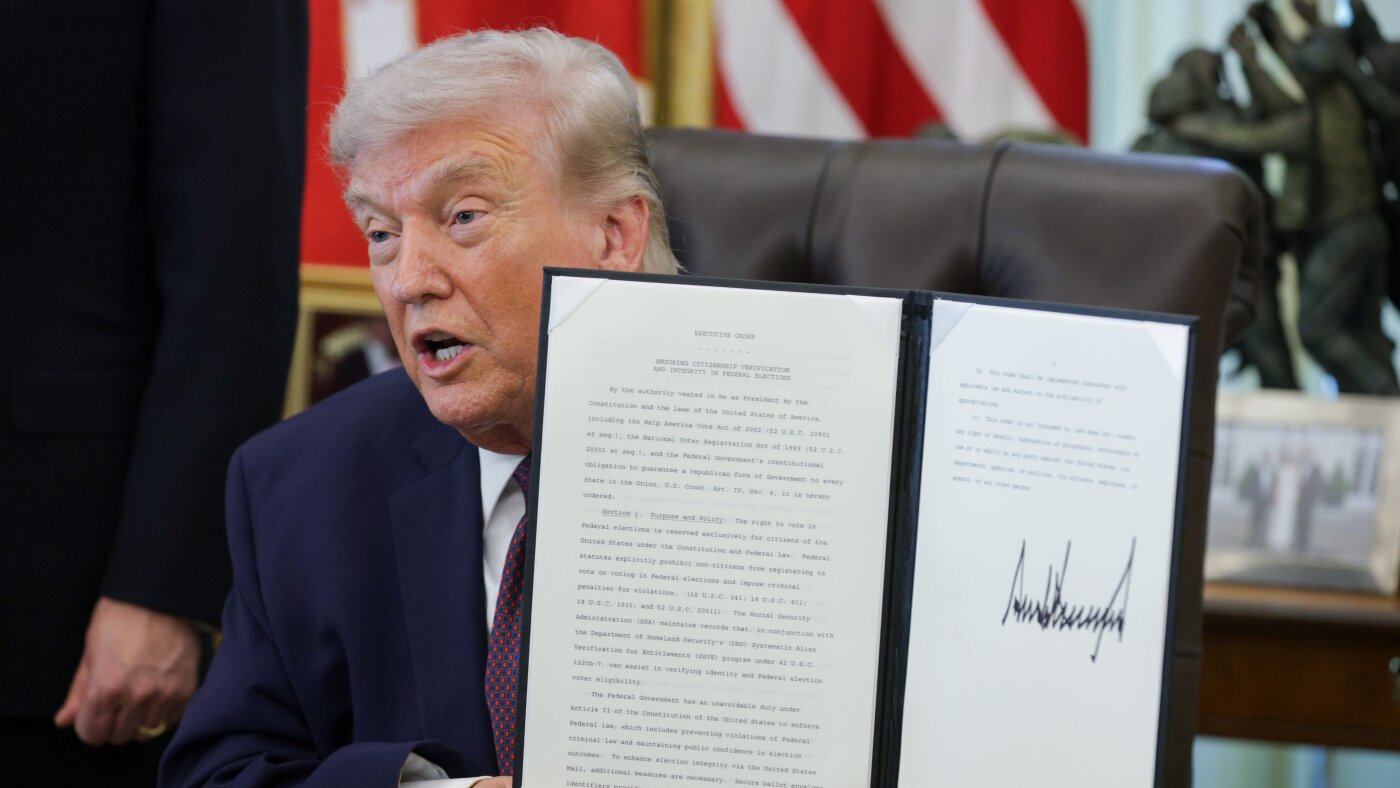
President Trump holds an executive order at the White House in March that calls for restricting voting by mail. Alex Wong/Getty Images hide caption toggle caption Alex Wong/Getty Images The Supreme Court has handed President Trump an interim victory in his effort to restrict mail-in voting. But with just weeks to go until voting begins in this fall’s midterm elections, legal and practical challenges are emerging over whether the U.S. Postal Service and other federal agencies can finish implementing Trump’s directives. On Monday, the conservative-led high court halted a lower court ruling that had blocked key parts of an executive order Trump issued in March. The lower court ruling applied to 23 primarily Democratic-led states, plus Washington, D.C., that sued the administration. The Supreme Court’s decision had no bearing on the legality of Trump’s executive order, which so far has not directly affected eligible absentee voters’ option to cast their ballot by mail. Instead, the ruling focused on the ability of states, mostly led by Democrats, to defy Trump’s order when they did so. A broader court order remains in effect. As part of a separate but related lawsuit, the Postal Service cannot follow Trump’s directives under a nationwide ruling released Aug. 11 by U.S. District Judge Indira Talwani in Boston. But in a court filing Monday night, the administration says it plans to ask the U.S. Court of Appeals for the First Circuit to stay that ruling if Judge Talwani does not stay or vacate it by 5:30 p.m. ET on Tuesday. A dozen Republican-led states have already appealed that ruling. It was a previous decision by Talwani, in June, that the Supreme Court ruled on Monday. The justices’ decision marks the latest court action in the legal fight over Trump’s March executive order, one of many efforts he has made to try to exert control over how the election is run. What the Supreme Court has decided for now The high court’s unsigned order on Monday said its “disposition of this application does not mean that any measure taken by the Government to implement the Order will necessarily be legal.” “In this regard, time will tell,” the court noted. The court’s three liberal justices, however, dissented from the court’s decision. In a dissenting opinion, Justice Ketanji Brown Jackson noted that the Supreme Court’s ruling “unnecessarily injects chaos and uncertainty into the upcoming midterm elections.” “To be sure, the Court has not prevented states from challenging this blatantly unconstitutional order,” Jackson added. “But it refuses to explain when, exactly, is the right time to file a meritorious claim about election rules challenging unconstitutional interference in election processes. The majority simply notes that these plaintiffs had to wait—even though the election cycle had begun and despite facing out-of-pocket costs, threats of prosecution, and an affront to their sovereignty—before receiving the relief to which they are likely entitled.” After the high court’s decision, New York State Attorney General Letitia James, a Democrat, said states challenging Trump’s order are now exploring legal options. “This decision is a painful setback, but it will not be the final word,” James said in a statement. “The right to vote is sacred and no administration should be allowed to jeopardize that right by making it difficult for eligible voters to cast their ballots.” How Trump’s order could affect mail-in voting Trump’s order requires the Department of Homeland Security to develop state lists of adult U.S. citizens and the Postal Service to obtain lists of eligible mail-in voters from states. Additionally, USPS is supposed to deliver mail-in ballots only to people on those lists. All election officials would also be required to have certain barcodes on their mail-in ballot envelopes. The Postal Service has released a final rule for federal mail-in ballots in response to Trump’s order. Trump, who voted by mail as recently as this year in Florida, has said he issued this order to stop illegal voting by non-U.S. citizens in federal elections, something that research shows is infinitely rare. Talwani’s June ruling concluded that Trump overstepped the president’s authority under the Constitution, which gives power to state legislatures and Congress to set federal election rules. The judge concluded that the USPS, which is independent of the president’s administration, also has no legal authority to control mail-in voting. But with its order Monday, the Supreme Court has accepted emergency requests from the administration and 12 Republican-led states to stay the judge’s June ruling in 23 states and Washington, D.C., without weighing in on the legality of Trump’s order. The legal fight is far from over, and a series of separate lawsuits led by Democrats and voting rights groups continue to unfold as this fall’s election approaches. The administration has previously acknowledged that the window of opportunity to implement Trump’s order for this year’s midterm elections is narrowing. In a court filing in July, U.S. Attorney General John Sauer noted that there may not be enough time to resolve legal challenges through the court appeal process. “That’s especially true because implementation efforts for any USPS rule or DHS policy will need to begin well before November (in fact, as early as mid-August) to be effective for the 2026 election, particularly given that absentee and mail-in voting begins (in some states) several weeks before Election Day,” Sauer said. Editor’s note: USPS financially supports NPR. Edited by Benjamin Swasey.