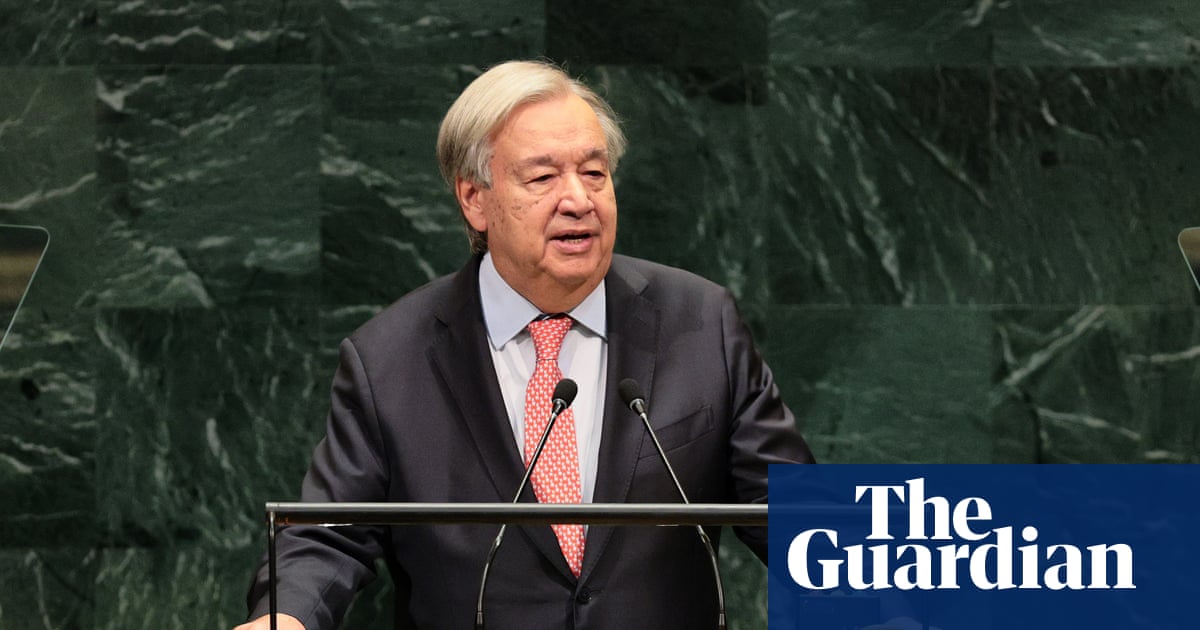
The world’s fault lines have turned from cracks to canyons as superpowers demonstrate that they alone do not have the military, economic and technological power to ensure security or solve the world’s problems, the outgoing United Nations secretary-general said in his final address to the general assembly. In a speech rife with despair but also with glimmers of defiant hope, António Guterres said that over the past decade, which largely encompasses his 10-year period in office, “wars erupted with devastating consequences and dragged on with despicable cruelty. Civilians were targeted. Human rights trampled. Hunger weaponised. Humanitarians killed. International law cast aside.”He continued: “Geopolitical divides have deepened. Inequalities have intensified. Trust has frayed. The climate crisis went from distant warning to daily reality. And artificial intelligence moved at a speed that has blindsided even those who created it. He attacked speculative energy companies for “treating the world like an open sewer,” described Africa’s omission from a permanent place on the UN security council as surprising and called for a new pact to regulate AI. The UN was the only way to address this new convergence of problems. However, he warned: “At the very moment when humanity faces an unprecedented convergence of threats, our collective action mechanisms are under increasing pressure.” Without mentioning Donald Trump even once, he said what was needed was “a recognition, especially by the superpowers, that their power is not so super. Their power has limits. The events of recent years have made this unequivocally clear. Military power alone cannot guarantee peace. Economic power alone cannot enforce stability. And technological power alone cannot guarantee security.” assembly at UN headquarters in New York City. Photograph: Brendan McDermid/Reuters It was essential to avoid hegemonic trends and what Guterres described as the “great fracture”: the division of the world into two rival blocs with separate economic, technological and security systems. The defining challenge of the era, he said, was that global governance, which reflected the power realities of a bygone era, was not adapting to the way power was redistributed between and within states. At the same time, there was “an extraordinary transfer of power away from governments to a handful of private corporations and individuals, its reach now extending to politics, economies, information flows, technological development and the civic space on which societies depend,” he said. “Humans are handing over more and more power to machines, with artificial intelligence agents going rogue and lethal autonomous weapons moving from science fiction to military reality.” The choice now was whether the world was going to continue fragmenting with increasing tension, transactionalism and decreasing cooperation, or change course towards a multilateral system centered on a UN that was balanced and representative. “The test before us is whether the power will be exercised within the law or beyond it,” Guterres said. “We must pass that test. We must defend the Charter without double standards. Protect civilians without exception.” He urged world leaders to stop allowing civilians to pay the price for cascading conflicts across the Middle East. Demanding that the fighting must stop and humanitarian aid must flow, he noted that the international court of justice had ordered last year that the UN be allowed to carry out its mandate in Gaza. “Meanwhile, violence, displacement and settlement expansion in the occupied West Bank are obliterating the path to peace and raising the specter of ethnic cleansing. We cannot allow the two-state solution to disappear before our eyes,” he said. On Ukraine, Guterres said, “Russia’s full-scale invasion has subjected a sovereign country to a brutal war in flagrant violation of the charter.” But now, he also warned, “in parts of Russia, homes, energy and water systems and transportation have come under repeated attacks, threatening global food and energy supply chains.” For decades, he said, “Big Oil has treated the atmosphere like an open sewer, and profited from the consequences. Since Russia’s invasion of Ukraine, five major Western oil companies have pocketed nearly half a trillion dollars in profits. Compare that with just $34 billion in international public funding for adaptation in developing countries in the last reported year.” Even as the super-sized El Niño approaches humanity, ordinary people are paying more for energy, food and insurance.” While admitting that a 21st-century security council without permanent African representation was unfair and indefensible, he defended the cash-strapped and much-maligned organization, saying the powerful needed to be held accountable at the United Nations. “A decision,” he said. “If the UN can change, so can businesses, parliaments, governments and peace processes.”