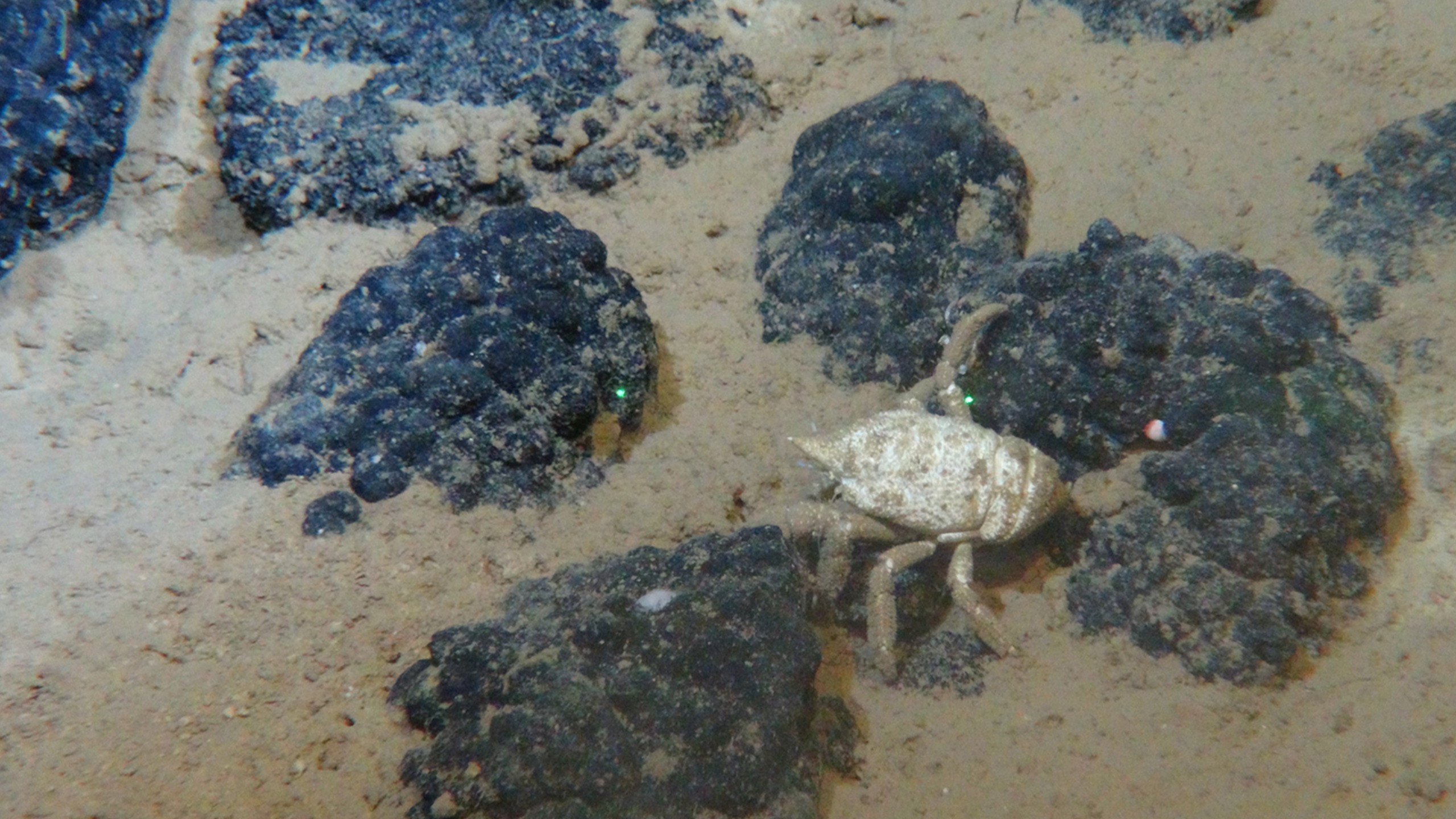
Polymetallic nodules cover the seafloor throughout the Clarion-Clipperton zone, and new research shows that each of these strange metallic potatoes contains an entire community of microscopic life unique to this habitat. There’s a reason humans have called them polymetallic nodules: we’re really interested in the metallic part. Our society’s dependence on metals like nickel, cobalt and copper is growing rapidly, and these nodules are loaded with them, as well as iron and manganese. But polymetallic nodules are not an easily renewable resource. Although it only takes a few minutes to extract a nodule from the seafloor, it took millions of years for it to form. Scientists fear that this speculative industry could destroy a unique ecosystem we barely knew existed before we have a chance to understand it. “Our findings indicate that commercial mining may result in a unique and undescribed irreversible loss of biodiversity associated with nodules,” says deep-sea biologist Sabine Gollner, from the Royal Netherlands Institute for Marine Research. “This must be considered in the environmental management of deep-sea mining.” The research is published in Scientific Reports. The nodules were collected in 2019 by a team of scientists participating in an expedition to the Clarion-Clipperton Zone aboard the German research vessel RV Sonne, as part of the JPI Oceans Mining Impact II project. a) The locations where the polymetallic nodules were collected. b) Box cores showing the nodules and surrounding sediment. (Díaz-Recio Lorenzo et al., Scientific Reports, 2026) The team carefully lowered a box corer to depths of around 4 to 6 kilometers (2.5 to 3.7 miles) to take a piece of sediment from the seafloor and the nodules embedded within it. For this study, researchers examined 244 individual nodules for signs of life in the cracks and pores. The nodules (and their marine inhabitants) were then frozen and taken to a laboratory. One hundred and fifty-three of the nodules came from an area where Germany’s Federal Institute for Geosciences and Natural Resources (BGR) has an exploration contract from the International Seabed Authority. Another 91 were collected in an area where Belgian company Global Sea Mineral Resources, a subsidiary of DEME, has an exploration contract. Most biodiversity assessments in the Clarion-Clipperton zone so far have focused on organisms that live in the sediment or cling to the surface of nodules. Much of the deep sea is covered in fine mud, but many of the animals that live there need a more solid surface to adhere to: polymetallic nodules provide an ideal substrate for those creatures. “We already knew that polymetallic nodules provide attachment surfaces for deep-sea organisms, but very little was known about the animals that live inside them,” marine genomicist Coral Díaz-Recio Lorenzo told ScienceAlert. By opening the nodules, the scientists found bustling miniature ecosystems along the nooks and crannies. Roundworms and crustaceans were the most common inhabitants, and one species of “armored amoeba,” Thurammina, dominated its kind. In just a few nodules, they recorded bristle worms, mud dragons, tardigrades and other less common creatures. “What surprised us most was how different the communities living inside the nodules were from those in the nearby sediments,” Díaz-Recio Lorenzo said. “Surprisingly, nodule communities collected in areas separated by approximately 1,000 kilometers were more similar to each other than to surrounding sediment communities.” Using microscopes to take a closer look at the nodules, the researchers also found fossils of diatoms, radiolarians and marine sponges embedded within the ancient layers. Example of cross section of a polished polymetallic nodule and examples of microfossils that can be found inside. (Díaz-Recio Lorenzo et al., Scientific Reports, 2026) “The presence of… biogenic particles within the cracks indicated that at least some cavity structures were colonized by ancient organisms, although this does not necessarily demonstrate in situ colonization at the time of incorporation,” the team writes. “The sponge spicules were visible in the [scanning electron microscope] images and the presence of the foraminiferal species Saccorhiza sp., which uses sponge spicules to construct its tests. [shell-like structures]indicates that the nodules may have provided habitat on the seafloor for millions of years.”Graphic summary of microscopic animal communities in polymetallic nodules. (Dr. Coral Díaz-Recio Lorenzo)If the ISA grants approval for deep-sea mining companies to extract the nodules en masse, these ancient ecosystems will be irreversibly destroyed. “Because their communities differ from those in the surrounding sediments, habitat protection of sediment alone would not preserve this biodiversity”, Díaz-Recio Lorenzo “Large-scale nodule removal could therefore lead to irreversible losses of unique species and ecological communities that we are only beginning to understand.” These distant, microscopic worlds may seem quite isolated from our own, but the reality is that we still have no idea how they influence global networks of nutrients, carbon and ecology. Scientists are in a race to find out before it is too late. The research has been published in Scientific Reports. This article was fact-checked by Fiona MacDonald and edited by Fiona MacDonald. While we take pride in our process, we’re human. If you spot an error, please let us know.