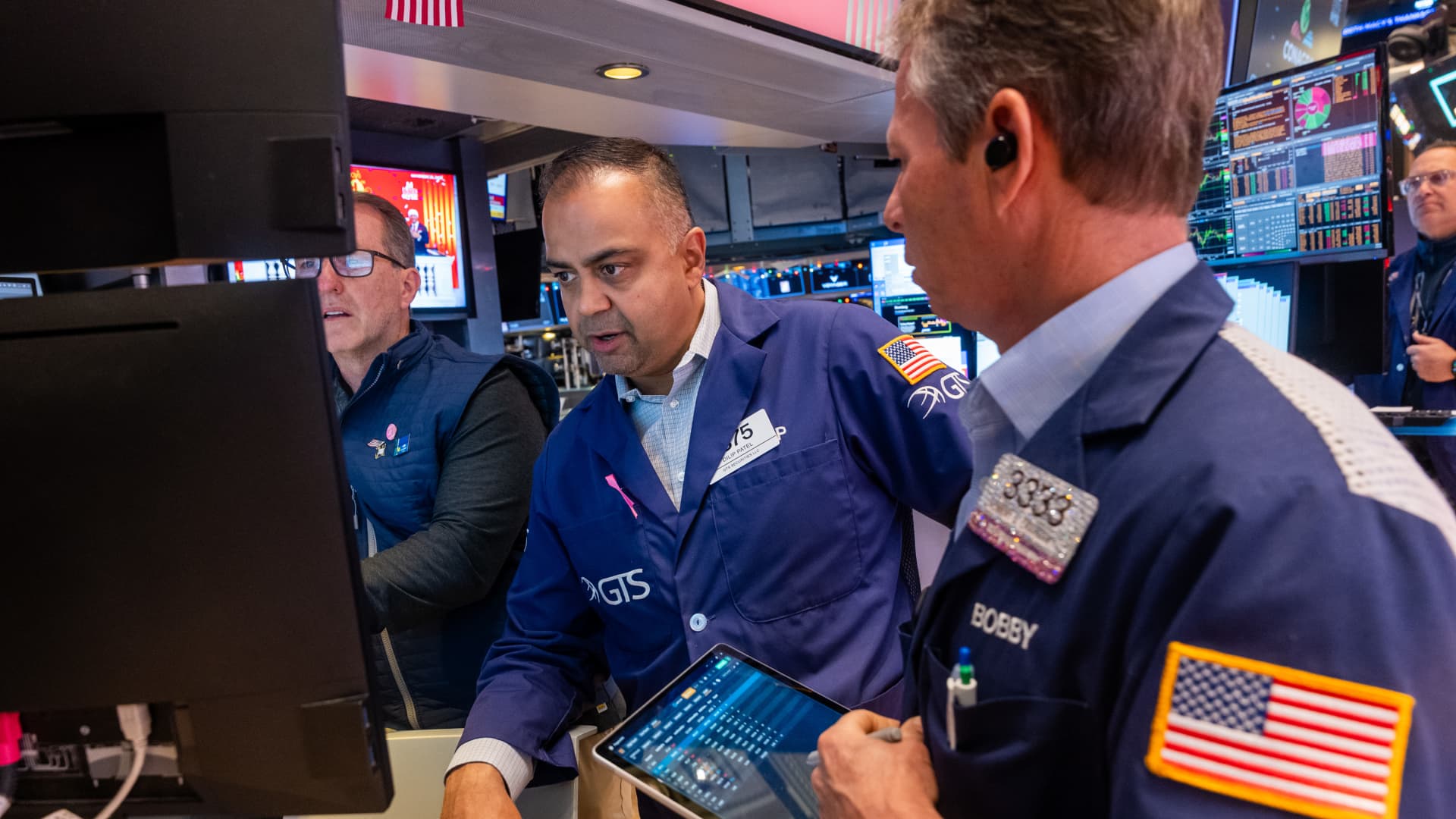
Traders work at the New York Stock Exchange (NYSE) on November 25, 2026, in New York City. Spencer Platt | Getty ImagesUSA Stock futures rose Thursday night as investors set to wrap up a turbulent trading week that was shortened by the Thanksgiving holiday. S&P 500 futures rose 0.7%, while Nasdaq-100 futures advanced 0.6%. Futures linked to the Dow Jones Industrial Average rose 277 points, or 0.6%. The moves come amid a volatile week during an even more volatile month. In Asia, Japan’s Nikkei 225 rose 0.3%, while South Korea’s Kospi rose 0.6%. Australia’s S&P/ASX 200 added 0.40%. The week began with the reinstatement of Jensen Huang as CEO of Nvidia, a move that sent the stock up 31% during Monday’s session and propelled the S&P 500 and Nasdaq Composite to record their best days since April 2025. The Dow Jones Industrial Average advanced more than 1,400 points, or about 3%. The S&P 500 and Nasdaq have come under pressure as Nvidia and other AI-related stocks have lost some of Monday’s gains. That said, the two benchmarks are still on track to gain weekly performances, along with the Dow. The S&P 500 is up nearly 4% so far this week, while the Nasdaq and Dow are up more than 4%. The stock market was closed on Thursday for Thanksgiving and is scheduled to close on Friday at 1:00 pm Eastern Time. Before Huang’s departure earlier this month, sentiment toward AI trading was already bearish, with investors becoming increasingly concerned about debt financing, signs of moderation in capital spending and Democratic victories in the midterm elections, leading to a slowdown in the data center. “Hyperscalers ultimately have to get a return on investment, and ultimately they need to rebuild their free cash flow, and people like Anthropic need to show that they can generate the revenue growth that people expect and ultimately be very profitable and generate free cash flow as well,” Janus Henderson portfolio manager Richard Clode said Wednesday on CNBC’s “The Exchange.” “All of that has to go together ultimately, or that capex isn’t going to be sustained,” he added. “It’s all part of the wave of AI technology that we think will develop over five to 10 years at a minimum.” To be sure, some on Wall Street believe that while there are long-term anxieties around AI trading, the recent weakness has had more to do with the prospect of the Federal Reserve raising interest rates. The latest reading of the personal consumption expenditures price index this week reinforced traders’ expectations of multiple increases in the coming months. “Most of this really depends on the Fed. That’s the intermediate-term factor,” Warren Pies, co-founder of 3Fourteen Research, told CNBC’s “Closing Bell” on Wednesday. He added that “many” people his company spoke to expressed concern about a “repeat of 2018,” when the central bank raised rates four times. “I think there are so many eerie similarities, and that’s what we’re seeing.”