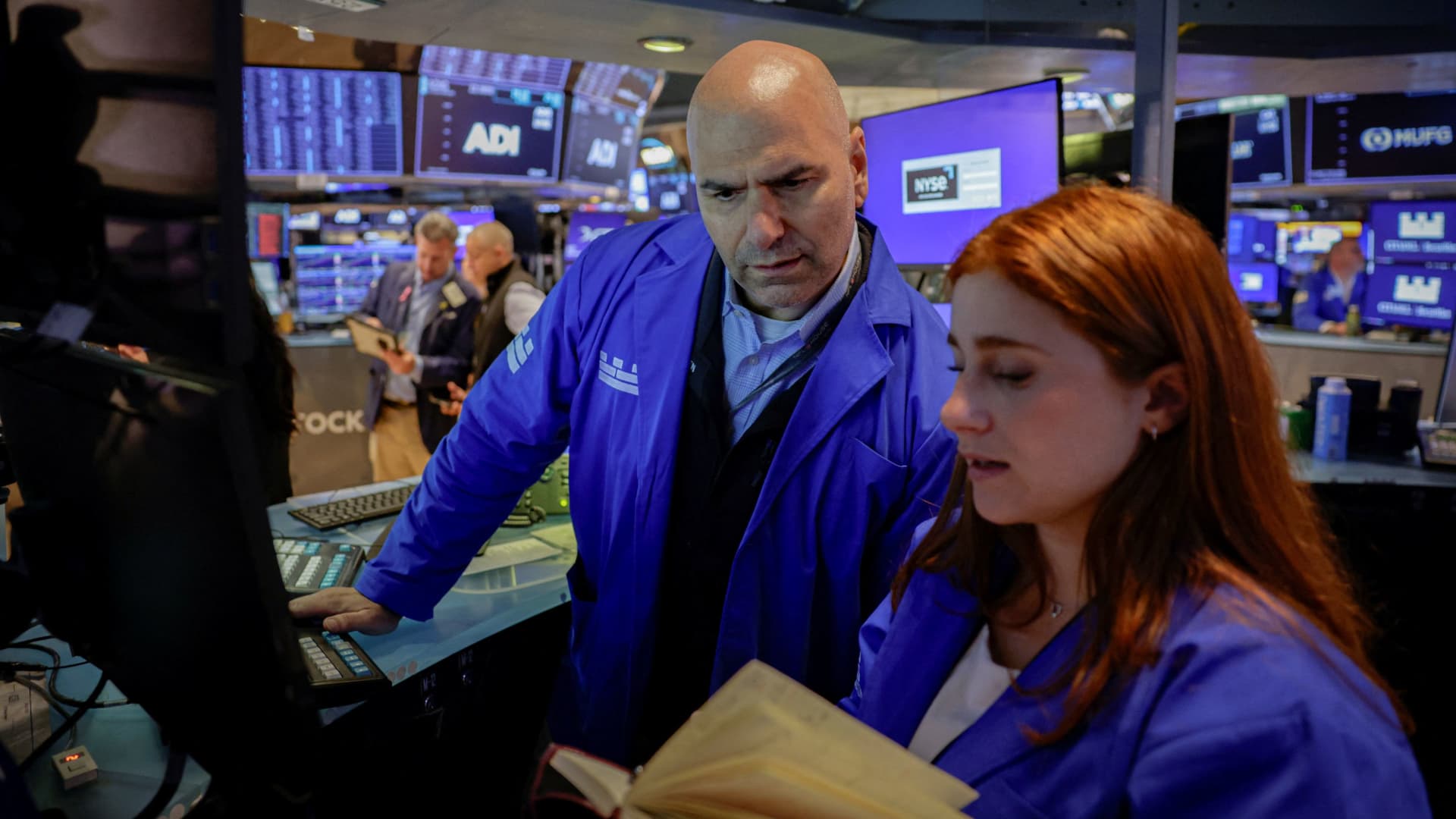
Traders work on the floor of the New York Stock Exchange (NYSE) in New York City, USA, August 4, 2026. Jeenah Moon | ReutersUSA Stock futures bounced Sunday as a shortened week began on Wall Street after all three major averages ended Friday in correction territory. Futures linked to the Dow Jones Industrial Average gained 673 points, or 1.4%. S&P 500 futures rose 2.03% and Nasdaq-100 futures rose 2.76%. In Asia, South Korea’s Kospi fell 3.16%, while heavyweights Samsung Electronics and SK Hynix fell about 3.6% and 3.2%, respectively. Australia’s S&P/ASX 200 was down slightly. Hong Kong’s Hang Seng Index fell 1.27% at its opening, and mainland China’s CSI 300 fell 0.58%. Japan’s markets were closed for a holiday. Last week, major indexes fell as concerns about AI trading continued to spook investors, despite Anthropic’s record debut on Thursday. At the end of last week’s decline (which was the worst weekly decline for the Nasdaq Composite and the Dow in more than six years, and the biggest for the S&P 500 since April 2025), all three major averages were in correction territory and the Nasdaq turned negative for the year. The Nasdaq-100 index ended Friday in intraday bear market territory, but was just shy of that mark as it fell from its closing high on Oct. 6. This week investors will get a reprieve, no matter what the price action looks like. Markets are closed on Thursday for the Thanksgiving holiday, and Friday’s session will be shortened with the closing bell scheduled to ring at 1:00 p.m. All eyes will be on the rocky tech trade, as investors examine whether last week’s sell-off represented the market finding a lasting bottom, or whether stocks have more room to fall. Drew Pettit, chief investment strategist at Roundhill, said in an appearance on CNBC’s “Closing Bell: Overtime” on Friday that the indiscriminate selling at the end of the week, which extended beyond technology, is a sign that the sell-off may be concluding. But he said the burden of proof is on the bulls to undermine the bearish sentiment dominating the market. “Basically, I think the floor is much higher,” he said of how low the stock could fall. “Technically… a number of catalysts are needed for the bulls to prove that the long-term earnings story is not broken.”