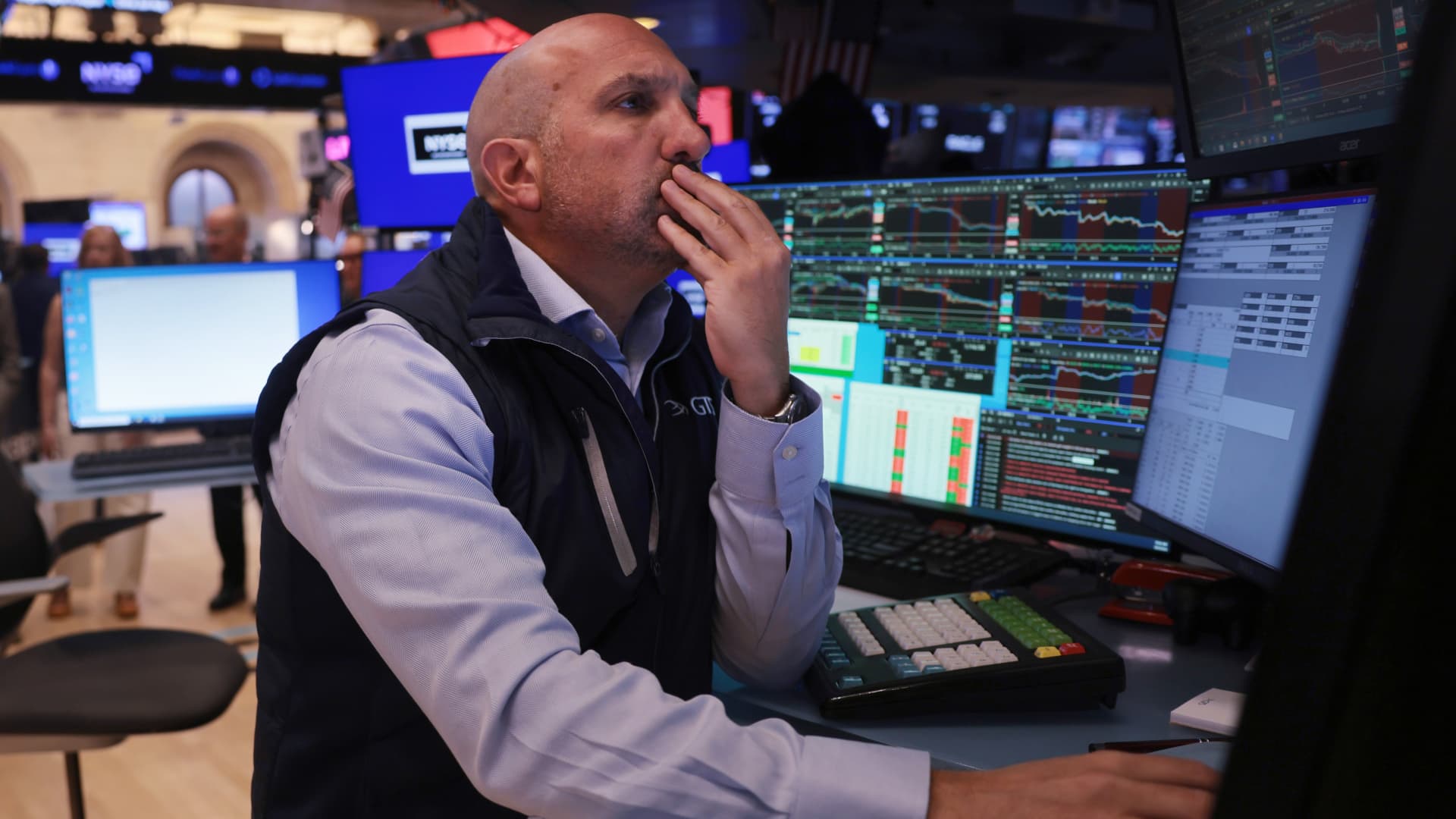
Traders work on the floor of the New York Stock Exchange (NYSE) on September 9, 2026 in New York City. Spencer Platt | Getty Images Stock futures were nearly flat Monday night as traders awaited the Federal Reserve’s policy decision due later this week and weighed a recent rise in oil prices and Treasury yields. S&P 500 futures rose 0.05%, while futures linked to the Dow Jones Industrial Average gained 21 points, or 0.04%. Nasdaq 100 futures advanced 0.03%. On the typical trading day, the Dow Jones was down 152 points, or 0.3%. The S&P 500 lost 0.5%, while the Nasdaq Composite fell about 0.6%. Asia-Pacific markets were mixed. Japan’s Nikkei 225 gained 0.6%, while the Topix lost 0.11%. South Korea’s Kospi fell 0.25% and the small-cap Kosdaq added 1.78%. Australia’s S&P/ASX 200 fell 0.7%. Hong Kong’s Hang Seng Index fell 0.3%, while the mainland’s CSI 300 fell 0.18%. A selloff in AI-related names has weighed on the stock market after Anthropic CEO Dario Amodei called for a slower pace in AI development. Over the weekend, OpenAI CEO Sam Altman also ruled out an initial public offering this year, pointing to growing concerns around AI safety. A number of AI-related stocks fell, with Nvidia falling 3% and specialist glass and fiber optics business Corning falling 13%. The iShares AI Innovation and Tech Active ETF (BAI) fell almost 4%. Higher Treasury yields also spooked investors. The 10-year Treasury yield briefly surpassed 5% on Monday, its highest level since October 2023. Oil prices also rose after Saudi Arabia shut down a key pipeline bypassing the Strait of Hormuz, leading Brent futures to close above $105 a barrel and West Texas Intermediate crude to settle above $101. Fed funds futures trading suggests a roughly 92% chance that the central bank will raise rates by a quarter point from the current target rate range of 3.5% to 3.75%. “We hope that the Federal Reserve, for the first time in [Chairman Kevin] Warsh, will raise his policy rate to an upper limit of 4.0% at this week’s meeting,” Christopher Hodge, chief US economist at Natixis CIB Americas. “We also believe he will emphasize that this decision was low-key and does not pre-commit the Federal Reserve to take any action in subsequent meetings, giving him and the Committee maximum flexibility to respond to shocks,” he added.