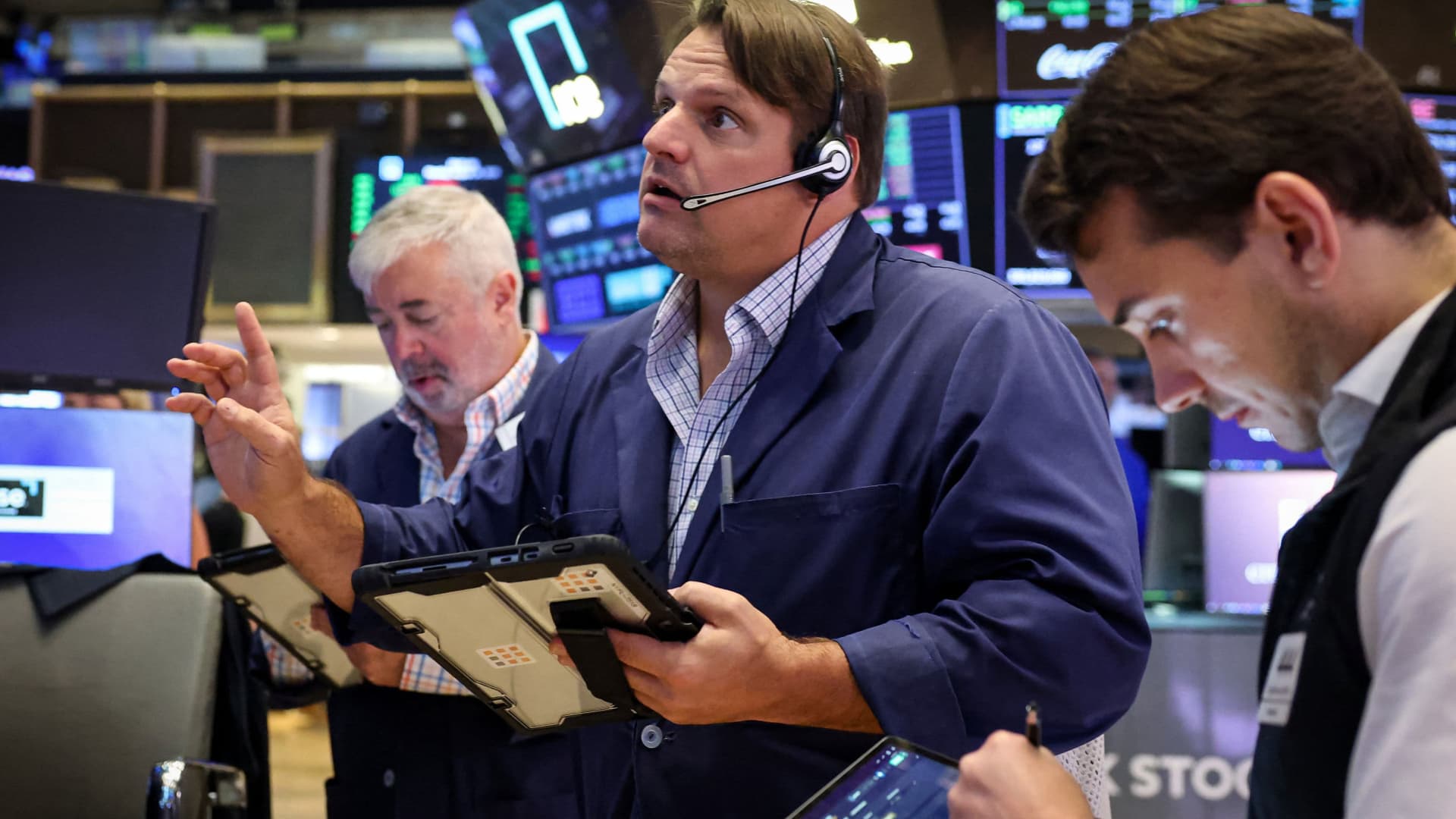
Traders work at the New York Stock Exchange (NYSE) in New York City, USA, August 24, 2026.Brendan McDermid | ReutersStock futures traded lower early on Tuesday after a losing session, although major US benchmarks still managed to post monthly gains. Dow Jones Industrial Average futures were down 0.54% as of 5:08 a.m. ET. S&P 500 futures fell 0.58% and Nasdaq-100 futures fell 1%. The S&P 500 advanced 2.6% in August, while the Nasdaq Composite rose 3.9% in that time. The Dow Jones rose 1.3% for the month, its fifth consecutive monthly advance. Wall Street closed the month on a sour note. The Dow Jones fell more than 370 points in regular trading as oil prices rose, sending rates higher, after the United States attacked two rocket launchers on Iran’s Larak Island. The S&P 500 and Nasdaq Composite also fell that day. “Despite trading within 115 bps of ATHs at the start of today’s session, the market is showing signs of nervousness across a host of indicators,” Goldman Sachs traders wrote, pointing to new data from the American Association of Individual Investors Sentiment Survey. “This attitude toward risk is not just theoretical: investors are literally putting their money where their mouth is in terms of portfolio risk allocations.” September has also been a historically bad month for stocks. Those seasonal factors, along with a packed economic calendar, are likely to keep investors on their toes for the rest of the week. Manufacturing and services sector data will be released on Tuesday and Wednesday. On Friday, investors will receive the August jobs report. Economists surveyed by Dow Jones expect 53,000 jobs to be created during the month. In Asia, Japan’s Nikkei 225 closed down 0.15%, while South Korea’s Kospi rose 0.23%. The Australian benchmark S&P/ASX 200 index fell 0.10%. Mainland China’s CSI 300 closed down 0.30%. European stocks fell across the board, with the regional Stoxx 600 index down 0.6% by mid-morning. Oil and gas stocks bucked the trend, trading 1.3% higher and tracking gains in crude oil prices.