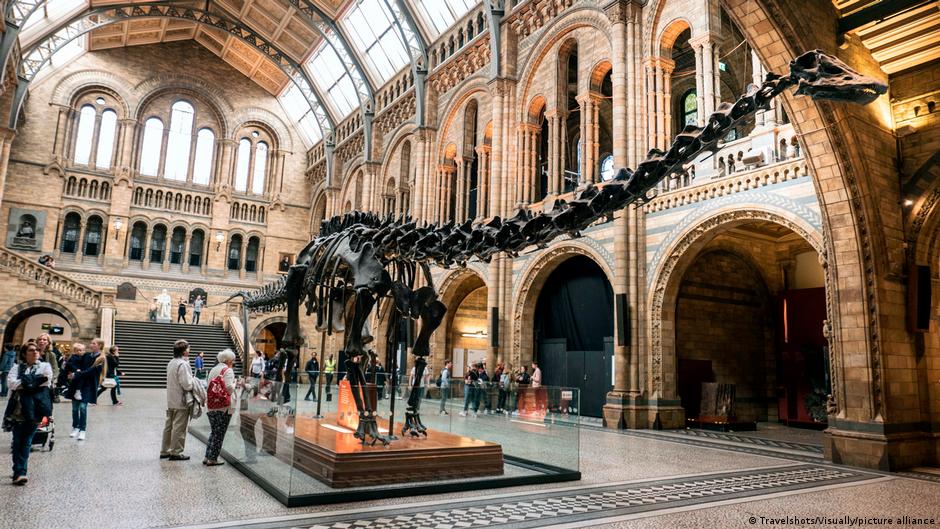
Researchers writing in the Journal of Vertebrate Paleontology this week said they found the first skeletal evidence of the Diplodocus dinosaur outside North America, discovering several chevron-shaped vertebrae and bones dating back to about 150 million years at a site in eastern Spain. The team from the Dinópolis Foundation of Teruel, which studies the rich fossil site of La Tejería, in the municipality of El Castellar, stated that the dinosaur joins an increasing list of giant sauropods found in the area. Although the long-necked, huge-tailed herbivore is one of the most recognizable dinosaurs in the world, until now only fossilized remains have been recovered in North America. Dinosaurs like Diplodocus and Stegosaurus were once thought to live exclusively on the North American continent, but evidence to the contrary is increasingly being discovered. Image: Andia.fr/imageBROKER/picture Alliance What did the researchers say about the discovery? The article published on Monday concluded that the find was “one of the most complete diplodocid skeletons in Europe.” He said the systematic study and analysis of 14 caudal vertebrae and several chevron-shaped bones “reveals that they can be confidently named Diplodocus,” one of several genera in the diplodocid family of sauropod dinosaurs. “This discovery is the first evidence of Diplodocus outside of North America (Morrison Formation) and is one of the strongest evidence supporting the exchange of continental faunas between North America and Europe during the Late Jurassic,” the authors wrote. Although Diplodocus is well known around the world, not least thanks to the famous skeletal model nicknamed “Dippy” that for years greeted visitors entering the British Museum of Natural History, researchers said that “the fossil record of European diplodocids is sparse and fragmentary.” How could dinosaurs cross an ocean? During the time of the dinosaurs, the continents were just beginning to separate. In recent decades, scientists have begun to theorize that the proto-Atlantic Ocean still had ephemeral land bridges or episodic marine regressions or some other temporary means of crossing that occasionally allowed terrestrial dinosaurs to move great distances between the separating continents. Recent fossil finds, especially in Spain and Portugal near the Atlantic coast, have further reinforced this idea. This is part of a land bridge believed to have connected Iberia to what is now Canada. The authors said the find “constitutes one of the strongest evidence for episodic faunal dispersal events and exchanges across the proto-North Atlantic Ocean during the late Kimmeridgian and early Tithonian period,” about 150 million years ago. Another route linked North America with Scandinavia, and another, much further south, connected what is now Brazil with Cameroon. Why did dinosaurs grow so big? To view this video, please enable JavaScript and consider upgrading to a web browser that supports HTML5 videos. If you trust our team for trustworthy reporting, please take a moment to select us as your preferred source on Google, so you always see our verified news first. Edited by: Kieran Burke