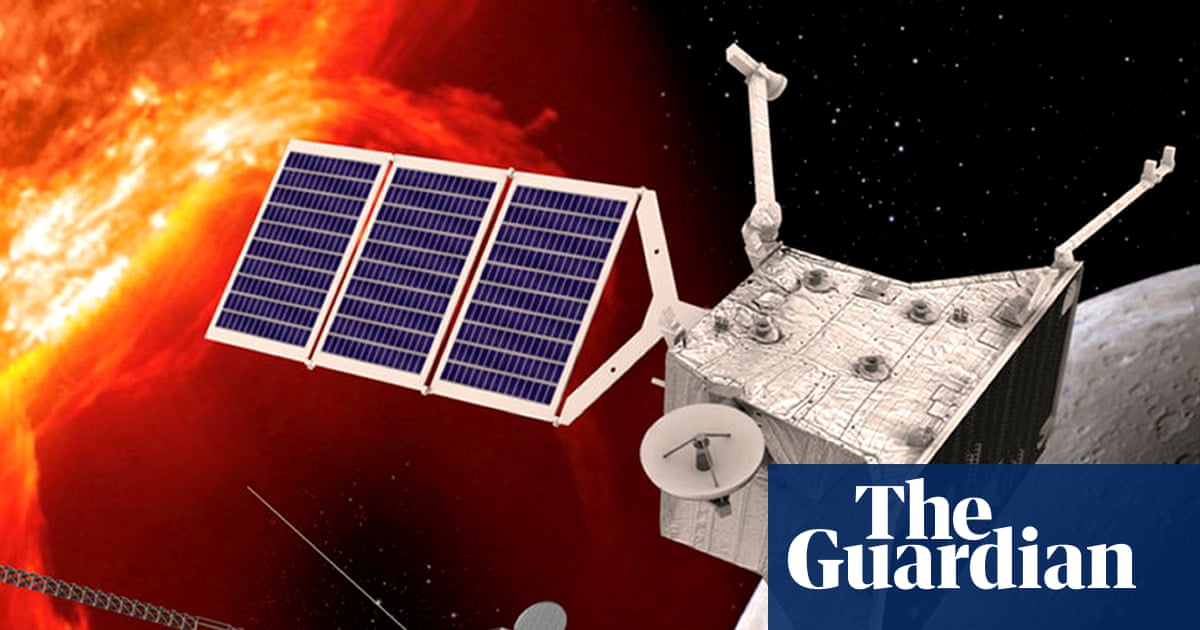
After a journey of more than eight years and 6 billion miles, a joint European-Japanese space mission has arrived at Mercury and is preparing to enter orbit around this small, barely explored world. The BepiColombo mission will become the second in history to circle the sun’s first rock and the solar system’s smallest planet when flight controllers fire the craft’s thrusters on Saturday and send it into orbit. For researchers, the €1.6bn (£1.4bn) mission is the best We still hope to understand how Mercury formed so close to the Sun, why it has a magnetic field and what constitutes the frozen ice hiding in the planet’s permanently shadowed craters. “We are very excited, it has been a long wait,” said Professor Emma Bunce of the University of Leicester, who has worked on the project for 20 years. Reaching Mercury poses unusual difficulties. Because the planet is near the center of the solar system, spacecraft accelerate under the sun’s gravity and must spend much of their time braking to avoid passing directly by. “It’s a very complex and challenging mission,” said Bunce, principal investigator of an instrument called the Mercury Imaging X-ray Spectrometer, or MIXS, which will analyze the geochemical composition of the planet’s surface. A photograph provided by the European Space Agency in October 2021 shows a view of Mercury captured by the BepiColombo mission. Photograph: European Space Agency/AFP/Getty Images It will be a few months before scientists can start observing Mercury. In early December, the spacecraft will separate into two orbiters, one European and one Japanese, which will maneuver into different polar orbits around the planet. Scientific operations will begin in April next year. The European probe, called Mercury Planetary Orbiter or MPO, will map the planet’s surface and composition in high resolution and study Mercury’s interior to shed light on its unusually large core. Its Japanese partner will measure the planet’s magnetic field and its sodium exosphere, the extremely thin layer of gas and atoms that surrounds the planet. Mercury is only 50% larger than the Moon but has four times its mass. One of the questions the mission will explore is why the rock is so dense. Professor Geraint Jones, lead scientist on the European Space Agency’s BepiColombo project, said the anticipation of the scientific results had kept everyone excited during the spacecraft’s eight-year journey. “We hope to learn a lot by bringing more powerful instruments on two spacecraft to study all aspects of the planet: its interior, its surface and the space around it,” he said. Mercury is a planet of extremes. The small world takes 58 Earth days to rotate on its axis, meaning that any point on the surface can experience daylight for three months and then night for three months. It is just over a third of the distance from Earth to the sun, just 36 million miles. During the day, soil temperatures reach 450°C, while at night they drop to -180°C. Jones said: “In addition to cameras covering a wide range of wavelengths to study the surface, we will ‘probe’ the gases around the planet, detect the magnetic field, probe the interior with ultrasensitive instruments and map the shape of the entire planet with a laser.” towards the surface. “Unfortunately, they’re not coming back,” Bunce said.