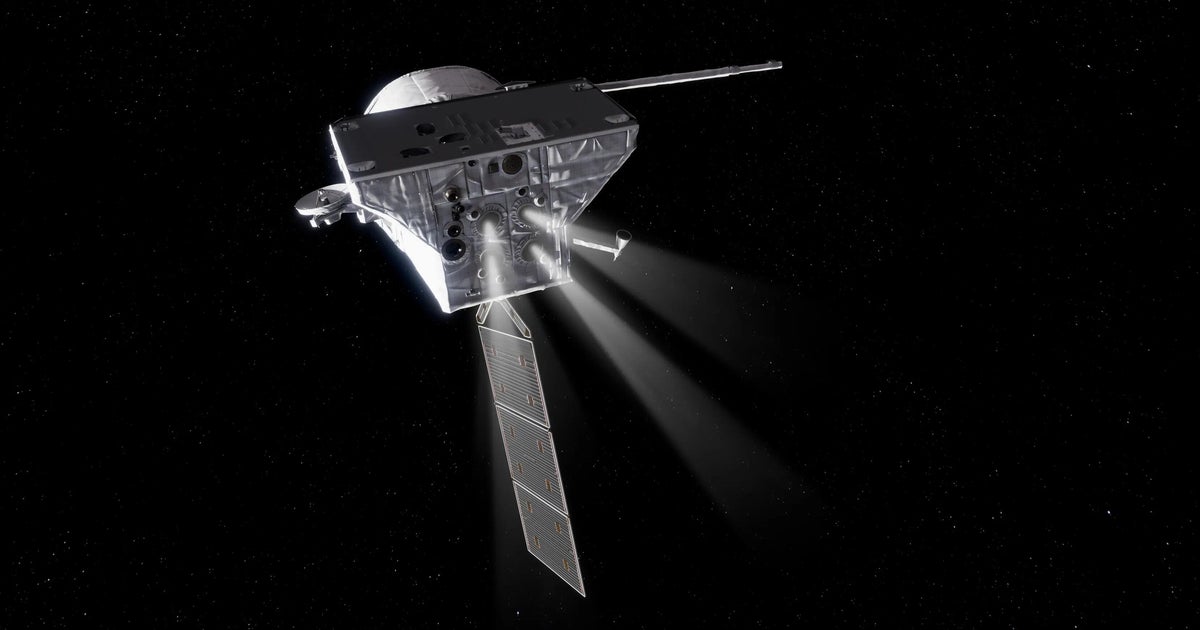
A spacecraft has entered Mercury’s orbit after an eight-year journey, overcoming a technical problem to continue its mission of making scientific observations around the planet. BepiColombo was launched as a joint mission between the European Space Agency and the Japan Aerospace Exploration Agency in October 2018. Since then, it has sailed towards Mercury. On November 21, the spacecraft attached itself to Mercury’s orbit. The maneuver began with a brief scheduled loss of contact with the mission control team at the European Space Operations Center in Darmstadt, Germany, ESA said in a news release. As BepiColombo passed over the planet, it fired four axial thrusters that slowed it enough to lock it into Mercury’s orbit. During this stage of the mission, the spacecraft came within 400 miles of Mercury’s surface. The burn was supposed to last about 37 minutes. BepiColombo fires its thrusters. ESA But when the ESA team reestablished contact with BepiColombo, they discovered that the maneuver had been interrupted, causing the spacecraft to enter safe mode, where non-essential activities are stopped. Analysis of the trajectory data showed that the spacecraft had only completed about 77% of the maneuver. “Finding Bepi in safe mode was like flipping a switch. Everyone was focused on understanding what had happened,” ESA’s BepiColombo flight operations director Ignacio Tanco said in a statement. The failure is due to a software problem related to attitude guidance and thruster control, ESA said. The investigation of the error continues. Despite the error and the incomplete maneuver, ESA scientists were finally able to confirm that BepiColombo had locked onto Mercury’s orbit. It took six hours from the time the maneuver began to confirm it had been successful, the ESA said. Over the next few weeks, the spacecraft will continue to perform small burns of its thrusters to gradually adjust its orbit around Mercury. Each movement will be adapted by BepiColombo’s flight dynamics team using the real trajectory of the spacecraft. This will allow BepiColombo to enter the “sweet spot” of the orbit. The ESA compared it to “braking a car at just the right moment” to find the “sweet spot.” Performing multiple maneuvers also allows the ship to maximize its fuel supplies. A summary of BepiColombo’s scientific objectives. ESA On December 9, BepiColombo will launch two scientific orbiters. ESA’s Mercury Planetary Orbiter (MPO) will spend a few more months sailing to find the right spot in Mercury’s orbit. It is expected to enter its final orbit in March 2027 and begin scientific operations in April. Science operations will study the interior, surface and space around Mercury, said Geraint Jones, principal scientist for ESA’s BepiColombo project. The second scientific orbiter is the Mercury Magnetospheric Orbiter, or Mio, of the Japan Aerospace Exploration Agency. Mio’s studies will include Mercury’s magnetosphere, interplanetary dust and electric fields, according to ESA. Go deeper with The Free Press on: