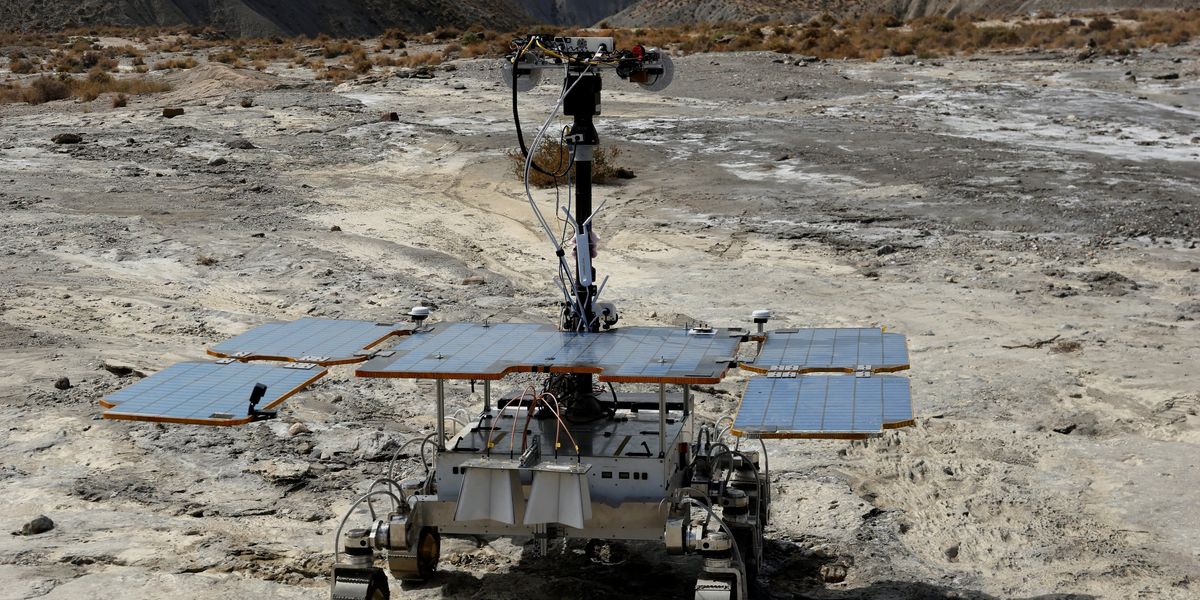
A British-built Mars rover is about to become the first spacecraft to drill two meters beneath the Martian surface in search of ancient biological traces. The ExoMars rover “Rosalind Franklin”, manufactured in Stevenage by Airbus for the European Space Agency, will be launched in 2028, and is scheduled to arrive on Mars in 2030. Scientists working on the mission believe that if they find life on Mars, it could share a common origin with life on Earth. organisms, a concept known as panspermia. Martian life could even have given rise to our own. Susanne Schwenzer, professor of planetary mineralogy at the Open University and interdisciplinary scientist on the mission, said: “If life is the same there, it may be that we all come from the same ancestor. “Is panspermia possible? Is it possible for life to travel from one planet to another? We don’t know, but these are all questions we have to answer. “About four billion years ago, Mars had lakes, rivers, and a vast ocean, protected by both an atmosphere and a magnetic field. This habitable era overlapped with the Late Heavy Bombardment, a period between 4.1 and 3.8 billion years ago when huge numbers of asteroids and comets collided with the inner planets, potentially generating components essential for life, such as amino acids and components of DNA. The rover ‘Rosalind Franklin’ was manufactured in Stevenage by Airbus for the European Space Agency | REUTERS However, Mars cooled much faster than Earth, causing its molten core dynamo to fail. The resulting collapse of its magnetic field left the planet exposed to the solar wind, which stripped it of its atmosphere and water, making it uninhabitable about 3.7 billion years ago. The rover will land at Oxia Planum, a site near the Martian equator selected for its ancient clay-rich sedimentary deposits, formed during an era when water flowed freely across the planet’s surface. The ExoMars ‘Rosalind Franklin’ rover is scheduled to arrive on Mars in 2030 | REUTERS The instruments on board include a panoramic camera designed by University College London and an Infrared Spectrometer built at Aberystwyth University, both used to identify locations. Then, a ground-penetrating radar examines what is below before extraction begins. In recent weeks, the team has been rehearsing navigation procedures in the Spanish desert of Tabernas, near Almería, whose terrain closely resembles the Martian landscape. Because radio signals between Earth and Mars take between four and 21 minutes, the rover must operate autonomously and receive daily instructions from the ESA control center in Turin. in 2022, and the rover should already be operating on Mars. Scientists working on the mission believe that if they find life on Mars, it could share a common origin with terrestrial organisms | REUTERSHowever, the conflict in Ukraine led ESA to cut ties with Roscosmos, which had been supplying key components. NASA and the UK Space Agency later stepped in to provide replacements. The ESA said: “I think that life could have existed on Mars, it seems somewhat credible.” He added: “Today our view is of the Earth as a small world alone, but if we find evidence that there was life at another time and in another area of our solar system, this suggests that life is absolutely everywhere. The way we imagine our universe will change forever.” Professor Schwenzer described the prospect as “almost terrifying to think about, because it changes everything.”